


I remember last September when I heard about 11x's $50 M Series B, raised just a couple months after their Series A Round. While the deal was not in scope for me, I remember feeling FOMO nonetheless when I read the press release.

However, the company’s recent press has eliminated any lingering doubts. As I foreshadowed in my first edition on 2025 Predictions, AI startups have finally started to draw increased scrutiny from investors - with customer churn a top issue.

A recent TechCrunch article shows the reality of the problem. Instead of offering a traditional “trial period”, 11x offered customers a break clause, typically at three months, that made it easy for customers to break the contract. Many customers took advantage, leading to some healthy churn.

Note: For what it’s worth, both 11x and a16z have come out and denied the allegations.
To be clear, there’s nothing wrong with this. It’s actually a clever way to potentially lock in long-term deals. But here’s where we have an issue:
When reporting annual recurring revenue (ARR), the company didn’t differentiate between trial periods and long-term customers, former and current employees said. The company would calculate ARR based on the full year. (Source: TechCrunch)
The Issue: Churn Happens
Enterprise clients churn after short pilot periods. This is a well-known fact of enterprise sales. Pilots play an important role in the sales cycle by giving enterprises the opportunity to “try-before-you-buy”, and sometimes companies decide that products simply aren’t a fit. In these cases, it’s best for both sides to move on.

Source: Jason Lemkin (Twitter)
But, for some reason, many startups still often recognize these contracts as “ARR” upfront, despite them not being recurring or annual in nature. This can be extremely tempting, especially when trying to fundraise or hit aggressive sales targets, but is unwise for many reasons. This idea is well captured in the tweet above by Jason.

Infographic from 11x’s Series B Press Release (Source: 11x)
The Current State of ARR
While there’s a lot more I can say about the 11x situation, I’m going to resist the temptation to dunk on this particular company, and instead choose to focus on the broader theme at hand. Not all ARR is made the same.
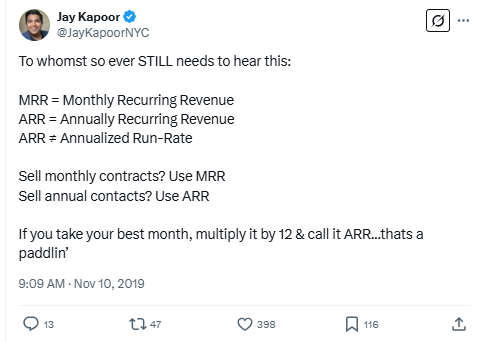
It’s ironic that the tweet above is over five years old. This is an evergreen issue. But in recent years, I’ve noticed that nearly 50% of startups we come across use CARR as a primary metric to run their business (if not, the primary one), believing it to be a better reflection of how their companies are growing.
CARR is defined as contracted annual recurring revenue, whether in production or not yet in production.
For some, reporting CARR has become even more popular than using ARR. At times, the terms are even used interchangeably, along with Annualized Run Rate. This is a mistake.

CARR ≠ ARR
If you’re wondering the difference between “CARR” and “ARR”, you’re not alone.
Put simply, Contracted Annual Recurring Revenue (CARR) includes revenue that's booked but can’t yet be recognized. Often these are deals that customers have verbally “committed” to but aren’t fully signed and aren’t yet in production. Committed ARR is sometimes used synonymously with Contracted ARR.
Why is this Distinction Important?
When startups look to raise their next round, they often are surprised to find that growth-stage investors ignore “CARR” calculations when analyzing revenue quality. That’s because verbal commitments can easily be cancelled, and future contract start dates easily be pushed back. Unfortunately, many startups find that once their CARR metrics are swamped with ARR, investor interest quickly fades.
The Lesson: Not All ARR Is Made the Same
There are three key lessons that emerge from the analysis above.
Know Your ARR Metrics. It’s hard to trust ARR figures from startups today. Always triple check how ARR is being calculated. Annualized run-rate does not mean ARR.
It’s not just 11x. Lots of early AI revenue is experimental in nature. Plan accordingly.
Don’t fall for the CARR trap. Even for startups in the circle of trust, CARR is being increasingly misclassified as ARR.
(1) Know Your ARR Metrics
ARR is no longer ARR. At this point there are so many different derivations of ARR metrics that’s it’s impossible to keep count. A few of my favorites are below:
Break Clause ARR (made famous by 11x) - Annual contracts that customers can “break” three months in. Still reported as ARR.
Annualized ARR - Customers pay on monthly contracts (or revenue is non-recurring), yet revenue is “annualized” assuming they will pay through year-end.
Contracted ARR - Startup has received a “verbal commitment” they believe is solid. So customer is not paying now, and the product is not yet deployed, but customer has promised to pay in the future.
Pilot ARR - Customer agrees to a $250 K, 3-month pilot. The startup reports this deal as $1M in ARR, believing it will convert to an annual deal. Similar to #1.
Takeaway: ARR should only be used if revenue is annual and recurring in nature.
(2) It’s Not Just 11x. Lots of ARR is Now Experimental
When it comes to AI startups, ARR is getting increasingly misclassified, and it’s hurting both startups and investors.
Why Investors Like SaaS
Historically, investors have preferred SaaS business models because ARR is inherently predictable - you know what revenue will be coming for the next 12 months. An added benefit of ARR is that, when calculated correctly, retention tends to be predictable. The key term here is when calculated correctly, because when ARR is misused, it has a huge downstream effect on churn and retention, which destroys the entire value proposition of SaaS.
With AI Startups, ARR Can’t Be Trusted
In recent times, AI startups have begun to claim a lot of experimental revenue (ERR) that lacks the same retention qualities of true ARR. The urge to book experimental revenue can be strong, as it allows startups to show explosive growth. However, mistaking ERR for ARR can lead to tremendous revenue volatility, poor investment decisions, and misaligned expectations that have significant downstream implications.
It’s important for founders and investors to be honest with themselves about the revenue quality of AI startups. If revenue is experimental in nature, it should be classified accordingly until it’s locked in.
(3) Don’t Fall for the CARR Trap
Even for startups in the circle of trust, we’re seeing CARR get misclassified as ARR more and more. Startups must resist the temptation to count pilot revenue and almost-but-not-quite-closed contracts as part of their ARR figure. The health of their startups (and the trust of VCs) will be significantly better off long-term because of it.
Where We Go from Here
In some ways, VCs have created a monster with their fanatical obsession with ARR. Startups know the answer key, and are gaming the system. Something needs to give.

Source: Michael Mignano (Twitter)
Investors need to more closely examine revenue quality during due diligence. What questions to ask specifically? The answer will be different for everyone. But a good place to start would be that whenever you read that a company has grown to $10M ARR in only a few months, be skeptical. Very skeptical.
Until next time.
Disclaimer: The information contained in this article is not investment advice and should not be used as such. Investors should do their own due diligence before investing in any securities discussed in this article. While I strive for accuracy, I can’t guarantee the accuracy or reliability of this information. This article is based on my opinions and should be considered as such, not a point of fact. Views expressed in posts and other content linked on this website or posted to social media and other platforms are my own and are not the views of NextEra Energy Investments (NEI) or NextEra Energy (NEE: NYSE).