


In Part I, we discussed Anthropic’s new AI Exposure Index report. It paints a fascinating—and sobering—picture of AI disruption in the workforce.
Since then, Anthropic surveyed 81,000 Claude users about their fears around AI. Somewhat surprisingly, work anxiety tracks observed AI usage almost line-for-line. For folks that are short on time, the TLDR is below.
Key findings:
A survey of 81,000 Claude users by Anthropic showed that people who work in roles that are more exposed to AI have more concerns about AI-driven job displacement. In other words, ignorance is bliss.
Those in the highest- and lowest-paid occupations report the largest productivity gains, most commonly from increases in scope (doing new tasks). Concerns are also higher among early-career respondents (for good reason).
My 2¢: Anxiety is the signal you’re paying attention. Keep paying attention and learning how to use AI tools, and there will always be a job for you. That job might just look different than the one you’re doing today.
Part I Recap: Picking up where we left off
A few months ago, I wrote about the gap between theotrical and observed AI exposure - the paper that quantified which jobs AI could automate vs. which jobs Claude was actually showing up in. That gap, I argued at the time, meant that much of the market panic about AI was being overblown - at least short-term. Long-term, however, I continue to worry about our future children’s job prospects.
Anthropic AI Exposure Index: A White-Collar Wake-Up Call

Anthropic just dropped new market research that has the internet buzzing. One interesting chart shows where AI could theoretically disrupt jobs versus where it’s actually disrupting them today. The gap between those two lines? It's either a big opportunity for founders — or a depressing countdown for the rest of us.
Part I was helpful in setting important context, but it was also missing an important piece of the puzzle. Anthropic’s new paper, What 81,000 people told us about the economics of AI, adds the perception layer: what workers think is happening to them. Plot it on the same axes and the picture sharpens dramatically.
Time to dive into Part II.
Part II: The New Data
The survey asked people about their visions and fears around advances in AI.
Chart #1: Workers’ fears track the usage data eerily well
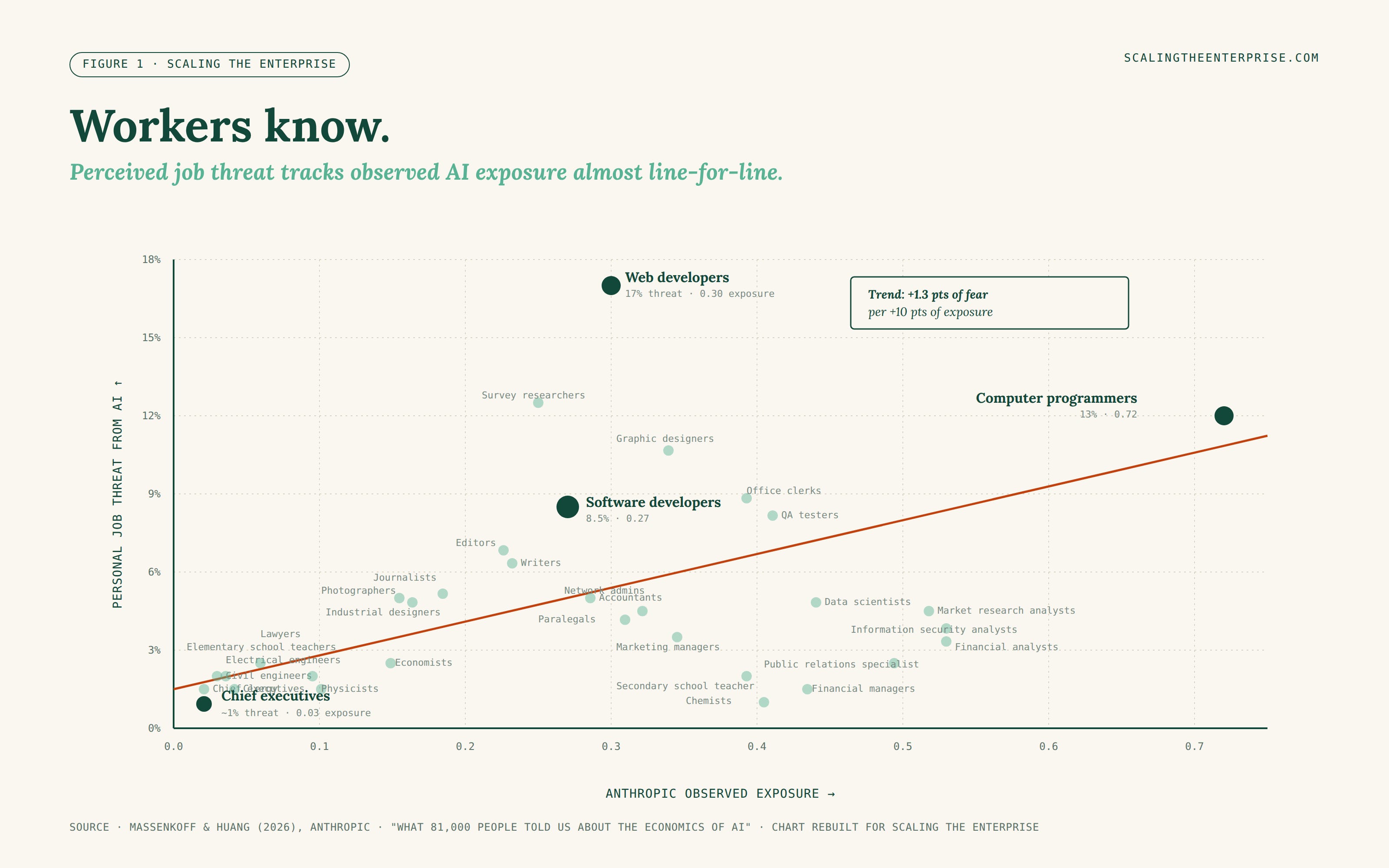
Web developers and computer programmers anchor the top-right corner — high exposure, high fear. CEOs and school teachers sit in the bottom-left. The trend line is clean: every 10-percentage-point increase in observed exposure produces a 1.3-percentage-point increase in perceived job threat. Workers in the top quartile of exposure mention the worry three times as often as those in the bottom quartile.
This matters because it’s the first piece of evidence that AI usage data and AI sentiment data are converging. People aren’t panicking based on Twitter doomscrolling — they’re calibrating to what’s happening based on their own jobs.
Chart #2: Unpacking the U-curve
The most striking finding is that results are U-shaped: workers reporting the largest productivity gains from AI are also the most worried about being replaced by it.
(I love Claude, and yet, why does it feel like Claude will replace me?)
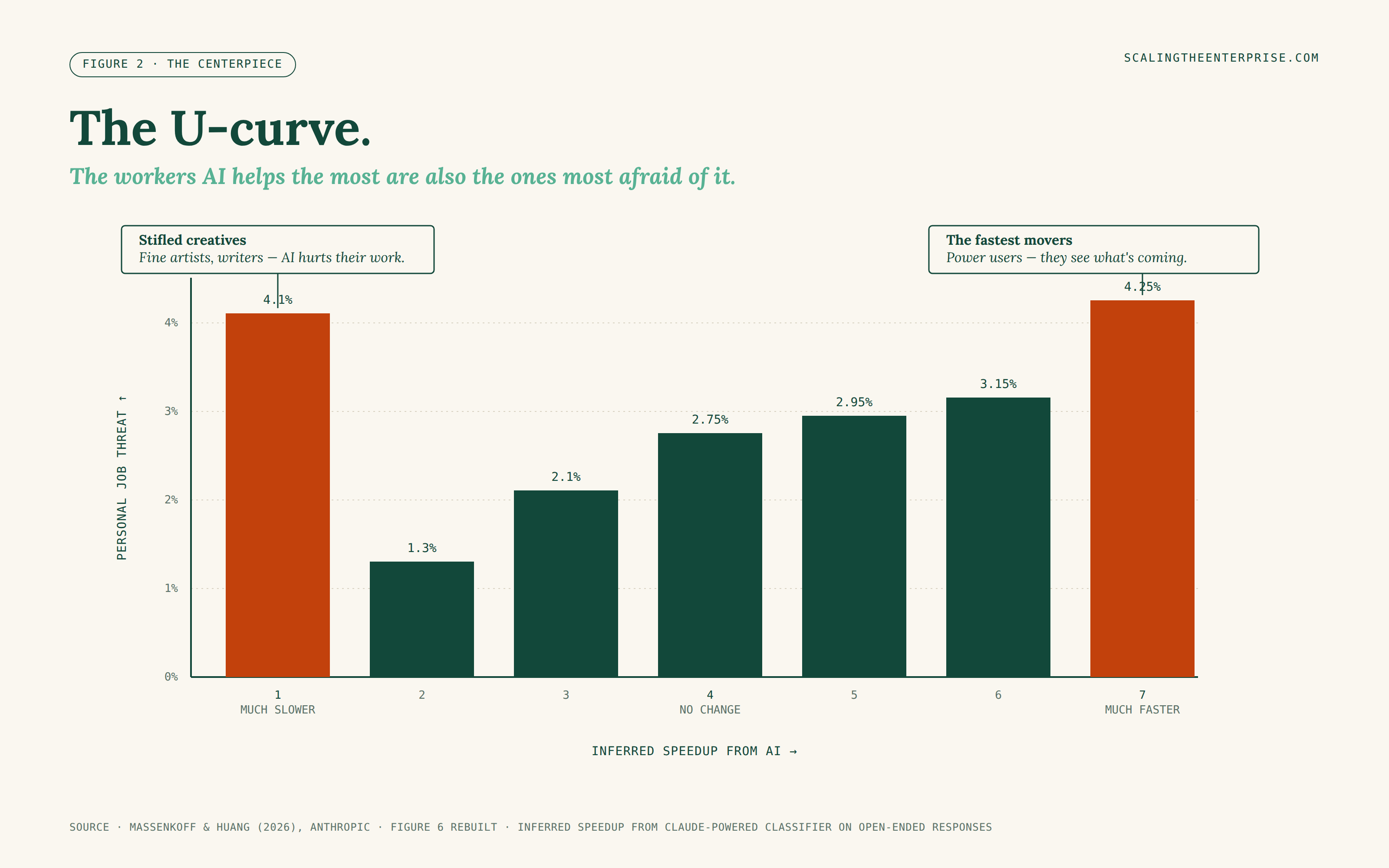
The people who report being slowed down by AI (left side — mostly fine artists and writers who find it stifling) are scared. Fine. But look at the right side: the people who report the largest boost are equally scared. The fastest movers and the most-stifled creatives both cluster at ~4% perceived threat, well above everyone in the middle.
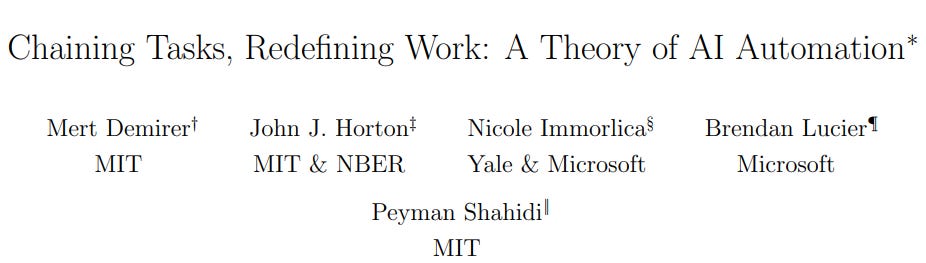
A recent MIT Sloan piece on workflow redesign gives this a name: coordination cost. AI doesn’t have to be better than at every task to replace your role in the workflow. It just has to be good enough that removing the human checkpoint produces a faster overall system. Every handoff requires review, validation, adjustment — that friction adds up. The system optimizes by eliminating handoffs, not by speeding them up.
Power users see this clearly because they’re the ones constantly deciding whether to validate AI output or just let it run. They’ve internalized the math. Task-level mastery lacks a true moat. Owning entire workflows end-to-end is the right one.
Chart #3: The early-career squeeze
In Part I, I flagged the most uncomfortable discovery of a 14% drop in the job-finding rate for young workers entering high-exposure occupations. The unemployment numbers weren’t moving yet, but the entry-level pipeline was already narrowing.
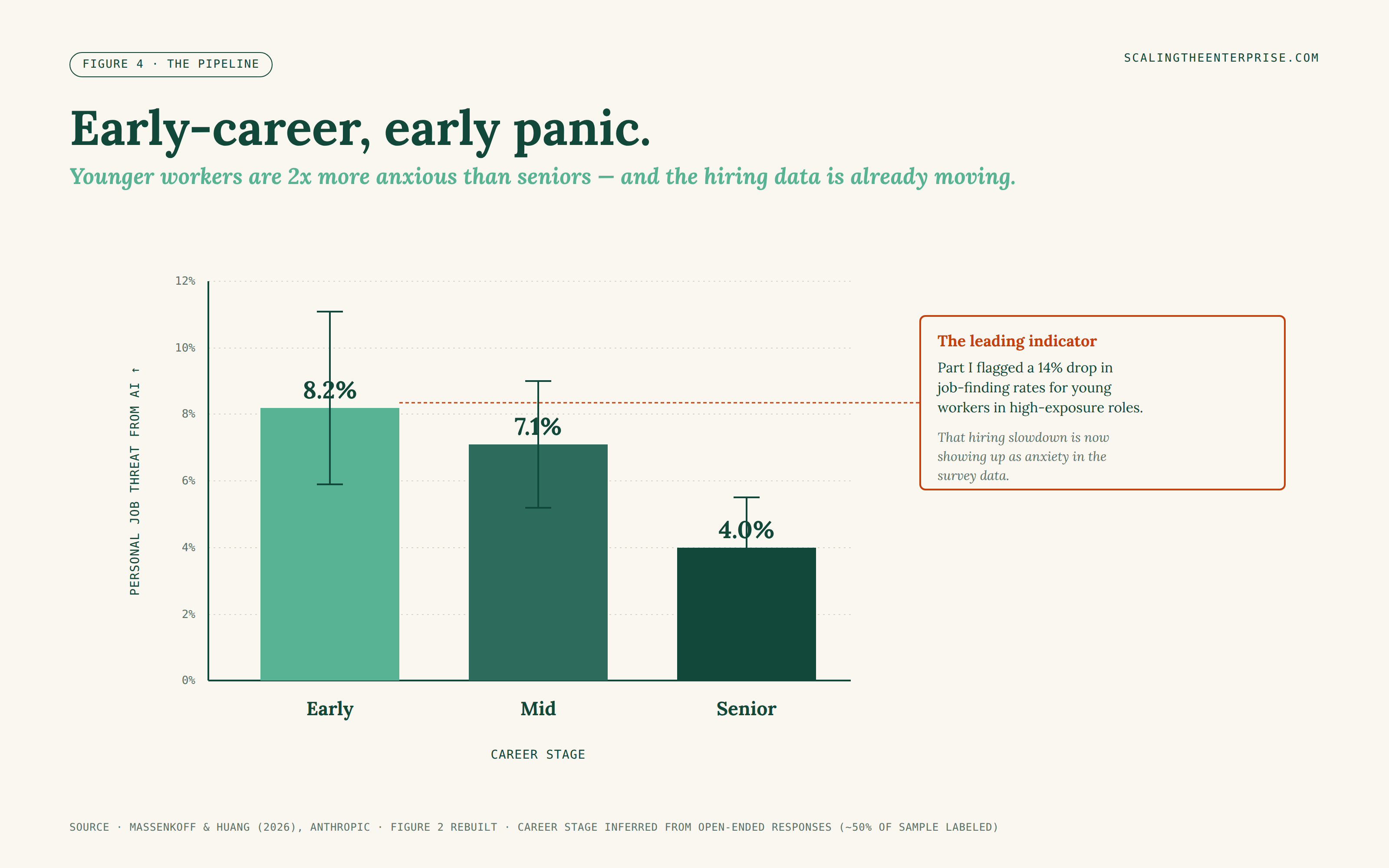
Two months later, that’s now showing up as tremendous anxiety. Early-career respondents are roughly twice as worried about displacement as senior workers (8.2% vs. 4.0%). Only 60% of early-career workers say they personally benefit from AI, compared to 80% of senior professionals.
Chart #4: The optimist’s counterweight: scope, not speed
When users describe how AI helps them, the most common answer isn’t “I can work faster”. It’s actually “I can now do things I couldn’t do before.” 48% of users who described a productivity gain pointed to scope — new capabilities, new workflows, and tasks previously out of reach. 40% pointed to speed. Quality and cost were afterthoughts.
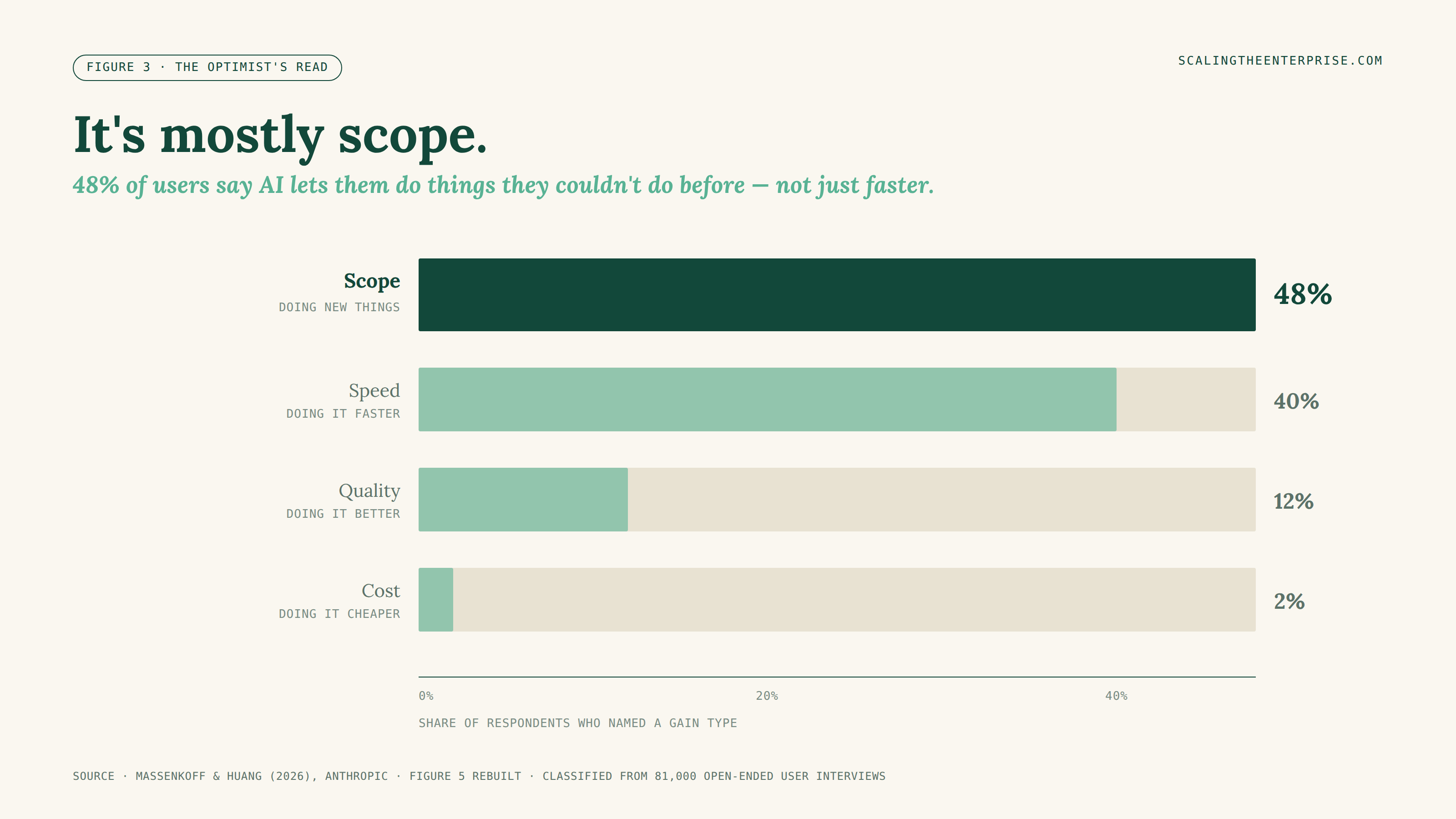
The optimistic frame is real. The market for tools that turn one person into ten is bigger than the market for tools that make ten people into one.
(One caveat: about 70% of survey respondents who named a recipient said the productivity surplus accrued to themselves, not their employers — but this survey only went to people with personal Claude accounts. Enterprise users, the ones whose employers paid for the seat, weren’t included. So take the 70% with a grain of salt.)
So what does this all mean? My takeaways
#1: The terrified are the prepared.
The right side of the U-curve is not where the casualties are — it’s where the survivors are.
The people reporting the largest speedups are also the people building the most accurate mental model of how AI changes their job. They’ve already noticed that the system optimizes by removing handoffs. They’re anxious because they understand the math — and the same understanding that’s making them anxious is what’s going to let them adapt. They’ll be the ones moving up the workflow ladder while their less-engaged peers are still optimizing tasks that don’t need optimizing anymore.
The ones who should actually be worried are the ones in the middle of the chart — high exposure, low perceived threat, low engagement. Casual users, modest gains, not really paying attention. Comfort with the tool is a leading indicator. Discomfort with what the tool implies is a lagging one — and the lag is the warning.
#2: The corporate ladder is being slowly disassembled rung by rung.
If the early-career anxiety holds — and the underlying hiring data suggests it will — it’s going to fundamentally reshape where ambitious young people go. The deal the corporate ladder offered for fifty years was: take an entry-level job, grind for a decade, climb. That deal assumed entry-level jobs existed. If those jobs no longer exist…what’s the rational move for a 22-year-old with a college degree? Only a few years ago, places like Meta and Microsoft offered enviable job security and perks. But times have changed.

Here’s what I think happens next:
Big Tech and the F500 lose their pull. The pitch — “join us, learn from senior people, climb” — only works if the rungs of the ladder still exist. If you’re a software engineer at Meta right now, you’re living in constant. Be sure to check on your friends working at M7 companies. The stress is real.
Graduate school becomes harder to justify. A two-year MBA or law degree is a bet that the credential premium will exist when you graduate. That bet looks worse when the work the credential gates is the work AI is best at automating. (I say this as someone who got an MBA from Harvard and loved it. Times have changed)
Startups, accelerators, and entrepreneurship win the talent war. YC and a16z Speedrun become the new prestigious early-career path — the only places where a 22-year-old can credibly bet on owning a workflow instead of being a node in someone else’s. YC’s next batch is going to be insanely competitive.
AI-native service firms eat the legacy ones. Trade organizations, agencies, boutique law firms, accounting/tax shops, consulting practices — anywhere a small team can punch above its weight using AI tools — wins. The 50-person AI-native law firm beats the 500-person legacy firm on price and turnaround.
#3: The Industrial Revolution, in reverse.
I would not be surprised to see a meaningful reverse migration from white-collar work back into blue-collar and manufacturing.
The data supports this: the most exposed occupations required the most education. The least exposed are physical, embodied, hands-on. The Industrial Revolution moved labor from fields and workshops into factories and offices. The current shift might run the same arc backwards.
Layer on the political moment: tariffs are pushing reshoring, the CHIPS Act is spinning up domestic semiconductor manufacturing, and electrical/HVAC/plumbing trades are facing a generational labor shortage with starting wages that look more attractive every quarter. Now imagine a generation of would-be knowledge workers looking at the corporate rat race and choosing the trades instead.
It sounds insane. So did “the cooks and the dishwashers will be the only ones with stable jobs” two years ago, and now I have a Part I post that literally made that joke. (Grounds Maintenance Technicians, here I’ve still got my eyes on you)
Am I betting the farm on this one? Probably not, but only because it means that I could be out of a job sooner than later.
The Bottom Line: Fear Not?
Strip away the doom narrative and the data is actually telling an optimistic story.
First, most AI productivity gains are accruing to individuals more than to employers — which is a welcome change from how every prior wave of workplace technology played out. For now, the leverage is in human hands.
Second, despite the media outlets love for reporting on layoffs and social media doomers obsession with telling people the world is ending, the AI layoffs are really more myth than reality. Many layoffs are due to declining performance, restructuring, and economic uncertainty from tariffs and middle east turmoil.
So if you’re sitting in the high-exposure, high-anxiety quadrant of these charts, here’s what I recommend you do based on the data:
Use AI more, not less. The U-curve says engagement is correlated with awareness, and awareness is correlated with adaptation. Casual users are the ones not paying attention. Become a power user — and become indespendible at work.
Move up the workflow. Task-level skill is depreciating. The unit of value has shifted to workflows you own end-to-end — not the discrete steps inside it. Ask yourself which workflow you can credibly run alone with AI, and master it.
Bet on yourself sooner. The traditional 5 or 10-year corporate apprenticeship is increasingly looking like a bad risk-adjusted bet. If you were going to start something in 5 years, the data says start it in two. Startups, AI-native services firms, and small high-leverage teams are where the surplus is being captured.
Pay attention to the trades. We love plumbers here! The reverse-migration thesis might be wrong, but the underlying truth — that physical, embodied, hands-on work is the most defensible part of the labor market right now — isn't far off.
The full paper is available from Anthropic’s research page. Part I of this series is here. Stay tuned for Part III -- coming in a few months. Happy Monday friends!
Disclaimer: The information contained in this article is not investment advice and should not be used as such. Views expressed are my own and should be considered as such, and are not the views of NextEra Energy Investments (NEI) or NextEra Energy (NEE: NYSE).