


Rapid Reactions
Horizontal AI agents are losing favor. Vertical, industry-owning AI is in.
Physical AI is now highly investable, and also getting crowded fast.
Founders want to rebuild entire regulated industries around AI rather than sell software to them.
Founder-reported metrics need more scrutiny than ever.
Is it possible for YC to get too big?
Demo Day Impressions
1. Horizontal AI Had Its Moment. It’s Over.
A year ago, roughly half the S25 batch was building horizontal AI agents. By W26 that number had fallen to about 20%. In this Summer 26 batch, it’s closer to 10%, a decline of about 80% in 12 months.
The founders who made it into this batch went vertical instead: AI dental receptionists, AI-native accounting firms, AI law firms, AI radiology practices, AI manufacturing operators, AI supply chain tools. Horizontal agents carry too much risk of getting steamrolled by the labs, and everyone knows it.
2. Physical AI: Investable, and Increasingly Frothy
Physical AI kept its momentum from last batch, but the category is filling up fast. Founders are attacking nearly every layer of the stack: robotics foundation models, robotics training data, robotics infrastructure, industrial automation, warehouse robotics, construction robotics, and robots built for specific industrial workflows. It was hard to sit through five minutes of pitches without hearing one.
This is starting to look like LLM infrastructure did two years ago. Everyone building picks and shovels for physical AI and robotics, just like there was a mad rush to build the picks and shovels for enterprise AI tools.
One thing is clear: the real world is the new RL gym. Startups are using physical environments and real human work to train models, test improvements, and bridge the gap between simulations and real world execution.
3. Founders Aren’t Selling Software Anymore. They’re Becoming the Company.
The clearest theme of the batch was founders rebuilding entire regulated industries around AI, rather than selling software into the incumbents who run them. Instead of selling to insurance companies, founders are becoming the insurance company. Instead of selling to law firms, they’re building AI-native law firms. Instead of selling accounting software, they’re building the accounting firm itself.
The same pattern showed up across healthcare, manufacturing, government contracting, financial services, and logistics. Services as software, not software for services. Quite the shift from golden age of SaaS earlier this decade.
4. Founder Metrics Sound Too Good to be True
One thing worth flagging for anyone doing diligence on this batch: founder-reported traction was hard to reconcile in a lot of these pitches. “$100K ARR our first week.” “Dozens of enterprise customers.” I wanted to believe, but I struggled to.
It felt like annualized revenue, pilots, signed agreements, and forward-looking bookings were getting blended together in real time, posing a challenge to investors looking to write checks quickly into the best companies.
5. Demo Day Is Becoming a Production
Somewhere along the way, Demo Day stopped being just a pitch event and started looking like a produced entertainment experience. The silent disco format is part of that. So is the vendor row, the sponsorship activations, and the TBPN booth.
The lunch keynote made this most obvious: Garry Tan interviewed Ashton Kutcher, General Partner at Decimal Capital, on the main stage. It was a great conversation too.
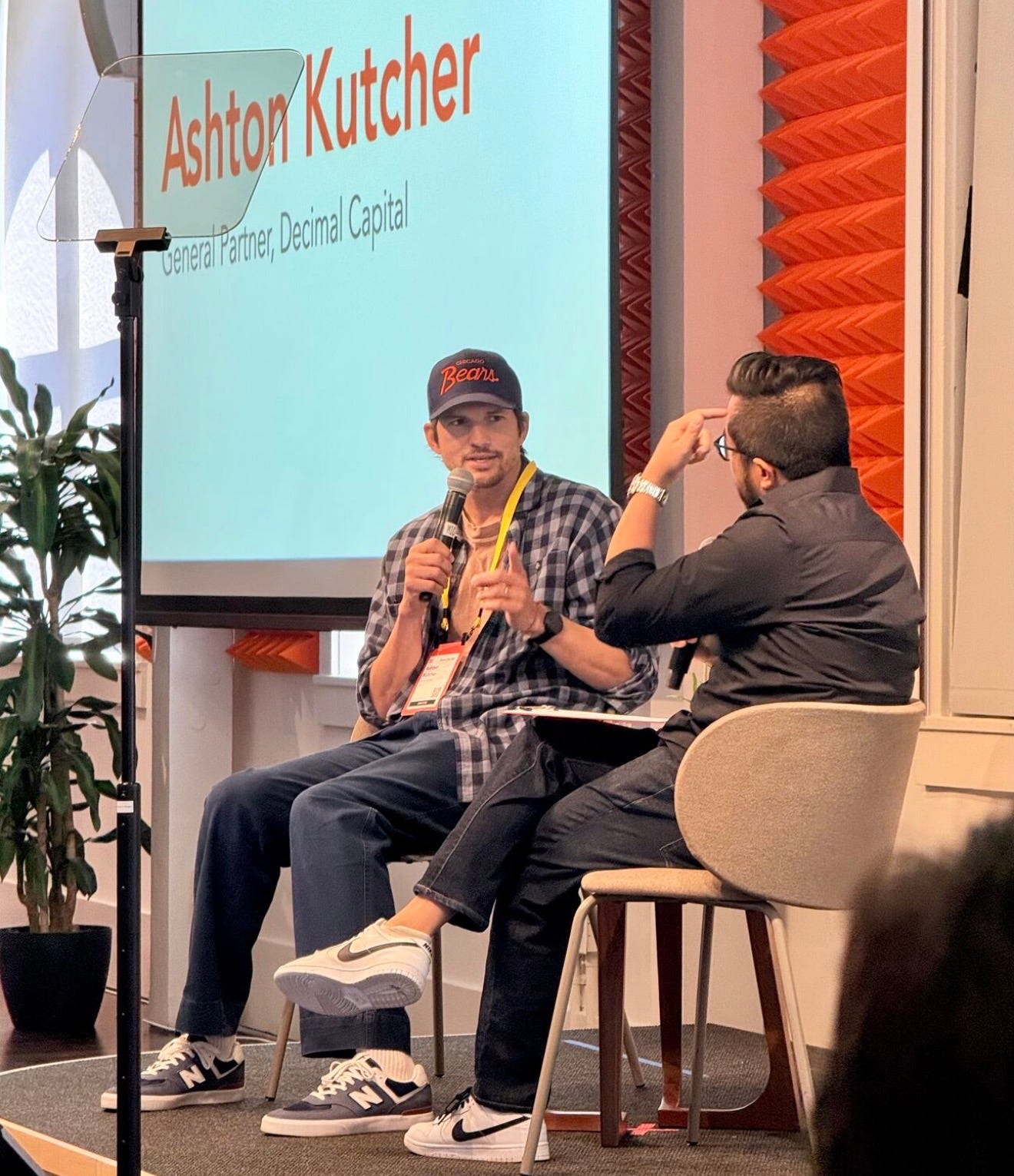
YC is no longer just running a pitch event. TBPN livestream. VIP tents. Free haircuts for founders. Founder-influencers posting content with behind-the-scenes takes about their demo day experience. This is the game being played on the field today.
Companies That Generated the Most Buzz
No one knows yet which companies will become the batch’s biggest winners. This is where a lot of investor attention seem to concentrate during Demo Day.
Physical AI & Robotics: Cosmic Robotics. Shiraz AI. Salem Robotics. Agency Tool Company. Neuron Industries. Hebbian Robotics. Moving Atoms.
AI Infrastructure (Inference, Evals & Training Data): OpenRelay. OneTriangle. Experiential Labs. Touchmark. Markov. CoArena. rekursiv.ai.
Industrial, Manufacturing & Supply Chain: FlowManual. Waybill. SubVision. Peer Freight. Derya.
Cybersecurity: Fabraix. Trident. Nebula Security. Caution. Verdict Machine. Traceforce.
Compute, Data Centers & Semiconductors: Baud. Atomarine. Dipole Labs. Kara. Mass Magnetics.
Energy & Climate: Edviro. Meteoric. Rise Reforming. Rasyn.
Overall
The Good: Talent density among founders and investors is unbelievable. While the overflow rooms can feel a bit like an awkward silent disco at times, the networking is top-tier. It’s hard to go more than five minutes without bumping into an old friend.
The Surprising: What struck me most was the sheer scale of the operation. YC now runs four batches a year, with this one putting ~250 companies on stage. This may be the ideal number, but 800+ companies a year is a lot. But perhaps I’m wrong.
Onward to F26!
Disclaimer: The information contained in this article is not investment advice and should not be used as such. Views expressed are my own and should not be considered as the views of NextEra Energy Investments (NEI) or NextEra Energy (NYSE: NEE).
The move toward vertical AI makes a lot of sense. As the underlying models become broadly available, the durable advantage looks less like ‘we have AI’ and more like domain knowledge + workflow ownership + proprietary context. In physical operations especially, understanding how work actually happens may become more valuable rather than less.