


What you need to know
Jensen Huang resigned as NVIDIA’s CEO and President on November 12, four days after the board opened an investigation into his affair with an alleged Chinese intelligence asset.
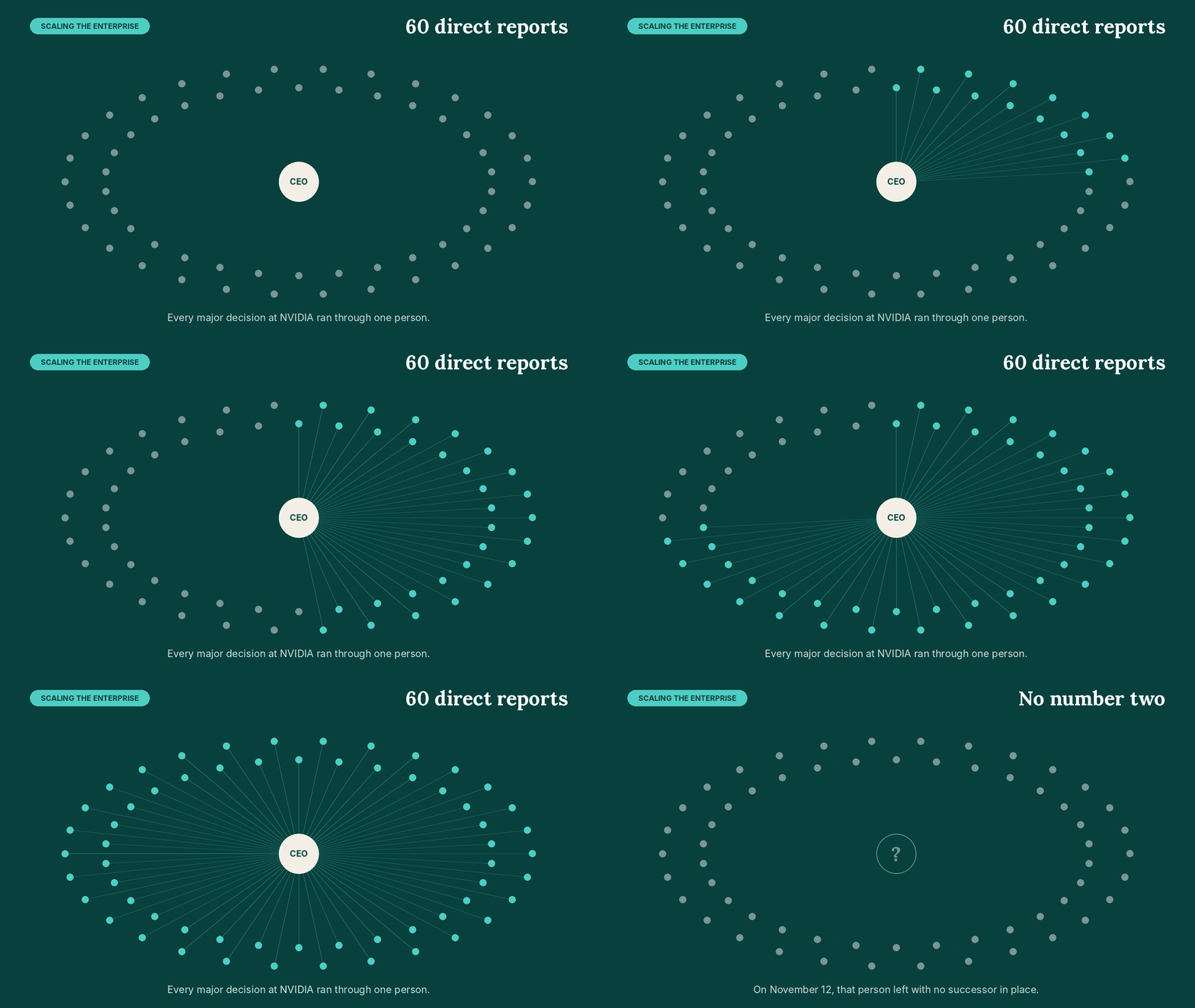
NVIDIA was built around one person. Roughly 60 direct reports, no #2, and a CEO who personally negotiated supply, chip allocation, and customer financing.
I won’t argue Jensen isn’t guilty. But the timing is…suspicious. Washington knew about the relationship for 13 months, and the story broke just as the Senate takes up a China chip bill Jensen spent the year fighting.
The board went from “no reason to believe” secrets were compromised to a total break with its founder in four days. Boards move that fast when they expect the story to get worse.
A former CFO now runs a company with $530B in guarantees standing behind its own customers. Her first earnings call is November 17.
A $4 Trillion Company With No #2
In January, a reporter at CES asked Jensen Huang how long he planned to stay CEO. His answer, per Quartz: “The secret for being CEO for this long is 1, don’t get fired.” Ten months later, his own board voted him out on a Wednesday night.
To understand why that vote matters, look at how NVIDIA is wired. Jensen ran the company from its founding in 1993, and he is the only CEO it has ever had. He had roughly 60 direct reports and held no one-on-one meetings with any of them, according to SemiAnalysis. The company has about 42,000 employees and exactly one person who could say yes.
There is no number two at NVIDIA, and that was a design choice. The company’s own leadership page features five executives besides Jensen, and two of them run legal and finance. The internal names floated as successors, Ian Buck and Jonah Alben, each own one slice of the technology, and SemiAnalysis reports that people inside the company doubt either one wants the job. MarketWatch said it plainly three days before the resignation: nobody at NVIDIA is ready to replace him.
The power went well past the org chart. Jensen personally decided which customers got chips when supply was short. He flew to Korea and Taiwan to lock up memory and manufacturing capacity, CEO to CEO. He put NVIDIA’s balance sheet behind its own customers: $530B in guarantees as of last quarter, up from $184B the quarter before, plus a $99B portfolio of stakes in the companies buying its chips. Investor Yoni Rechtman put it best on Thursday when he wrote that NVIDIA has “functionally become a bank” that runs on one man’s relationships.
So when you read that a CEO resigned, adjust the picture. NVIDIA lost its chief executive, its top salesman, its chief negotiator, its lender of last resort, and the public face of the entire AI industry in a single press release.
Everyone Knew, Yet Said Nothing
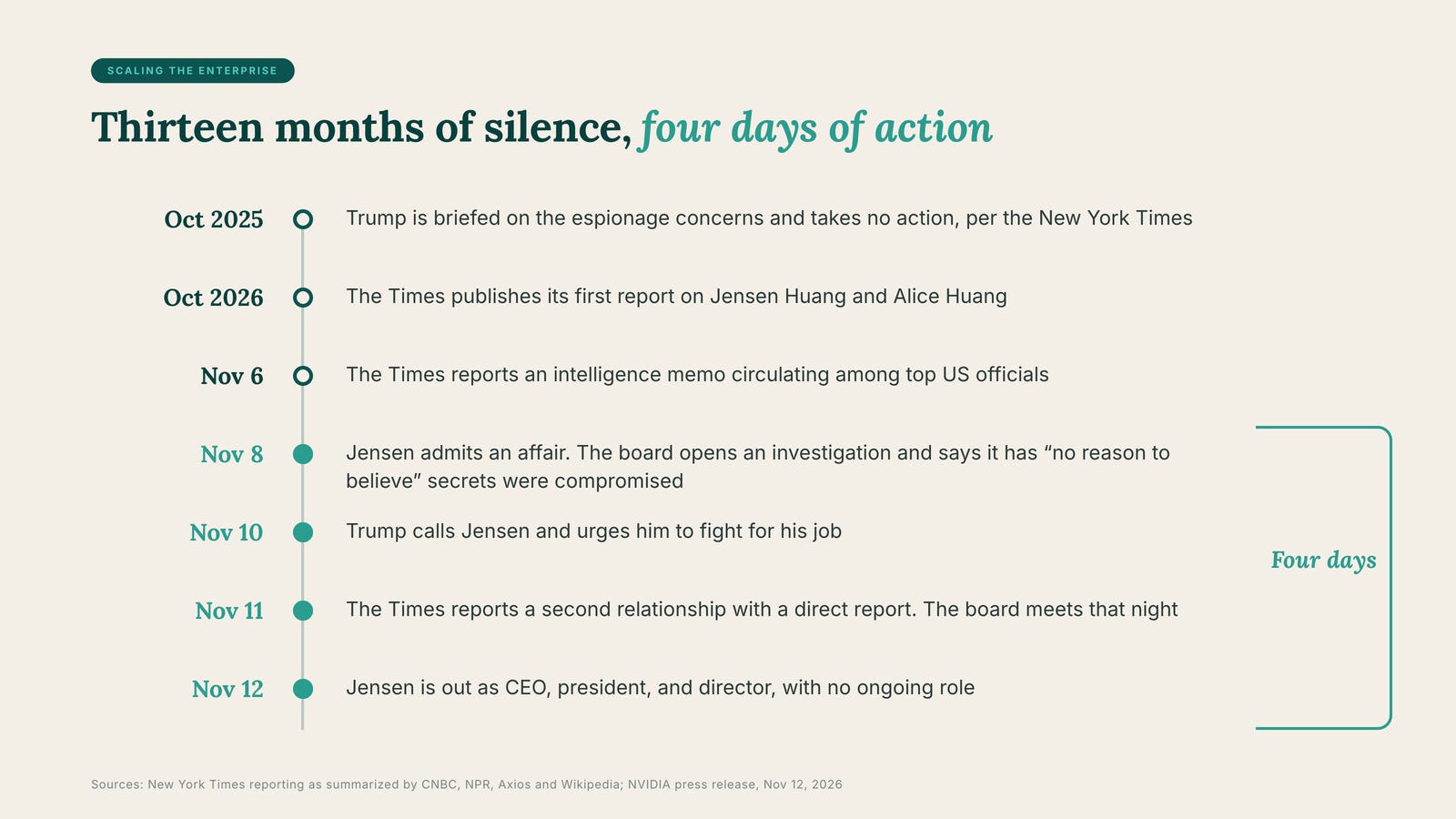
Start with what’s confirmed. Jensen admitted to an affair in an email to employees on November 8. On November 11, the New York Times reported a second relationship with a senior NVIDIA executive who reported to him, per Axios. Those are real problems and any board would have to act on them.
Now look at the calendar. Jensen and Alice Huang (no relation), an executive at NVIDIA customer Megaspeed whom US intelligence reportedly considers a Chinese asset, were seen together as far back as June 2024. The Wall Street Journal reported that the businessman who introduced them spoke openly about how close they were. And according to the Times, President Trump was briefed on the espionage concerns in October 2025 and chose to do nothing (timeline).
Washington sat on this for 13 months while Jensen flew on presidential trips, and I’d bet people in his own circle knew for longer than that. A secret that many people keep for that long is an arrangement. Arrangements end when somebody with access decides the cost of keeping them has gone up.
So what changed in the fall of 2026? Politics. The Remote Access Security Act, which would bar Chinese companies from renting the American chips they’re already banned from buying, passed the House 369-22 in January and has sat in the Senate ever since, with NVIDIA lobbying hard against it. The midterms just shifted Congress. And SemiAnalysis points out that the Times’ reporting leans explicitly on sources in the US intelligence community. Intelligence memos do not leak themselves.
My read: the affairs were just the ammo that was needed to launch the takeover. The true target was the most effective opponent of China chip restrictions in America.
Look at all the folks who are much better off this week than last.
The China hawks. The loudest and best-connected voice against the bill no longer has a job, and the Senate vote is coming.
The closed AI labs. Jensen was the biggest funder and spokesman for open-source AI, which gives the world a reason to buy chips without paying OpenAI or Anthropic. Anthropic CEO Dario Amodei has argued for tighter chip export controls for years, and Jensen publicly disagreed with him.
Rival chipmakers. AMD, Broadcom, and the in-house chip programs at the big cloud providers have been short of manufacturing capacity because Jensen got there first. SemiAnalysis now thinks more than 70% of capacity could go to non-NVIDIA chips by 2028.
Huawei. Jensen’s China argument was that Chinese labs should stay dependent on American chips. With the hawks winning, that market goes to Huawei’s Ascend chips, and SemiAnalysis shows the migration has already started: DeepSeek open-sourced inference software for Ascend in April, and Meituan says it trained its LongCat 2.0 model entirely on Huawei hardware in June.
To be clear, I have seen nothing that ties any company to these leaks, and every thread in the reporting runs back to “Washington” in one way or another. The competitors didn’t have to do anything except wait.
One more detail is worth mentioning. Trump allegedly called Jensen on Tuesday and urged him to fight for his job, according to CNBC. The president of the United States wanted him to stay and he was gone 48 hours later, which tells you how much force was pushing the other way.
Boards Don’t Fire Founders in Four Days
On Sunday, November 8, NVIDIA’s board announced an independent investigation and said it had “no reason to believe” that national security or company secrets were compromised (NPR). A spokesperson said Jensen was committed to continuing as CEO. The board hired Wachtell, Lipton, Rosen & Katz, the law firm you call when you expect a long fight.
By Wednesday night the board had decided to remove him, according to CNBC. By Thursday he was out as CEO, president, and director, and a spokesperson confirmed to NBC News that he won’t work with NVIDIA in any capacity. The founder of a $4 trillion company got no advisory title, no transition period, and no chairman emeritus role. The board also created the position of board chair for the first time in company history and filled it the same day.
Investigations like this take months, and this board acted before its own lawyers could have finished. The charitable reading is that the second affair, with a direct report, was a clean governance violation that made the decision easy. That reading explains the firing and leaves the total severance unexplained. You only cut every tie with your founder when you expect his name to get worse.
There are plenty of reasons to expect that:
The Information reported that the relationship may have helped move at least $7.5B of NVIDIA chips into China since 2023 (Yahoo Finance).
SemiAnalysis tracks more than 1.5 gigawatts’ worth of restricted NVIDIA chips that ended up in China anyway, and says the Commerce Department now agrees.
A senior manager at NVIDIA Taiwan is under indictment in a separate chip-smuggling case.
Allegations of a third affair surfaced within hours of the resignation.
Jensen has offered to testify before Congress as soon as next week, and one senator has already said the resignation doesn’t absolve him or the company.
To be fair to the facts, no finding of national security wrongdoing has been announced, and China rejects the espionage claims. The board’s behavior is still the tell. The next question in Washington is what NVIDIA the company knew about where its chips were going, and the board is making sure the answer has as little Jensen in it as possible.
A CFO Inherits a Central Bank
Colette Kress is the interim CEO, and she is keeping the CFO job while she does it. She has been NVIDIA’s finance chief since 2013, after nearly 25 years in finance at companies like Cisco and Microsoft. By every account she is an excellent CFO. She has also never run a product line, a supply chain, or a company, and on Tuesday, November 17, she hosts NVIDIA’s first earnings call without Jensen.

The board says it will consider internal and external candidates for the permanent job. The most prominent outside name so far is Tim Cook, and the person who nominated him is Donald Trump, on Truth Social. That is the state of the bench.
Whoever takes the job inherits three problems that Jensen handled personally.
The guarantees. NVIDIA has $530B in commitments standing behind its own customers, many of them smaller cloud providers that raised money because Jensen vouched for them. A cautious board and a CEO from finance will look at that number very differently than he did.
The supply chain. NVIDIA’s purchase commitments jumped from $119B to $279B in one quarter, mostly for memory, on the strength of deals Jensen cut in person. Suppliers gave him priority because of who he was. Now priority might be given to others, namely AMD.
The people. NVIDIA’s senior ranks are full of executives who are already rich and stayed for the founder. Jensen is 63, California doesn’t enforce non-competes, and he has every reason to feel he was pushed. Elon Musk has already posted that it would be an honor to hire him. If he starts a company instead, his recruiting list is NVIDIA’s org chart.

The stock fell as much as 13% on Thursday and closed down a little over 4% (Boston Globe). Analyst Dan Ives says NVIDIA is worth 25% less without Jensen, which is roughly $1 trillion, and Axios counts about $1.4 trillion in market value already gone in the two weeks since the first Times report. A 4% drop says investors believe the machine runs fine without the person who built it, and everything about how the machine was built says the opposite.
What Comes Next
NVIDIA’s chips, guarantees, and supply contracts sit underneath nearly every company in the AI trade, and the AI buildout now accounts for a large share of US economic growth. If the company at the center starts to unravel, the cloud providers, model labs, and lenders that depend on it unravel too. Part II covers that next…
The information contained in this article is not investment advice and should not be used as such. Views expressed are my own and should not be considered as the views of NextEra Energy Investments (NEI) or NextEra Energy (NYSE: NEE).