


Scaling the Enterprise · Owning Your Intelligence, Part III, Vol. 2
Last week, we made the case that renting frontier intelligence is no longer the default move. That’s because open-source models have reached frontier quality at the same time frontier token prices have grown astronomically. The math no longer works.

Agentic workloads have made frontier API economics untenable. Open source is excellent. And the Mythos shutdown has highlighted the risk of relying on private companies for intelligence.
This week, we cover what enterprises can do about it: migrate to cheaper open models and regain control of your intelligence, your workflows, and your gross margin.
Post-Training Open Models is So Back
After a brief hiatus the past few years where model improvements from the AI labs made building your own models pointless and wasteful, the tide has shifted.
In short, the idea of post-training open source models is coming back. Previously, this strategy had been rejected on the basis that general models alone would become so good they would make such niche and customised approaches pointless.
But recently, things have changed. And many companies have proved it can work.
Take Baseten for example. The AI inference platform raised a massive $1.5 billion Series F in June 2026, achieving a post-money valuation of $13 billion. Altimeter's Apoorv Agrawal, the partner who led the firm's investment, laid out his thesis in a post titled Why we are doubling down on Baseten.

His thesis is remarkably simple:
He believes inference will be the largest market
He believes post-trained open source models deliver the best combination of capability, cost and control
Baseten provides the entire model supply chain to harness open source. Train, deploy, and serve models all on the same platform
Of particular interest to this post is the bolded claim above about how that demand actually gets served: "Post-trained open source models deliver the best combination of capability, cost and control." Baseten's own numbers back that up — the company says its fastest-growing customers now direct 30-50% of total model spend toward custom, post-trained models built on their own data, rather than frontier APIs alone.
Agrawal points to Harvey as the proof case: a legal foundation model series built on Baseten's platform, inspired by Cursor's Composer, designed to serve frontier intelligence at an affordable price while building toward law firms owning their own models outright. This is the very playbook we’ll describe for you below.
The Companies Already Doing It
The best way to understand how owning intelligence works is to look at the companies already doing it — and what their approaches have in common.
1. Cursor + Composer
Cursor started with Kimi K2.5 — Moonshot AI’s open-source one-trillion-parameter mixture-of-experts model, with approximately 32 billion active parameters per inference pass. That’s the foundation. Everything else is Cursor’s.
The defining choice: 85% of total compute went to post-training and reinforcement learning, not pretraining. They ran thousands of agent rollouts in parallel, scoring each against private eval rubrics and updating the model toward what worked. Training data wasn’t benchmarks — it was actual Cursor work: agentic coding, multi-step debugging, refactoring across large codebases.
The result: Composer 2.5 matches Claude Opus 4.7 on coding benchmarks at one-tenth the cost. No competitor can replicate that by calling an API.
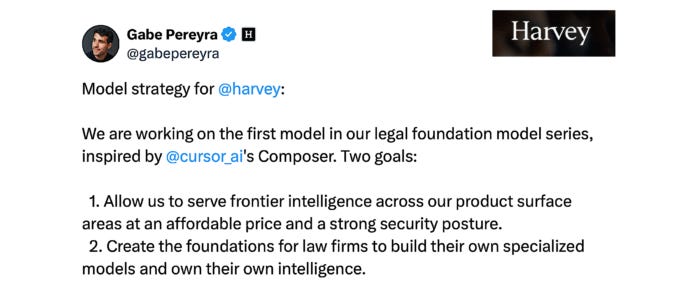
2. Harvey + Fireworks AI, Then Baseten Research
Harvey ran two experiments with two infrastructure partners. Both worked.
First, with Fireworks AI, Harvey fine-tuned Kimi K2.5 as the primary “worker” model and made Claude Opus 4.7 a callable advisor for only the hardest sub-tasks. Measured across 100 tasks on Harvey’s Legal Agent Benchmark: $84 versus $954 for Opus alone. Eleven times cheaper, not eleven percent.
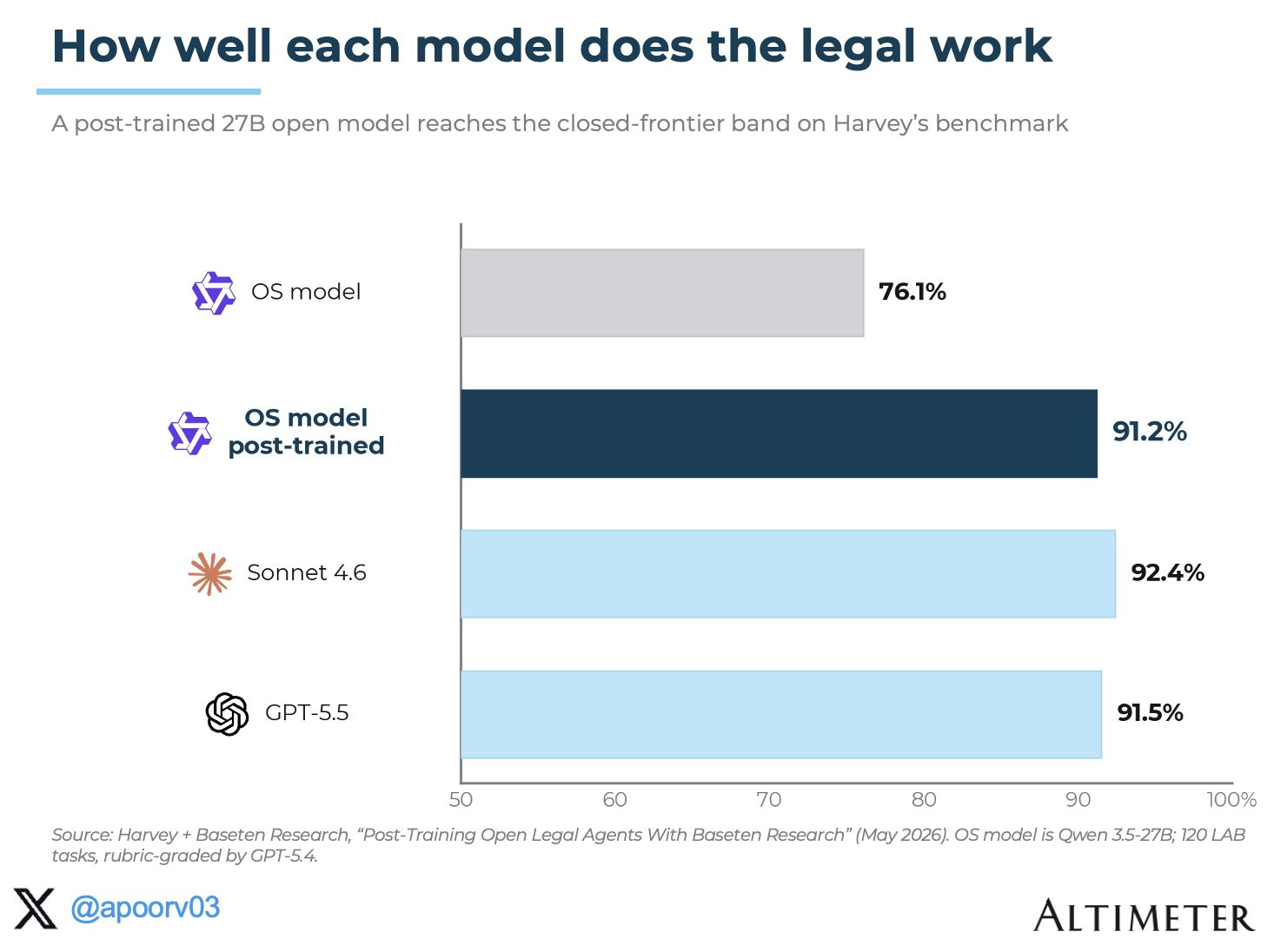
Harvey then went deeper with Baseten Research — a post-training pipeline built around their Legal Agent Benchmark (LAB): 1,200+ tasks across 24 legal practice areas, expert-written rubrics, all-pass grading. Partial completion counts as failure.
Before training, they built a compaction harness — periodic context compression into structured memos so the agent can process long documents without losing prior findings. What emerged after training was telling: the post-trained 27B model adopted end-to-end document reading, not because Harvey programmed it, but because the reward signal made comprehensive reading the winning strategy.
Result: a 27B open-weight model inside the closed-source frontier band, at a fraction of frontier’s $50-per-task cost. The core lesson: the model and the agent harness must be developed together. The same training run without the harness produced minimal lift. With it: frontier-level performance.
3. Ramp
One of the first enterprise companies to run an own-vs-rent playbook at scale. Expense categorization, financial document analysis, and workflow automation are exactly the workloads where post-trained models outperform frontier API calls: real company data, clear evaluation criteria, predictable workflows. The raw material was already there. Ramp used it.
4. Genspark
Genspark’s Deep Research agent hit a ceiling on a closed-source model — prompt engineering was the only lever, and it couldn’t deliver the tool-calling behavior a mixture-of-agents architecture requires.
Working with Fireworks AI, Genspark RFT-trained Kimi K2 against their own reward function. Four weeks later: +12% quality, +33% tool-call volume, roughly half the cost. CTO Kay Zhu: “Fireworks enabled us to own our AI journey, and unlock better quality in just four weeks.” The post-trained model didn’t just match the frontier. It beat it.
5. Vercel
Vercel’s v0 runs as a composite model — retrieval, a reasoning LLM, and a custom auto-fixer that corrects errors mid-generation. That last piece started on Gemini Flash 2.0 and hit the same wall every closed-model does: prompting was the only lever.
Vercel RFT-trained the auto-fixer with Fireworks and paired it with speculative decoding. Result: 93%+ error-free generation rate, beating Claude Opus 4, Sonnet 4, Gemini 2.5 Pro, and GPT-4.1 on the same benchmark at roughly 40x the inference speed of GPT-4o-mini. CTO Malte Ubl: “The SOTA in this space changes every day, so you don’t want to tie yourself to a single model.”
The wrinkle Vercel adds: you don’t need to own the whole pipeline. Owning one narrow, high-volume sub-task was enough to beat frontier across the board.
6. Plus More!
There are many other examples I could share, but you get the point. Moving on…
Step-by-Step: How to Build Your Own Intelligence 101
Friends, below you’ll find a step-by-step guide on how modern enterprises can build their own intelligence from the ground up. The future is here.
Step 1: Audit your data assets
Before you touch a GPU, answer three questions. How many real user interactions have been logged from your production AI workflows? Do you have agent eval traces — the complete chain of reasoning steps, tool calls, and outputs your agents produce in production? What are the highest-volume, highest-cost AI tasks in your product?
If you have more than a million real user interactions and a year of eval traces, you have the raw material. Most scaled AI companies do. Almost none have inventoried it.
Step 2: Pick the right open-source foundation
The tier-one open models in 2026: Kimi K2.5 (Cursor’s choice, strong on coding), Qwen 3.5 (exceptional reasoning, 1M token context), DeepSeek V3.2 (near-frontier on benchmarks), and Llama 4 (broad commercial ecosystem).
Match model size to use case. For cost-efficient production serving, 7–27B parameter models handle most domain-specific workloads. For complex long-horizon tasks — legal analysis, financial modeling, medical diagnosis — 70B+ is the right starting point. Check licensing before committing; terms vary widely.
Step 3: Build your private eval rubrics before you train anything
This is the step most teams skip, and it’s the most important one. You cannot optimize toward a target you can’t measure. Harvey’s LAB is the gold standard: expert-written rubrics defining what good output looks like for each task type, with all-pass grading that treats partial completion as failure.
Build the equivalent for your domain. Aim for at least 200 held-out evaluation tasks before training begins. The rubric writing is time-consuming. Do it anyway — it’s the lever that makes everything else work.
Step 4: Design the agent harness before training
Your model will train on the same context windows it sees in production. If the production system uses a compaction strategy — periodic context compression, tool use sequences, memory structures — train with that structure in the loop from the beginning.
Harvey’s research made this point definitively: the 27B model showed minimal lift without the harness. The same training run with the harness produced frontier-band performance. Harness design and model training are not separate workstreams. They are one.
Step 5: Post-train iteratively
Three techniques in order of complexity and payoff.
Supervised fine-tuning (SFT) is the fastest path. Take your best agent traces, filter to rubric-passing examples, and train a base model on them. Immediate domain adaptation, minimal infrastructure investment. Start here.
Iterative SFT is what Harvey used with Baseten Research. Run the base model through your eval tasks. For rollouts that fall short, use a teacher model to produce a corrected version and train on it. Iterate. Critical constraint: teacher hints must be invisible at inference.
RL with domain reward is Cursor’s approach and the most powerful. Run thousands of rollouts in parallel, score each against your private rubrics, and train toward what scored highest. More compute required — but it produces domain fit that SFT alone cannot replicate.
Step 6: Evaluate relentlessly against your private holdout
Never compare your custom model to frontier models on public benchmarks. Use your private holdout, your private rubrics. The metric that matters: all-pass rate on end-to-end tasks. A model that’s 80% correct on a legal contract review is not good enough — the missed 20% is the liability.
Run evals after every training run. The trajectory tells you whether the training signal is working before you spend further compute.
Step 7: Deploy on the right infrastructure
Custom models need GPU serving infrastructure, a continuous update pipeline, and traffic routing between your custom model and frontier models for workloads where frontier still wins.
Three production-ready options: Fireworks AI offers training and inference under one roof. Baseten is built for high-throughput agentic workloads — their research arm did Harvey’s post-training work. Modal is developer-first and maximally flexible, for teams that want deep production control.
Step 8: Build continuous learning
Post-training is not a project with a launch date. It’s an engineering discipline. Your model should improve every quarter as production data accumulates, base models improve, and eval rubrics sharpen.
Treat it as a product: production data → eval filtering → retraining trigger → new model version → deployment → repeat. The companies that build this loop compound their advantage every quarter. The ones that treat post-training as a one-time project will find themselves starting over when the next base model drops.
The Ecosystem Making This Possible [Preview]
Thankfully, enterprises don’t need to build intelligence alone. There exists a growing ecosystem of startups providing the infrastructure that enables enterprises to post-train and serve their own custom models without building a frontier research lab.
(More on this next week when we cover a deep dive into the landscape)
Below are the companies making it possible for enterprises to own their intelligence without building a frontier research lab. The picks and shovels layer.
Introducing: The Owning Your Intelligence Market Map
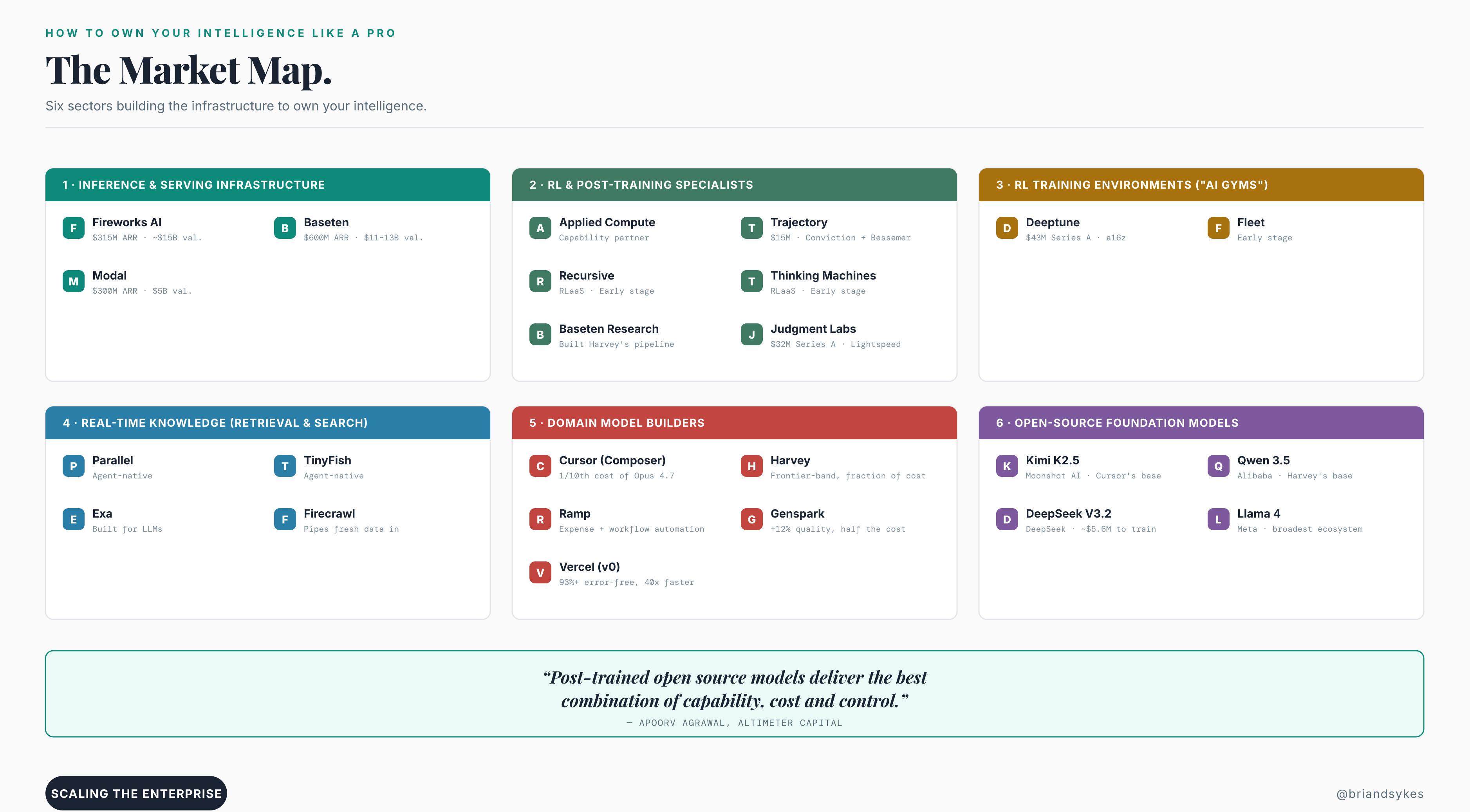
The market map above is a preview of next week’s post, where I’ll dive deep into each of these categories. But for now, here’s what you need to know.
Sectors to Know
Inference & Serving Infrastructure
RL Training Environments (”AI Gyms”)
Open-Source Foundation Models
RL & Post-Training Specialists
Real-Time Knowledge (Retrieval & Search)
Domain Model Builders
Each sector is early. All six are growing faster than most investors anticipated a year ago. The VC dollars are flowing in: Baseten’s $13B Series F, Fireworks’ latest round potentially valuing the company at $15B, Applied Compute’s $1.3B valuation.

These valuations reflect a market that has concluded this category is real, is compounding fast, and is one with tremendous upside potential.
The Bottom Line
Owning intelligence is not a research initiative. It’s an engineering discipline, and the infrastructure to execute it now exists.
The era of renting the best frontier intelligence for every task is over. The companies that own their intelligence won’t just have lower costs. They’ll have better accuracy, better latency, and a clear path to competitive advantage.
Remember: Your intelligence. Your terms. Your moat.
Next time (Part III, Volume III): The Market Map: Owning Your Intelligence [Deep Dive]
Disclaimer: The information contained in this article is not investment advice and should not be used as such. Views expressed are my own and should be considered as such, and are not the views of NextEra Energy Investments (NEI) or NextEra Energy (NYSE: NEE).
Post training is where most of the real gains are hiding right now, base model jumps have slowed down a lot more than fine-tuning work has. I’d add that for smaller teams the ROI is in narrow, task specific fine-tuning rather than chasing a general model, that’s the only place I’ve actually seen it pay off on client work.
Your publication has been a great find. I've subscribed and look forward to what's next!