


The AI Frontier Report · Issue #1 · July 2026
A recurring briefing on the models, companies, and dynamics reshaping enterprise AI — with clear implications for founders and buyers.
Executive Summary
The frontier is compressing: Kimi K3 now sits within striking distance of OpenAI and Anthropic across key enterprise workloads, and the gap closed in a single model generation.
Open-weight models are approaching proprietary frontier models across many real-world enterprise workloads — faster than most enterprise buyers anticipated.
Single-model architectures are increasingly a liability for AI founders. Multi-model routing is becoming the default.
Enterprise buyers are shifting evaluation criteria away from raw capability and toward flexibility, governance, deployment options, and cost.
Kimi K3’s rise has reignited concerns about IP theft in AI
The AI Landscape Is Changing Faster than Ever
Six months ago, most enterprise AI conversations revolved around OpenAI, Anthropic, and Google. Those companies defined the frontier, set expectations for model capability, and largely dictated where enterprise AI was heading. Today, one of the most capable models in the world comes from Moonshot AI, a Chinese startup that many enterprise executives had never heard of until this week.
If you’ve been following Scaling the Enterprise, this probably won’t come as a surprise. It mirrors the trend I’ve been writing about for months.
In The End of Renting Intelligence, I argued that enterprises shouldn’t assume their long-term AI strategy should depend entirely on renting intelligence through proprietary APIs. In Post-Training Is Back, I expanded on that idea by explaining why the organizations that ultimately win will own the systems, data, and post-training pipelines that differentiate their AI from everyone else’s.
Kimi K3 reinforces both of those ideas. When I started the Owning Your Intelligence Series, one of the themes I kept returning to was that open-weight models were improving at an extraordinary pace — not because any single company had cracked something new, but because every breakthrough from OpenAI, Anthropic, Google, and other frontier labs raises the ceiling for the entire industry. Those advances quickly become the baseline from which competitors innovate.
Kimi K3 may be the clearest example we’ve seen of that dynamic in action. The success of Chinese startups is sounding alarm bells in Washington and Silicon Valley, as China appears to be rapidly erasing America’s lead in advanced AI.
Observation #1: The Frontier is Getting Crowded
Enterprise implication: Don’t hard-code your product to one model.
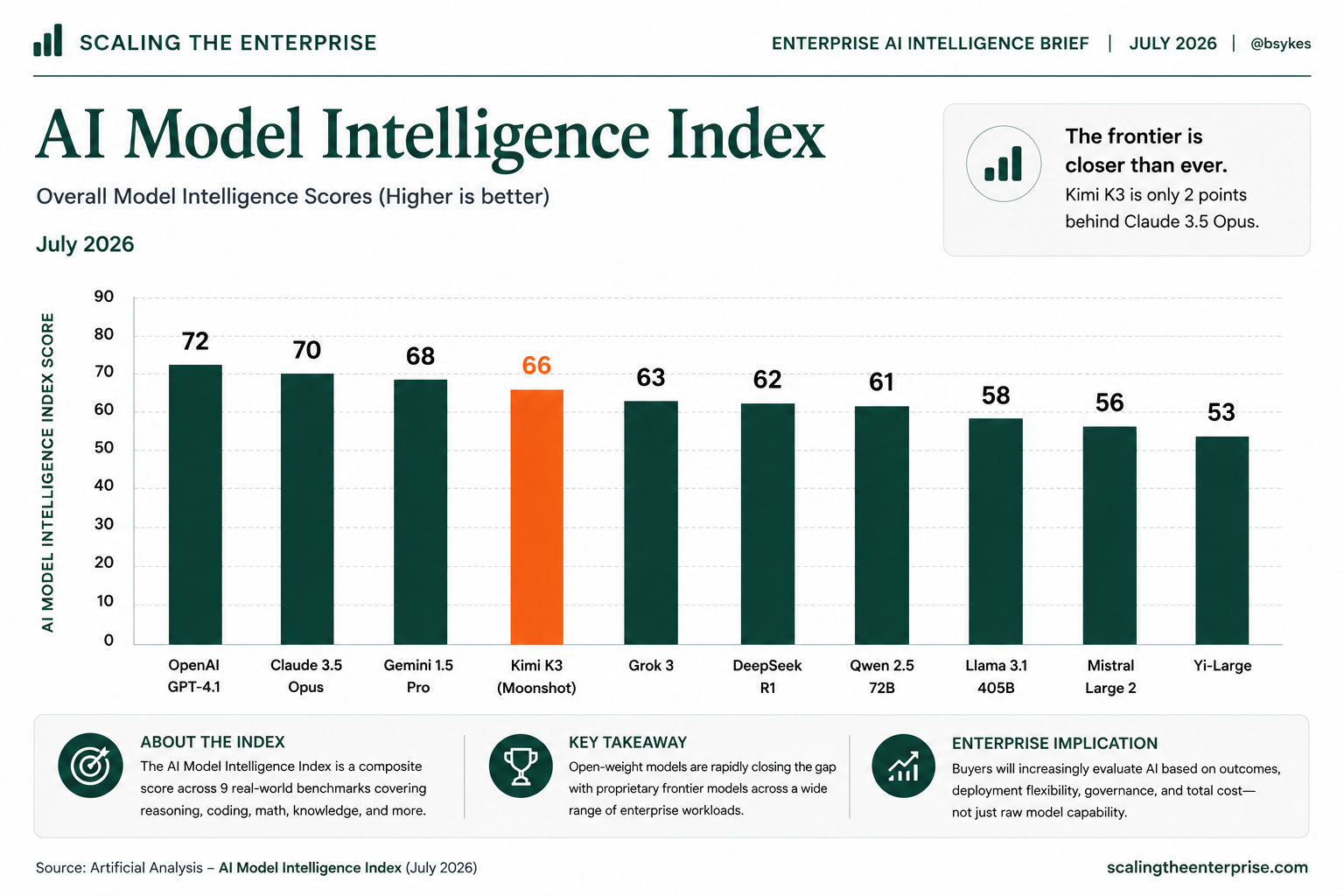
Kimi K3 doesn’t have to become the smartest model in the world to fundamentally change the market. The important development is that an open-weight Chinese model now sits within striking distance of the industry’s leading players. Only months ago, this level of capability was reserved for a handful of U.S. frontier labs. Today, that lead has narrowed to just a few points across independent evaluations.
This is exactly how enterprise markets mature. Once several vendors become “good enough,” purchasing decisions begin shifting away from absolute technical leadership and toward economics, governance, deployment flexibility, and ecosystem maturity.
For founders, this changes the conversation. Winning won’t necessarily come from building on the model that appears at the top of the leaderboard this quarter. It will come from building products that remain valuable regardless of which model leads six months from now.
📈 Enterprise Implication
If you’re building an AI startup today, don’t architect your product around a single foundation model. The companies that win enterprise deals will build platforms capable of intelligently routing workloads across multiple models while giving customers confidence they won’t be locked into one provider.
Observation #2: The Leaderboard Isn’t Everything
One of the results that immediately caught my attention wasn’t another academic benchmark. It was Code Arena.
Shockingly, Kimi K3 climbed from eighteenth place with K2.6 to the number one position in a single generation. Whether it remains in first place next month is an open question. So are claims that Kimi borrowed heavily from Anthropic’s Fable to post these results. What matters is the speed of improvement and where that improvement is happening.
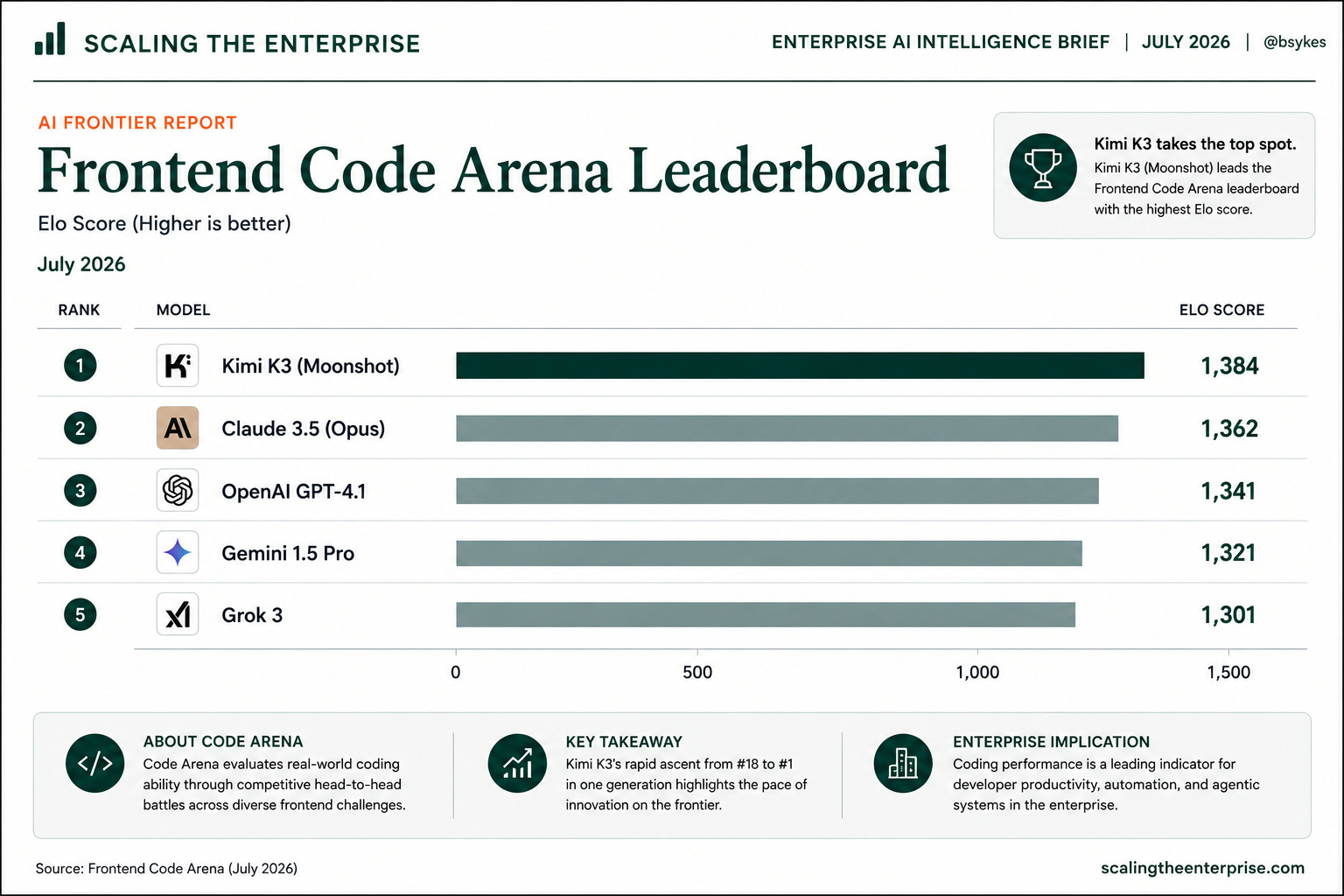
Coding has become one of the most practical measures of real-world model capability because software increasingly sits at the center of enterprise AI adoption. Models are writing code, orchestrating workflows, generating documentation, automating repetitive business processes, and powering autonomous agents. Strong coding performance often translates directly into better developer productivity and faster product development.
That’s why I think the leaderboard itself isn’t the story.
The real story is that multiple organizations can now compete at the highest levels of enterprise usefulness. The pace of innovation is accelerating, and that benefits everyone building AI products.
📈 Enterprise Implication
Enterprise buyers increasingly evaluate AI based on business outcomes rather than benchmark scores. Founders should expect customers to ask which model performs best for coding, document processing, customer support, analytics, or agentic workflows inside their environment, not which model ranks first overall.
Observation #3: The Center of Gravity is Shifting
Only a few months ago, most conversations around open models centered on Llama, Gemma, and Mistral. Those projects remain incredibly important, but the landscape has evolved rapidly. Today, companies like Moonshot, Z.ai, Alibaba, DeepSeek, and MiniMax are pushing the boundaries of open and partially open foundation models at a pace few people expected.
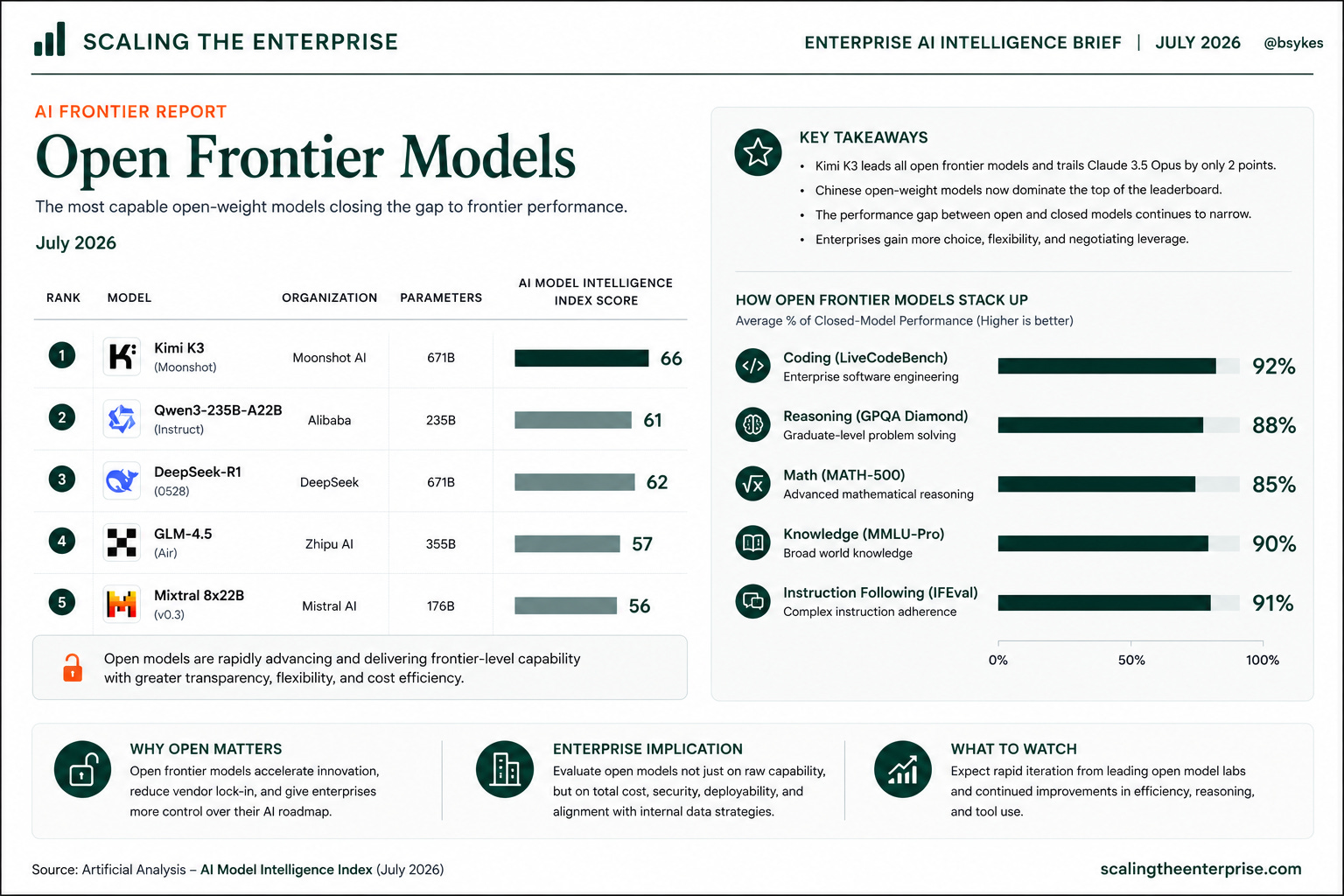
The above graphic on Open Frontier Models connects directly to one of the central ideas behind my Owning Your Intelligence series.
That isn’t simply an interesting trend. It fundamentally changes how enterprises should think about AI architecture.
If organizations can deploy models that perform within a few percentage points of the frontier while maintaining control over infrastructure, governance, proprietary data, and post-training, then owning intelligence becomes far more compelling than renting it indefinitely through proprietary APIs.
That doesn’t mean OpenAI or Anthropic become less important. It means enterprises finally have meaningful architectural choices.
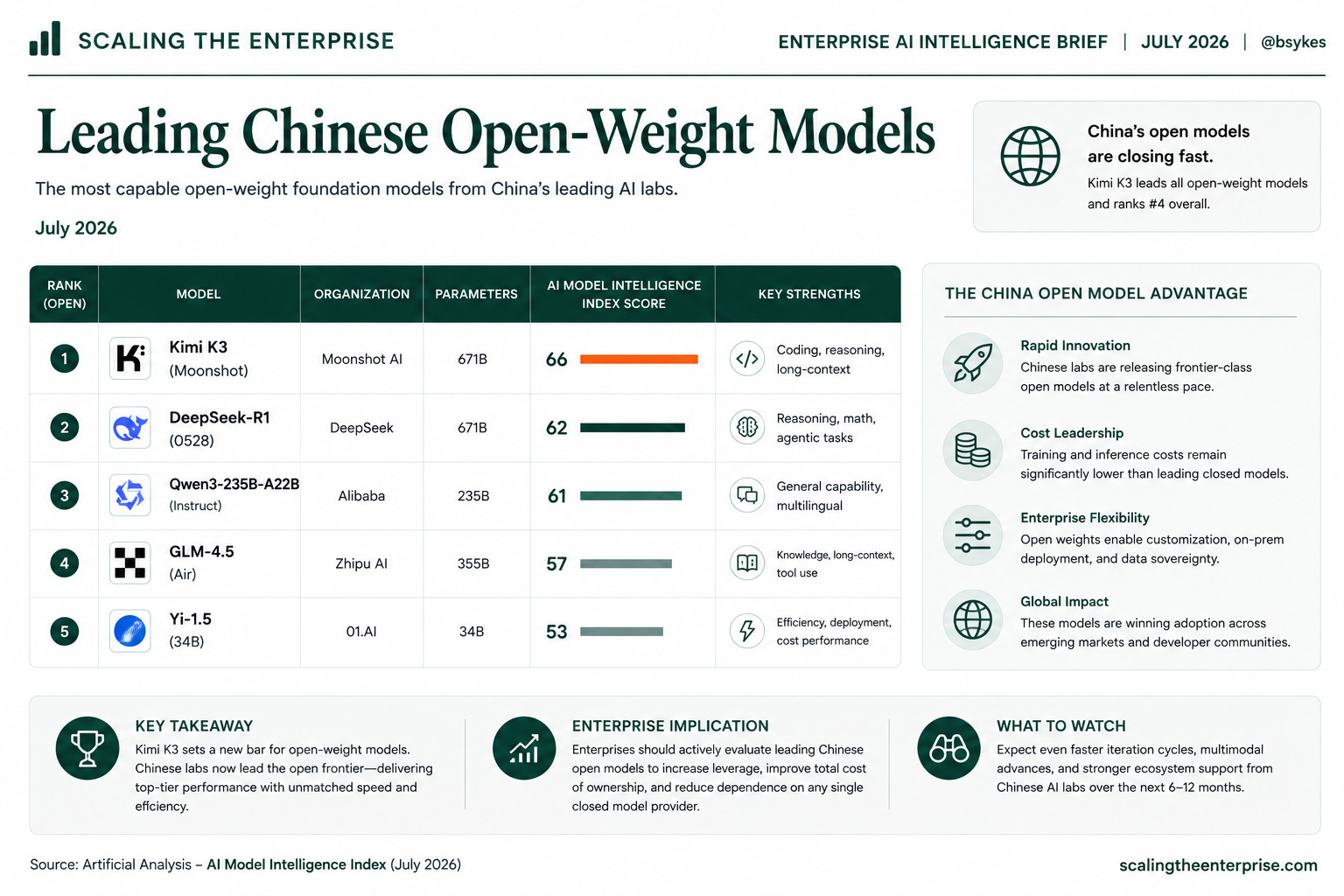
One mistake many people make is treating “China AI” as though it’s a single company. It’s not. What has emerged over the past year is an increasingly sophisticated ecosystem of companies solving different problems in different ways.
Moonshot is pushing frontier capability with Kimi K3. Z.ai continues to optimize aggressively around efficiency. Alibaba’s Qwen family remains one of the strongest open ecosystems available to enterprise developers, while DeepSeek and MiniMax continue expanding what organizations can accomplish with increasingly capable open models.
Taken together, these companies represent something much larger than a single model launch. They demonstrate that frontier AI innovation is becoming increasingly global — and that healthy competition benefits customers by accelerating innovation, creating downward pressure on pricing, and expanding deployment options.
📈 Enterprise Implication
If you’re selling AI into the enterprise, flexibility is quickly becoming a product feature. Customers increasingly want optionality across deployment models, foundation models, and infrastructure providers. Architecting for portability today may become one of your biggest competitive advantages tomorrow.
Observation #4: The IP Theft Question Is Not Going Away
I would be remiss if I didn’t address the elephant in the room.
Amidst the many reactions to Kimi K3, we saw a strong response from Washington. Michael Kratsios, director of the White House Office of Science and Technology Policy, claimed that Moonshot AI created the model by effectively cloning the capabilities of Anthropic’s Claude “Fable” model — a process known as model distillation.
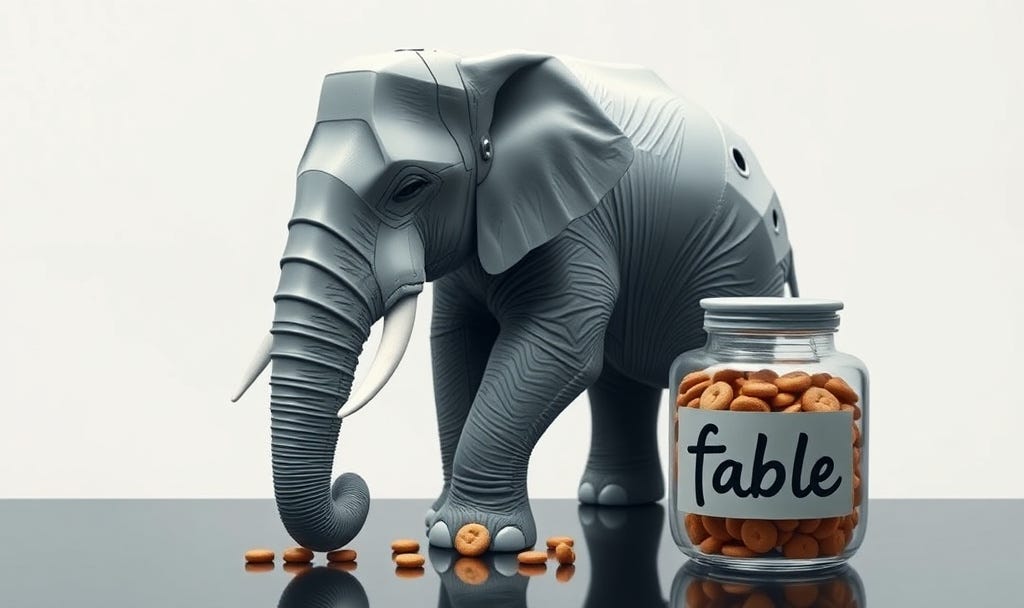
The key allegations:
Covert Distillation: U.S. officials allege that Moonshot AI used a sophisticated internal platform and hundreds of automated accounts to illicitly extract knowledge from Anthropic’s Claude “Fable” model. Model distillation allows developers to train a smaller model using the outputs of a larger, more advanced one. But there’s a meaningful difference between legit and covert distillation.
Policy and Sanctions: The U.S. Treasury and the White House have signaled that they draw a line between legitimate distillation and “covert industrial distillation” aimed at stealing U.S. technology. Officials have threatened direct sanctions against Chinese firms if IP theft is confirmed.
Watermarking: Treasury Secretary Scott Bessent stated that the government has found “watermarks” of U.S.-made AI models within some Chinese models, prompting active investigations into proprietary data extraction.
The counterargument:
Not everyone agrees with Washington’s framing. Many analysts believe Kimi K3 represents a genuine native breakthrough, which complicates the debate over whether its capabilities are a product of theft or independent Chinese R&D.
What isn’t in dispute: this question will not be resolved quietly, and the regulatory stakes are rising.
📈 Enterprise Implication
IP provenance is becoming a procurement consideration. Enterprise buyer, particularly in regulated industries, will increasingly ask where a model’s capabilities came from and whether deploying it creates legal or reputational exposure. Founders selling AI into the enterprise should be prepared for these questions.
What to Watch Next
Three things worth tracking before the next AI Frontier Report Issue:
How OpenAI and Anthropic respond. Kimi K3 is a direct competitive shot. The frontier labs’ next model releases — and how aggressively they’re priced — will tell us whether they’re treating this as a real threat or a temporary headline.
Whether U.S. regulatory action materializes. Officials have threatened sanctions. If they follow through, it changes the calculus for enterprise buyers considering Chinese open-weight models. If they don’t, the IP theft debate loses its teeth.
The open leaderboard in 90 days. Kimi K3 sits at number one today. Qwen, DeepSeek, and Llama are all actively developing. The leaderboard will look different in three months — and watching who holds the top coding spots will tell us a great deal about where real-world enterprise capability is consolidating.
Final Call: Your Move, Frontier Labs
Kimi K3 isn’t interesting because it won a few benchmarks.
It’s interesting because it shows how quickly the frontier can compress once foundational research begins diffusing across the industry.
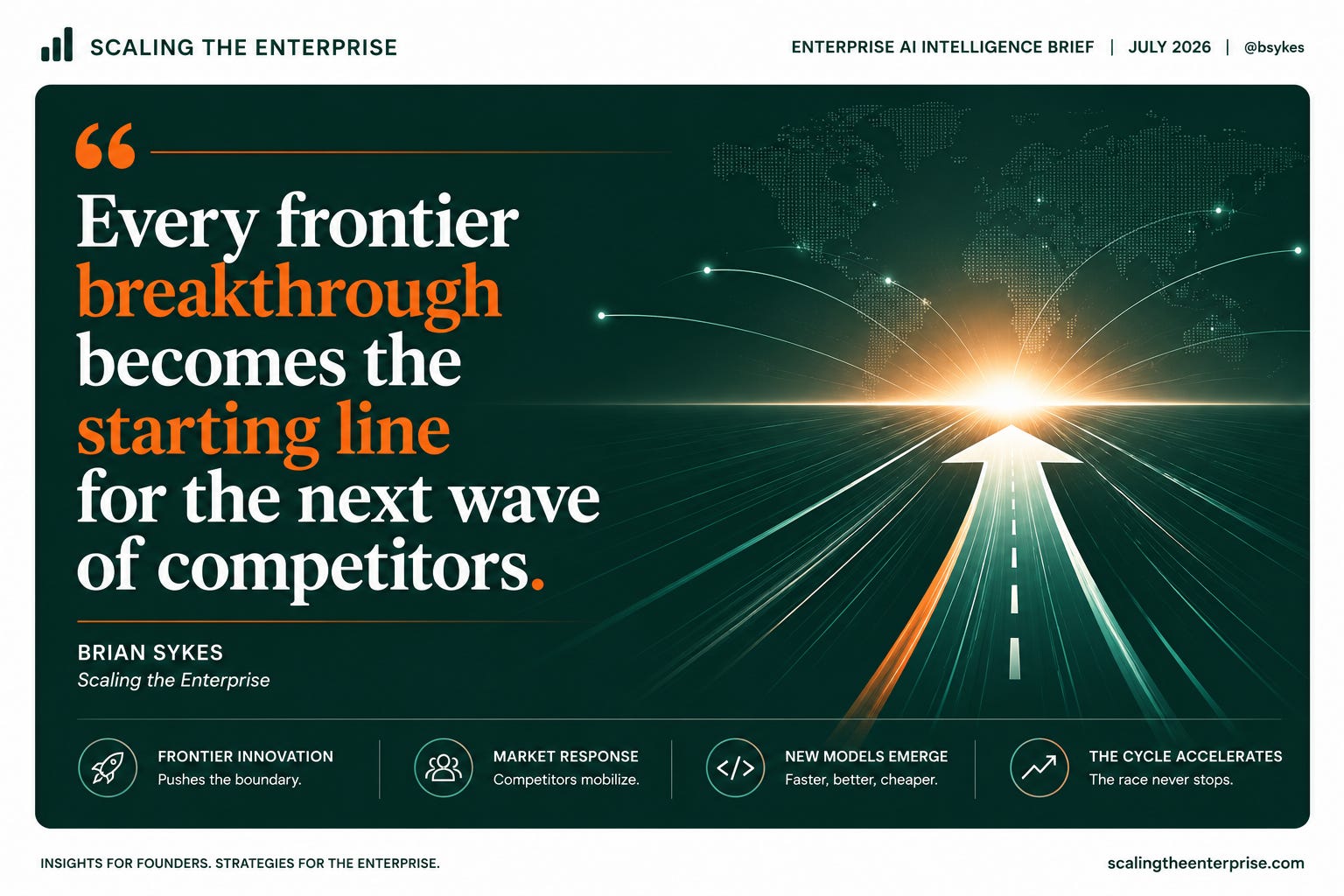
The leading AI labs, including OpenAI and Anthropic, invested years of research, billions of dollars, and extraordinary engineering talent to establish today’s state of the art. Those advances transformed the industry and created the foundation that others are now building upon. Every major breakthrough published by the frontier becomes the starting line for the next wave of competitors.
That doesn’t diminish what they’ve have accomplished. If anything, it highlights how influential their work has become. The pace of diffusion is accelerating, and the half-life of a technical advantage is becoming shorter with every release.
For founders building AI companies: I think this reinforces one of the central themes behind Scaling the Enterprise. Don’t optimize your company around today’s best model. Optimize for adaptability. The companies that win over the next decade won’t be the ones that guessed correctly in 2026. They’ll be the ones that built products capable of continuously evolving as the frontier changed around them.
For the U.S. AI Labs: it’s time to start paying attention. Chinese startups are knocking on your doors with models they can sell to your customers at far lower costs.
For regulators: it's getting harder and harder to ignore rising concerns about IP theft of U.S. AI technology by Chinese companies.
“Every frontier breakthrough becomes the starting line for the next wave of competitors.
Kimi K3 represents the clearest example yet of a challenger rapidly closing the gap by building on the trajectory established by Claude and ChatGPT. It allowed Kimi to leapfrog to the head of the pack — at least momentarily.
The next move will reveal how these companies intend to defend their lead in a market where capable challengers are arriving faster than ever.
OpenAI and Anthropic, the ball is in your court.
Selling to the enterprise is hard. Understanding it shouldn’t be.
Disclaimer: The information contained in this article is not investment advice and should not be used as such. Views expressed are my own and should be considered as such, and are not the views of NextEra Energy Investments (NEI) or NextEra Energy (NYSE: NEE).
From our testing, Kimi K3 has almost 0 content issues when it comes to security related prompts. There are PRs I have it look that that Fable and Opus immediately fail on. Big missed opportunities here by the western labs.
One pattern I've seen with founders evaluating this exact tradeoff: the moment open-weight models hit 'good enough,' the buying conversation shifts from 'which model' to 'who owns the inference stack.' Teams that built abstraction layers early (swappable model backends) are capturing the price drops immediately, while teams hard-coded to one API provider are stuck negotiating. Worth a follow-up piece on how much migration friction actually costs founders when the frontier compresses this fast.