


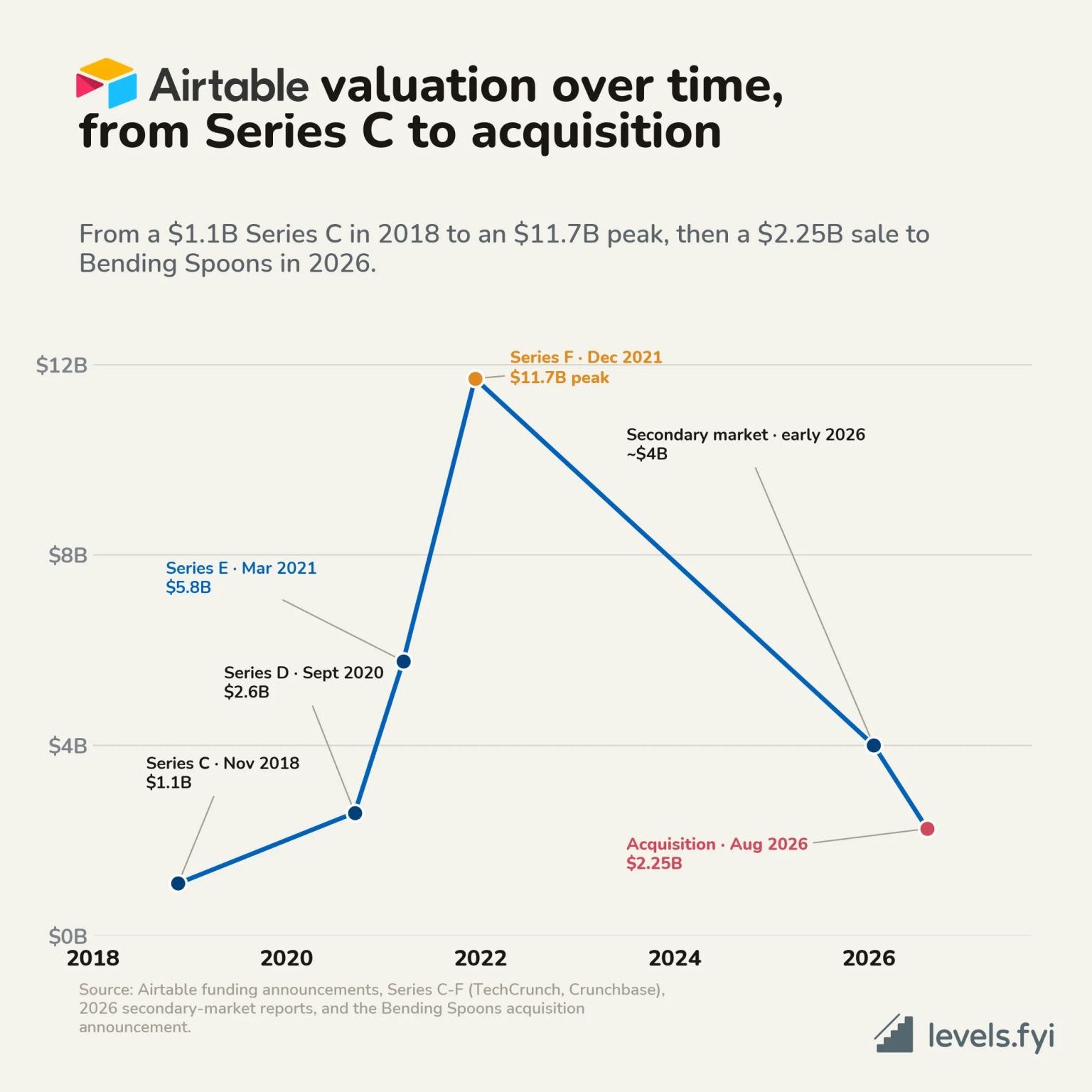
Earlier this month, Airtable agreed to be acquired by Bending Spoons for $1.285 billion in enterprise value — roughly $2.25 billion including net cash. At its peak in December 2021, Airtable was valued at $11.7 billion. It raised $1.4 billion in total VC dollars and was generating approximately $480 million in ARR, growing over 20% year-over-year. By conventional metrics, the company was a success. So, what went wrong? Since it’s December 2021 peak at $11.7 billion, the market’s view on SaaS has changed drastically. The chart below tells the whole story: a straight line from Series C unicorn to peak-era darling to a 2.7× ARR exit.
Bending Spoons, the Italian software company behind this deal, has been on a quiet acquisition tear in recent years. It’s scooped up Evernote, WeTransfer, Meetup, Vimeo, and AOL along the way. Bending Spoons IPO’d on Nasdaq just weeks ago, and Airtable is their first deal as a public company. Their playbook is well-established: acquire cash-flowing software businesses at compressed multiples, cut costs aggressively, and run them as high-margin assets. It’s one that would make the PE world proud. But why would Airtable sell? That’s the question on everyone’s minds.
My Thesis: AI is Eating SaaS
In 2011, Marc Andreessen wrote that “software is eating the world” — that every major industry would eventually be disrupted by companies built on software. He was right, but he didn't finish the thought: AI is now eating the SaaS that ate the world.
The Airtable sale isn't an anomaly. It's the first legible data point in a repricing that's going to run across dozens of software categories over the next 3-5 years, and the companies sitting on 2021 valuations with 2026 growth rates are the most exposed. Airtable built a genuine category around a genuine insight: most business teams shouldn't need engineers to build the tools they use, and that belief powered a decade of growth. But AI didn't just disrupt Airtable's product, it challenged the entire value proposition behind the company. That’s why we’re seeing a 2.7x ARR exit.
Jensen Huang put it plainly at Computex last year: "There is no software anymore — software has been replaced by AI." Traditional SaaS is morphing into Agent-as-a-Service (AaaS), where autonomous agents utilize traditional developer tools to execute complex workflows. The Bending Spoons deal is the first example of the market pricing that direction in. The question isn't whether this happens again. It's which company is next, and whether we’re all ready for what’s to come.
Part II: What Factors Caused the Collapse?
1. The 2021 Valuation Hangover
Airtable’s $11.7 billion valuation was priced in a market defined by near-zero interest rates, limited competition in no-code tooling, and investor willingness to pay premium multiples for any software growing above 30%.
All three of those conditions have since changed. Higher rates repriced growth assets broadly. Competition in workflow software intensified. And the arrival of capable AI assistants changed what “growth” looks like for seat-based businesses.
Airtable was not uniquely overpriced in 2021. It was priced like its peers. The problem is that its peers have largely experienced the same multiple compression, and a reset from 20× to 2.7× ARR is not survivable as an independent company without a path back to justified premium pricing.
2. Multiple Compression Is Permanent Until Proven Otherwise
The question isn’t whether Airtable deserves a higher multiple. The question is what multiple the market will assign to a workflow software company without a clear AI-native strategy.
Public SaaS multiples are down 60–70% from 2021 peaks, and the BVP Emerging Cloud Index spent most of 2024–2026 in the 5–8× revenue range, with a sharp correction in Q1 2026. The February 2026 AI agent selloff erased roughly $2 trillion in SaaS market capitalization as investors ran fleeing from the category.
Multiple compression this severe it’s temporary. It reflects a structural reassessment of what software is worth that doesn’t have a clear and compelling AI story. Airtable, at $480M ARR and 20% growth, was repriced into the commodity bucket.
3. AI Attacked Airtable’s Core Value Proposition
Airtable’s original promise was effectively: build custom business software without building custom software. The no-code layer was the product.
That promise is increasingly redundant when AI can help a competent employee write a production-ready application in an afternoon.
AI made software easier to build, which eliminated the premium customers were willing to pay for software whose main advantage was making custom software easier to build.
The HBS case study on Airtable (h/t my alma mater) captures the tension well: Airtable built a business on the observation that the cost of custom software was too high for most teams. In 2020, this thesis was absolutely correct. But we’ve already seen how quickly the “disruptor” can become the “disrupted”.
Once AI coding tools — Cursor, Replit, Claude’s coding capabilities, Codex — dramatically reduced that constraint, Airtable’s core differentiation narrowed.
4. AI Also Attacks Seat Economics
SaaS businesses grow in two ways: add more customers, or expand revenue per customer by adding seats as teams grow. Seat expansion — the net dollar retention engine — is what justifies the premium multiples software companies command.
AI agents do work that used to require human users. When an agent handles data entry, workflow routing, or status tracking, those tasks no longer require a seat. The question for every seat-based business is whether agent adoption expands the platform (more work gets done, more users needed to manage agents) or contracts it.
For Airtable, the honest answer is that agent adoption is a clear threat. Project tracking, database management, and no-code workflow building are all tasks that AI agents can do extremely well autonomously.
Part III: Airtable’s Most Dangerous Competitor Isn’t Notion
It’s Claude + Cursor + Supabase + a competent employee.
That stack — a capable LLM for reasoning and generation, an AI coding tool for building the application, and a managed database backend — can now reproduce a meaningful percentage of what Airtable does in a few hours of skilled work.
This is the new build-vs-buy pressure that SaaS vendors face. The question used to be: is it worth paying for Airtable’s pre-built infrastructure, or should we spend six months building a custom solution? For most teams, the answer was clear (Airtable).
However, the question now is different: is it worth paying $50,000 per year for Airtable, or should we spend two days with Claude and own the result? For a growing number of teams, especially technical ones, the answer is now the reverse (build).
This doesn’t mean Airtable loses all its customers overnight…switching costs, existing data, and organizational familiarity are real. But the risk is hard to ignore. Adoption and growth slows down. Churn accelerates. Net dollar retention declines as seat expansion becomes harder to justify.
Section IV: The SaaS Vulnerability Index
The Airtable story won’t be the last. The same pressures also apply to dozens of other software companies, as AI is attacking their core value propositions.
The SaaS Vulnerability Index (SVI) is designed as a scoring tool for enterprise software companies. Each company is scored 1–5 on six factors (for a total out of 30). As model capabilities improve, investment conditions shift, and companies adapt their strategy, the scores will change. But the SVI will provide an objective measure.
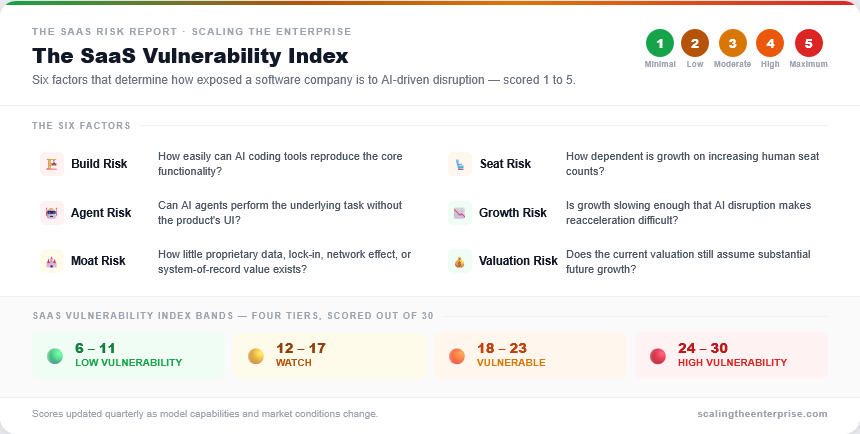
Reference point: Airtable SVI 26/30 🔴 — The event this issue is built around. Growing revenue (~$480M ARR, 20% YoY), but the market repriced it to 2.7× ARR because the category’s structural risk is higher than its current growth rate can offset.
The SVI Full Index
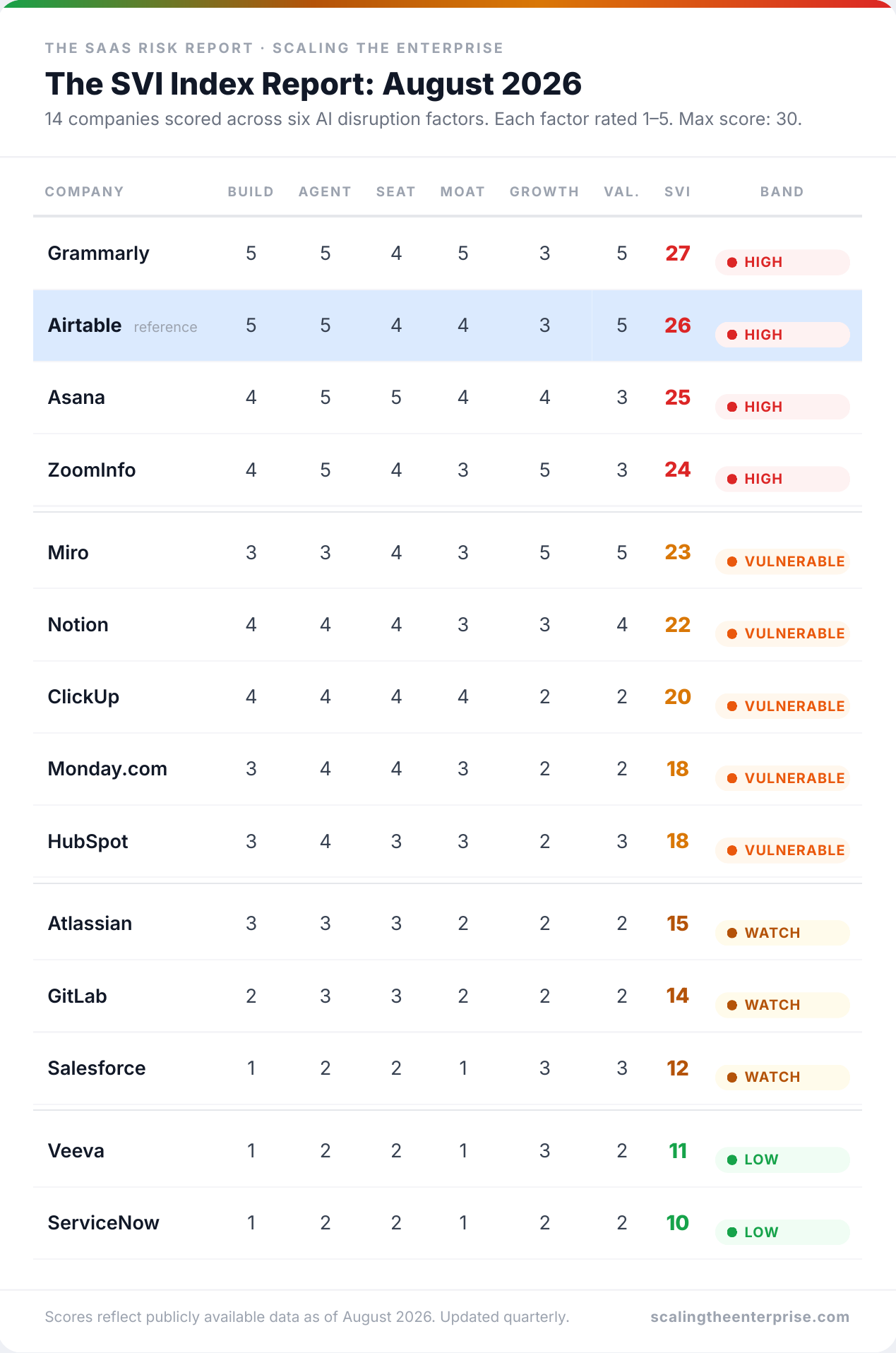
Scores reflect publicly available data as of August 2026. Updated quarterly.
Company Profiles
Profiles cover the 🔴 High and 🟠 Vulnerable bands — the companies where the structural risk is greatest. Watch and Low bands are scored in the index above.
🔴 High Vulnerability (SVI 24–30)
Grammarly — SVI 27/30 🔴 The highest score in the cohort, edging above Airtable itself. The core product — writing assistance and grammar correction — is now freely available inside every frontier LLM, natively, in the tools people already use. At $700M ARR and a $13B valuation (18.6× ARR), Grammarly’s brand retains real enterprise recognition, but the original defensible moat is gone. If it needs to raise or exit at current market conditions, the Airtable math applies faster here than anywhere else.
Asana — SVI 25/30 🔴 The clearest public-market Airtable analog. Revenue of $723.9M growing just 11% year-over-year; stock down ~50% in 2026 to around $6. Task management, project tracking, and workflow routing are precisely what AI agents handle autonomously — and seat-based pricing in a world where agents do the coordination work is a structural problem, not a product one.
ZoomInfo — SVI 24/30 🔴 The sharpest growth collapse in the cohort: ~1% revenue growth projected for 2026 on a $1.2B ARR base. ZoomInfo’s own language says it clearly — “AI and agentic confusion” among buyers, customers shifting to internal AI tools, and AI-native competitors like Clay and Apollo closing in. B2B contact enrichment is exactly what AI agents assemble from public sources. Analyst price targets have been cut from $12 to as low as $3.
🟠 Vulnerable (SVI 18–23)
Miro — SVI 23/30 🟠 A private-market name with Airtable-level valuation risk. ARR of ~$665M growing 5.6% year-over-year, against a $17.5B valuation set in January 2022 — a multiple that hasn’t been tested since. The company laid off 18% of its workforce in late 2024. Visual collaboration retains genuine human value, which keeps the score at 23 rather than higher, but if Miro needs to raise or exit, the repricing math is severe.
Notion — SVI 22/30 🟠 $600M ARR at an $11B valuation — roughly 18× ARR. AI writing assistants commoditize the document-creation layer; AI agents are increasingly capable of managing the databases and project workflows Notion hosts. The moat is real (sticky organizational knowledge), but the valuation is pricing in growth that AI competition and slowing enterprise adoption are actively pressuring.
ClickUp — SVI 20/30 🟠 “One tool to do everything” is a harder sell when AI agents do the work across tools natively. ARR of $300M at a $4B valuation (~13×) is more reasonable than most peers, and AI momentum is real (400% YoY growth in AI product sales). But the structural exposure is unchanged: seat-based project management in a category AI agents are automating.
Monday.com — SVI 18/30 🟠 The healthiest name in the vulnerable band — $1.232B revenue, 27% growth, 110% net dollar retention. Diversification into CRM and product management creates more lock-in than pure task tools. The watch signal: the work-OS core still sits squarely in agent territory, and seat-based growth is the category’s shared structural exposure.
HubSpot — SVI 18/30 🟠 Revenue guided at ~$3.7B for 2026, growing 18–23%. HubSpot is actively adapting — transitioning to a credits-and-outcomes model, with AI prospecting and data agents already live. The open question is whether that transition outpaces AI-native alternatives and Salesforce Agentforce eroding the mid-market category it dominates.
Section V: Who Might Be Next?
The pattern Airtable illustrated isn’t unique to Airtable. Here’s where the next repricing events are most likely to originate.
Public Companies
The companies below share the same underlying structure: peak-era valuations still on the books, seat-based growth models under pressure from AI agents, and core value propositions that looked durable in 2021 and look a lot more fragile today. For the public companies below, the repricing is already visible in the stock price. But are these value-buys, or are the current valuations a sign that bleak futures ahead?
Asana is the clearest Airtable analog in public markets. The stock is already down 50% in 2026, trading around $6, like many other SaaS company names. Revenue growing at 11% in pure seat-based task management, in a year when AI agents are being deployed specifically to automate coordination work, suggests the repricing reflects something structural, not cyclical.
ZoomInfo is a different but arguably more severe case: ~1% revenue growth projected for 2026 on a $1.2B ARR base. The B2B data category (contact enrichment, firmographics, intent signals) is exactly what AI agents now assemble. ZoomInfo’s own management flagged “AI and agentic confusion” among buyers. That isn’t a demand pause; it’s demand destruction. Analyst price targets have been cut from $12 to as low as $3.
Private Companies
For many private SaaS companies, the future is very cloudy. For example, here’s what the Airtable sale actually did to many of the people who built it.
According to Levels.fyi, a senior Airtable engineer who joined in early 2021 was offered equity valued at roughly $5.4 million at the December 2021 Series F peak. When Bending Spoons closed the deal earlier this month, that same grant was worth approximately $1 million. A dollar of quoted equity paid 11 cents at exit — because investors who put in $1.35 billion in preferred reclaim their liquidation preference first, leaving employees to split what’s left at a fraction of the headline price.
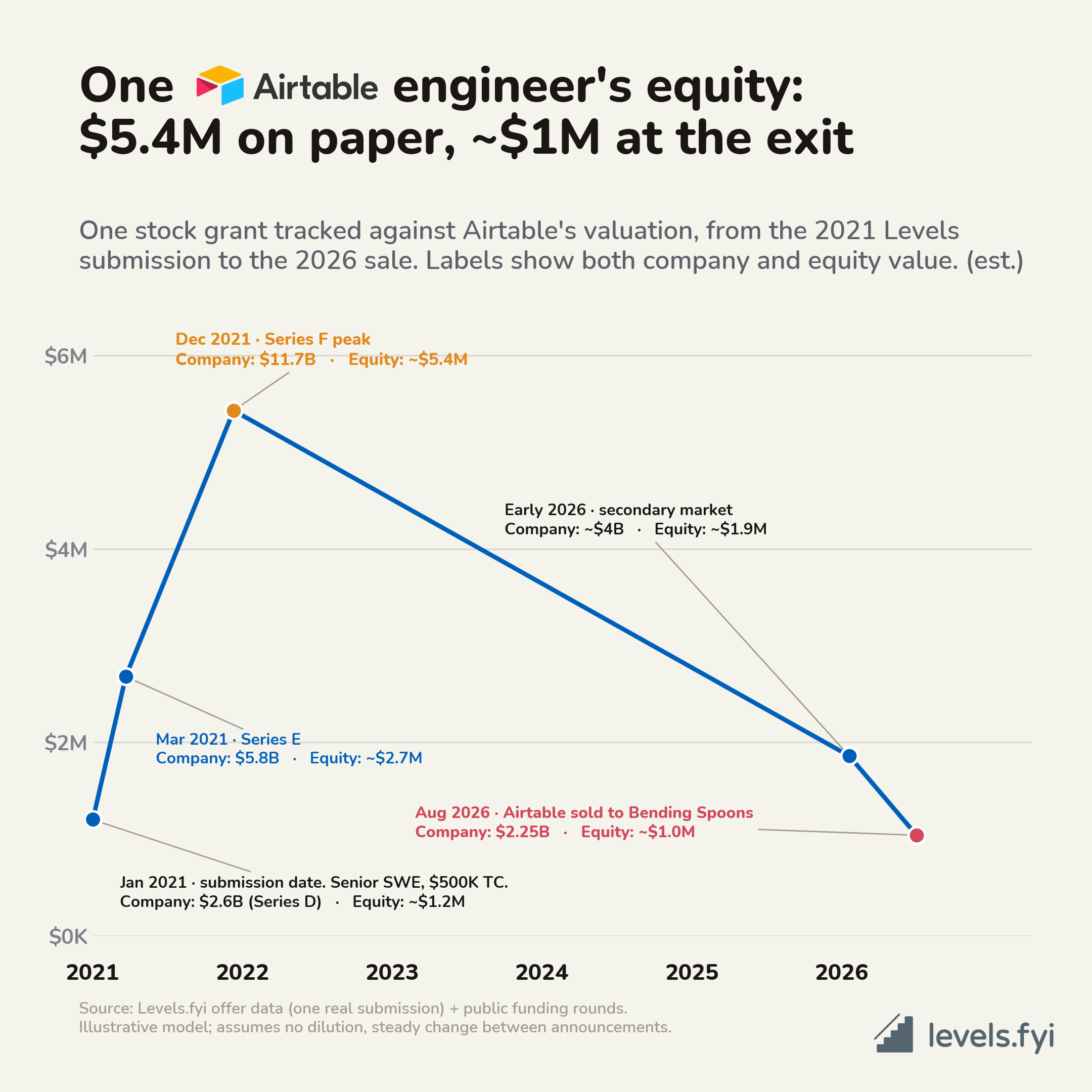
This isn’t an Airtable-specific problem. It’s the math of any company that raised at Covid peak multiples and exits below them. Most don’t realize until it’s too late.
The companies below haven’t exited yet, but could be in for similar fates before long.
Miro raised at $17.5 billion in January 2022. With ARR now at ~$665M growing 5.6% year-over-year, the Airtable comparison is almost too perfect: solid revenue, dramatically decelerating growth, stale peak-era valuation. At current private SaaS acquisition multiples of 3–5× ARR for slow-growth assets, Miro's realistic mark today is $2–3 billion, an 80–85% markdown from the last round. The company acquired Reforge in March 2026 and has announced AI-native features, but neither move changes the growth trajectory. Likely buyers at the right price: Bending Spoons (which just established a SaaS roll-up playbook with Airtable), a strategic like Microsoft or Atlassian, or a private equity roll-up. An IPO at anything close to $17.5B isn’t a realistic near-term path.
Grammarly (now operating as Superhuman Platform Inc. after acquiring Coda and the Superhuman email app) has been trying to build its way out of the problem — pivoting from writing assistant to broader workplace AI platform. It’s the right move. But the core product’s moat, the original “Grammarly grammar engine,” has been replaced by every frontier LLM. At $700M ARR and a $13B last-round valuation, the realistic range today is $2–3 B at 3–4× ARR, roughly an 77–85% markdown. Potential buyers are largely the same as Miro: Microsoft, Adobe, Salesforce, or a PE buyer like Thoma Bravo or Francisco Partners.
The pattern across all three is the same one Airtable illustrated: sky-high multiples leave these companies exposed to AI disruption, despite growing revenue. And even then, it’s clear the market believes that Airtable revenue will eventually drop to zero. Companies like Notion, Miro, Grammarly, and ClickUp might soon see a similar fate.
The Airtable sale just closed. It won’t be the last of its kind.
The SaaS Vulnerability Index will be updated quarterly as model capabilities, funding rounds, and public company results change the picture.
Disclaimer: The information contained in this article is not investment advice and should not be used as such. Views expressed are my own and should not be considered as the views of NextEra Energy Investments (NEI) or NextEra Energy (NYSE: NEE).