


The corporate rebellion against AI tools has been fast and furious. Quietly at first, then all at once. What’s driving the sudden AI pushback?
Key Findings
The AI narrative is turning. Corporate pushback against AI tools is primarily driven by an ROI reality check
Anthropic is the new AWS — minus the lock-in. Bills are arriving that look like cloud infrastructure, but customers can leave on a Tuesday.
“Tokenmaxxing” has become a real corporate phenomenon, and the early data on it isn’t pretty: 78% of IT leaders report unexpected AI charges, and 80–85% of enterprises miss their AI infrastructure forecasts by 25%+.
Microsoft and Uber’s recent moves matter more than the headlines suggest — neither was about AI quality, and both signal that the next 18 months will likely look choppier than expected for OpenAI, Anthropic, and Enterprise AI teams.
The cost-accounting era favors three things: switching-cost discipline, consumption-aligned pricing, and real cost visibility.
Introduction
Early in my career as an investor, one of the signals I looked for in breakout companies was a specific kind of love-hate relationship:
What product do CFOs hate paying so much for, but absolutely can’t live without?
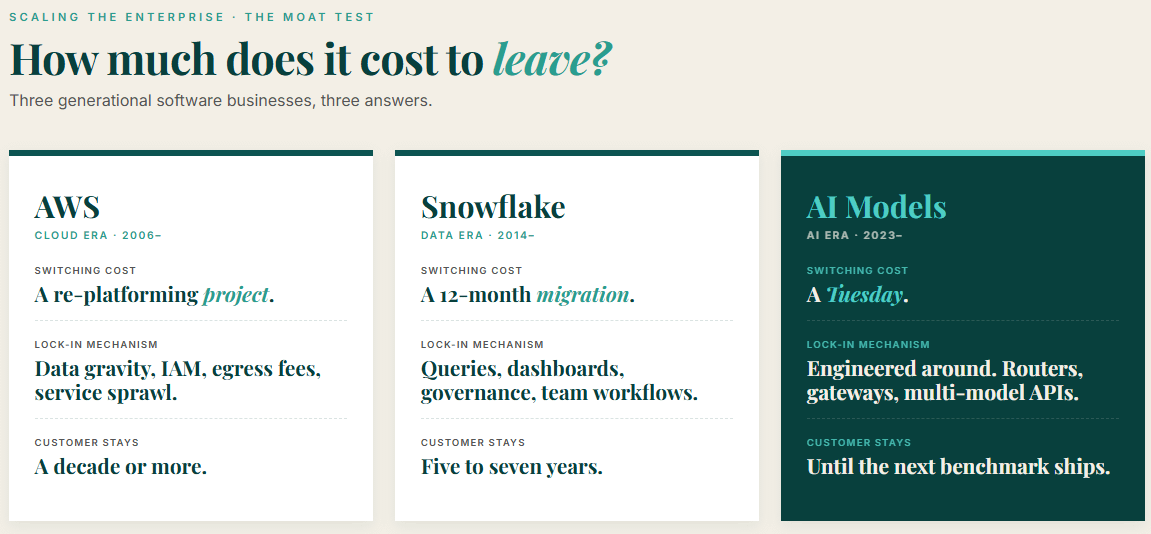
AWS came first. Bills skyrocketed year over year. Finance teams stared at invoices in disbelief and paid them anyway. They had to. By the time you noticed how big the bill was, your data was in S3, your auth was tied to IAM, your apps were stitched together with Lambda and RDS, and leaving wasn’t a procurement decision — it was a re-platforming project. AWS earned its margins because switching costs were enormous and the cloud enabled new and improved capabilities.
Then Snowflake. Before COVID, Snowflake ripped through enterprise IT budgets like wildfire. CFOs were furious. Then they signed the renewal. Once your queries, dashboards, governance, and data science teams lived in Snowflake, you weren’t going anywhere. Same lesson, different mechanism.
And now Anthropic. Bills are arriving that look more like AWS than SaaS. The mechanics are simple. Claude charges based on tokens processed—every word input and output costs money. Agentic AI tools can consume up to 1000x more tokens than basic chat queries, especially when employees deploy them for multi-step workflows or complex integrations.
Maybe that’s why Anthropic is currently valued at $965 billion, making it the most valuable private AI company in Silicon Valley.
Part I: The Sticker Shock Is Real
The End of Tokenmaxxing?
Corporate leaders are finally starting to question whether soaring AI spending is delivering meaningful returns.
Tokenmaxxing — the practice of maximizing employee AI usage to game adoption metrics — has surprisingly become a real corporate phenomenon overnight.
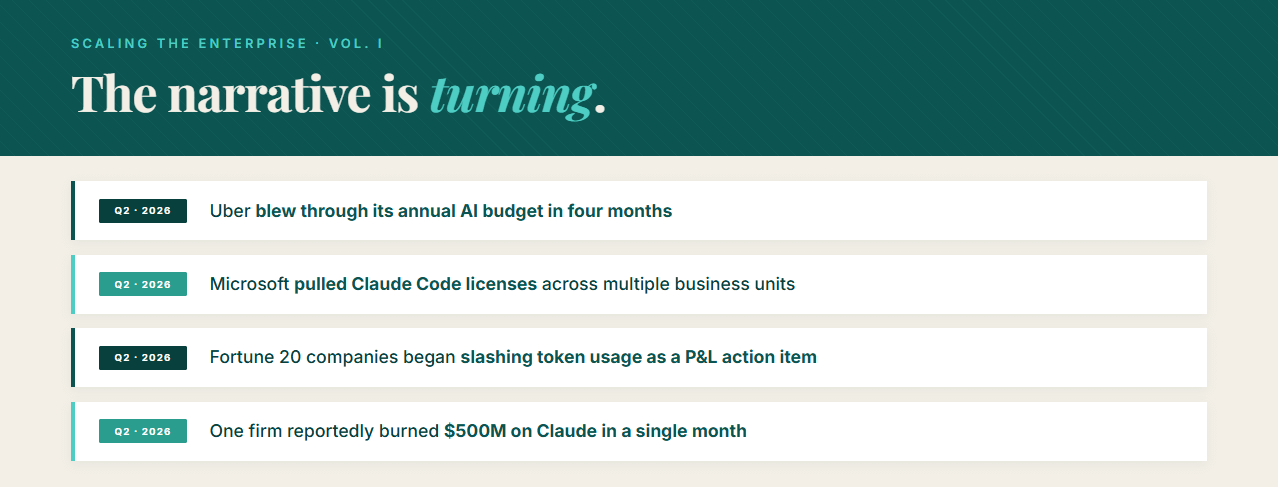
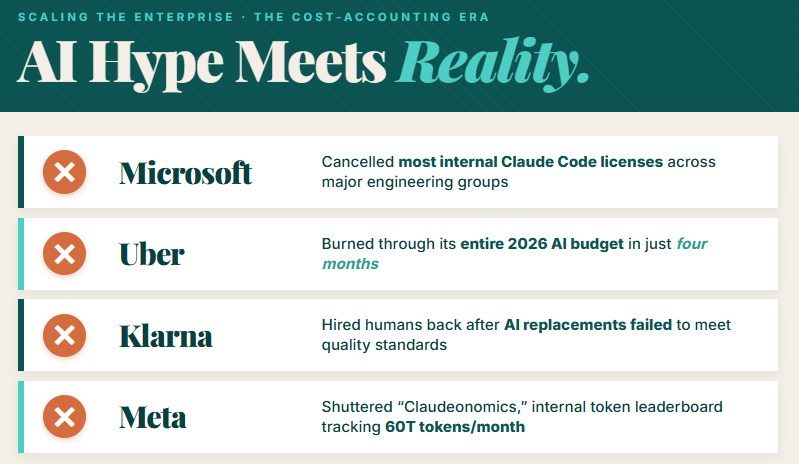
Uber blew through its annual AI budget in four months. Microsoft pulled Claude Code licenses across multiple business units. Fortune 50 companies began slashing token usage as a P&L action item. Amazon and Meta pulled internal AI leaderboards after employees gamed them with fake tasks. One anonymous large enterprise even allegedly burned $500 million on Claude in a single month.
Let’s Look at the Data
The pushback you’re hearing about is real. The early data on tokenmaxxing is starting to paint a bleak picture.
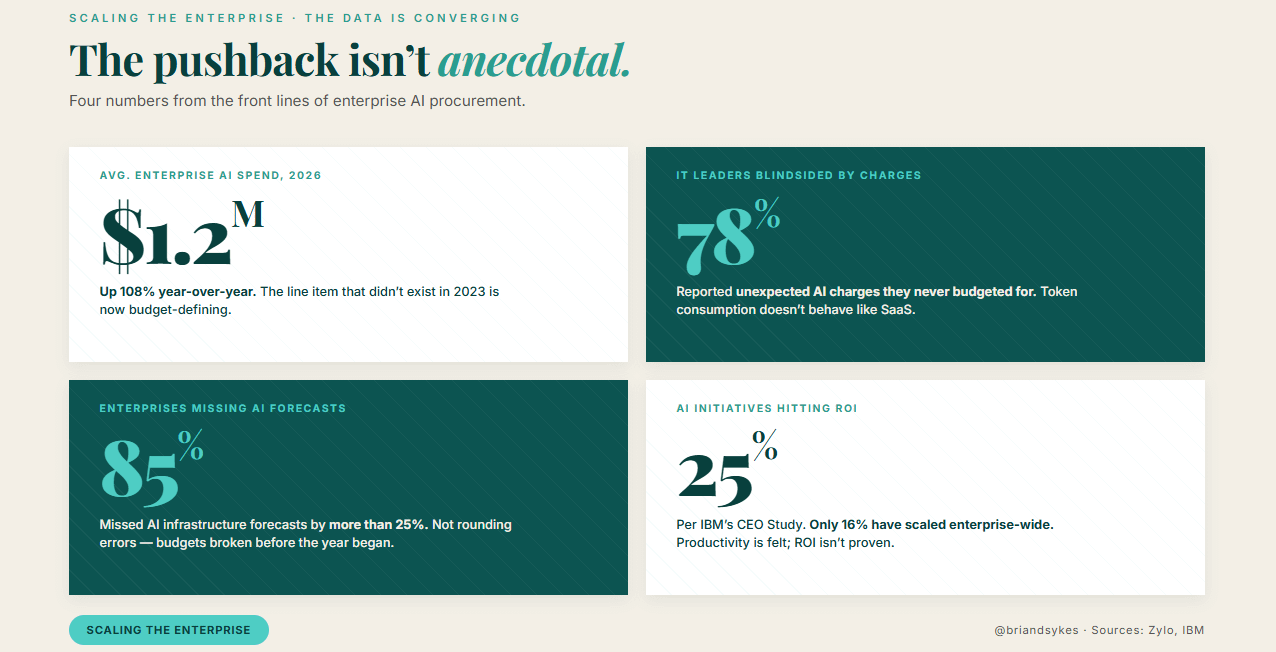
Enterprise AI spending hit a $1.2 million average per organization in 2026, up 108% year-over-year. 78% of IT leaders reported unexpected AI charges they never budgeted for. Roughly 80 to 85% of enterprises missed their AI infrastructure forecasts by more than 25%. Many companies aren’t seeing measurable ROI from their AI projects at all.
It’s possible we’ve simply reached the natural conclusion for the Tokenmaxxing trend. Take Meta’s dashboard, for example. Created by an employee, it tracked the top 250 token users among Meta’s 85,000+ staff. It awarded playful badges such as "Token Legend" and "Cache Wizard" to gamify usage. Quite ridiculous.
Are we seeing a "healthy swing" away from AI overuse and tokenmaxxing, or something more concerning for long-term AI demand?
Part II: How Insatiable Demand Is Breaking AI Platform Economics
The answer to the question above depends on something the AI industry has been wrong about for two years:
The assumption that inference costs — the cost of running an AI model every time a user sends a prompt — would keep collapsing indefinitely.
Models would get smarter every quarter. Open-source competition would commoditize intelligence. Hardware improvements would lower serving costs. And eventually, AI companies would inherit the same envied economics that made SaaS one of the great business models in history.

That belief shaped an entire generation of startups. Founders launched “unlimited AI” plans before understanding long-term usage behavior. Investors rewarded explosive adoption over contribution margins. Enterprises rolled out copilots across entire organizations, assuming economics would naturally improve with scale.
In the early wave, the assumption looked correct. Costs per token kept falling. Every new release made the previous generation cheaper. AI adoption exploded faster than almost any software category in history.
But underneath all that excitement, another trend was growing even faster.
Usage.

Per-token costs fell — but token consumption per task is up an estimated 10 to 100x since late 2023, as reasoning models and agentic workflows have taken over. This is an obvious, but important point. It seems that many companies did not realize that agentic AI can consume up to 1000x more tokens than standard AI.
The math broke in the simplest possible way: per-token costs fell, but total tokens per task rose faster.
Part III: Why Recent Moves by Microsoft & Uber Matter More Than You’d Expect
Recent experiences at Microsoft and Uber have made the new AI economics impossible to ignore. Both involve sophisticated enterprises with deep AI commitments — and neither was about AI quality.
Microsoft
Microsoft is reportedly removing most internal Claude Code licenses across major engineering groups, redirecting developers toward GitHub Copilot CLI instead. Yikes.
Microsoft was not rejecting Claude’s quality. It clearly still believes frontier AI matters. Microsoft still has deep ties with Anthropic — the Azure partnership remains intact, and Anthropic models are still available in Azure AI Foundry.
Microsoft was rejecting the cost of unlimited third-party AI usage. A global organization with over 200,000 people will always need to prioritize platform control, infrastructure optimization, and procurement discipline.
Uber
Reports suggest Uber burned through its entire 2026 AI coding tools budget in roughly four months after internal adoption exploded. Monthly AI tooling costs reportedly reached $500 to $2,000 per engineer, while nearly 95% of engineers were actively using AI tools every month.
That is strong adoption.
But the important part wasn’t the adoption. It was the ROI. Once Uber’s leadership started digging into whether the rising token spend was actually translating into proportional business outcomes, they didn’t like the answer they found. And so they pulled the plug.
The Takeaway
Microsoft and Uber land on the same point from opposite directions. Microsoft has the platform leverage to swap one AI tool for another and chose to. Uber has the engineering culture to adopt at 95% saturation and still pumped the brakes on cost.
Neither company asked whether AI platforms are effective. Both asked whether the tools are worth what they’re paying for them.
Part IV: The Cost-Accounting Era: What to Watch
Three trends worth following. Each one is a question I’d now ask of any AI company that I’m evaluating for an investment.
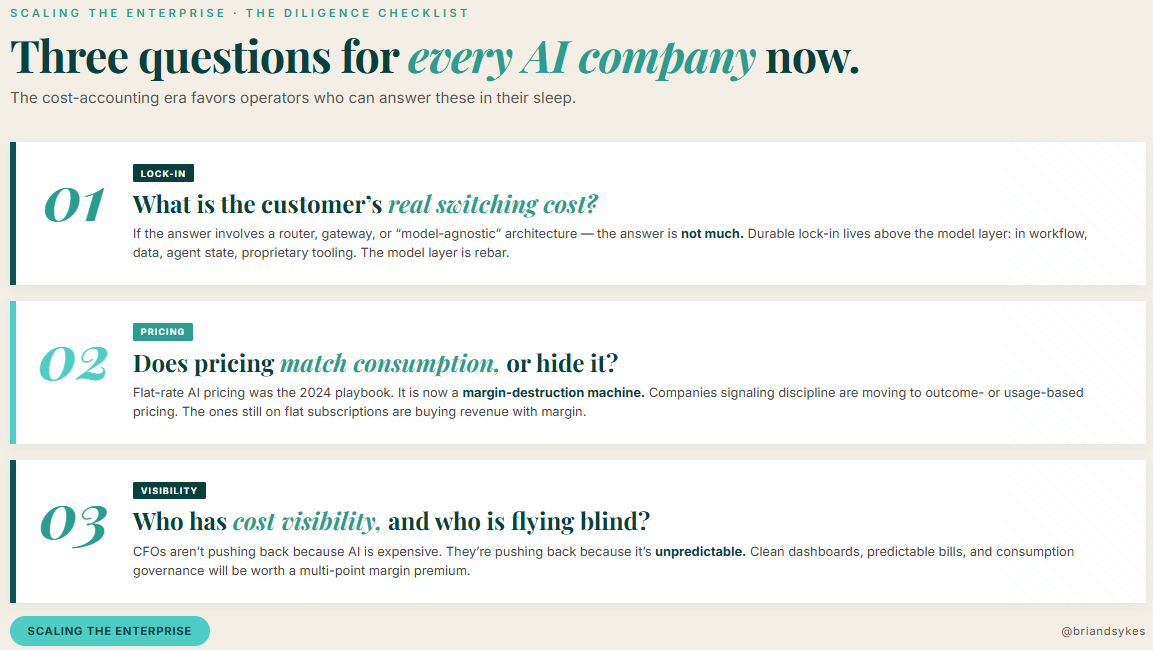
1. What is the customer’s real switching cost?
If the answer involves a router, a gateway, or a “model-agnostic” architecture, the answer is: not much. Durable AI businesses are building lock-in above the model layer — in the workflow, the data, the agent state, the proprietary tooling. The application layer is where customer retention lives. The model layer is increasingly rebar.
2. Does pricing match consumption, or hide it?
Flat-rate AI pricing was the 2024 playbook. It is now a margin-destruction machine. The companies signaling discipline are moving to outcome-based, usage-based, or hybrid pricing. The ones still on flat-rate subscriptions are buying revenue with margin. Watch for who shifts first — and who waits too long.
3. Who has cost visibility, and who is flying blind?
CFOs aren’t pushing back because AI is expensive. They’re pushing back because it’s unpredictable. The first companies to give their customers — and themselves — clean dashboards, predictable bills, and consumption governance will look like adults in a room full of toddlers.
The Bottom Line
AWS was a generational business because its customers couldn't leave. Snowflake was a generational business because its customers wouldn't leave. The AI startups raising at AWS-like valuations need to prove that their customers won't want to leave — a fundamentally different argument, and a much harder one to win.
The good news: the cost-accounting era is also when great businesses get built. The operators and investors who lived through the 2001 dot-com reckoning will tell you the same thing. The companies that survived a serious unit-economics conversation became the companies that ran the next decade. The ones that didn’t, didn’t.
The AWS moment for AI isn’t a disaster. It’s a filter.
Next week: if the bottleneck on AI economics is cost, the bottleneck on cost is energy. Why the AI bottleneck isn’t chips — it’s watts.
Disclaimer: The information contained in this article is not investment advice and should not be used as such. Views expressed are my own and should be considered as such, and are not the views of NextEra Energy Investments (NEI) or NextEra Energy (NYSE: NEE).