


Scaling the Enterprise · Owning Your Intelligence, Part III, Vol.1

Last week, Anthropic launched its two most powerful models: Fable 5 and Mythos 5.
Three days later, both were gone.
A US government export control directive, issued on June 12, ordered Anthropic to shut off access immediately. With little warning, the company was forced to shut down its two most powerful models for all users — globally, immediately, with no transition period. Anthropic didn’t choose to do this — they had no choice.
It was a moment few people saw coming, including Anthropic. They went into damage control immediately.
This is what renting intelligence actually looks like. If your product runs on Anthropic, that means it runs on someone else’s infrastructure, operates on someone else’s terms, and is even subject to someone else’s government directives. Any company operating at the application layer now faces the unsettling possibility that everything it has proudly built could disappear overnight.
Sadly, thousands of companies are still building this way.
We are entering an era of token scarcity and rapidly shrinking gains from each new frontier model release. At the same time, the smartest companies are starting to increasingly build and host their own models to power their AI tools, rather than renting general-purpose intelligence from the AI labs. In other words, we’ve reached…
The End of Renting Intelligence
For the last few years the default for AI apps was simple: call the best general-purpose model through an API, steer it with detailed prompts, give it tools, and improve behavior through evals. But times have changed.
What happens when a fine-tuned open model can match frontier model quality at a fraction of the cost? Because that’s increasingly our reality today. And what happened this week with Mythos shows why that’s never been more important.
The Math That Used to Work
From 2022 to 2024, renting frontier intelligence was the right call. If you were building an AI company and didn’t build on GPT-4 or Claude, you were making a mistake. The best models were dramatically better. The open-source alternatives weren’t close. And even if you wanted to train your own model, the infrastructure to do this cost effectively didn’t exist yet.
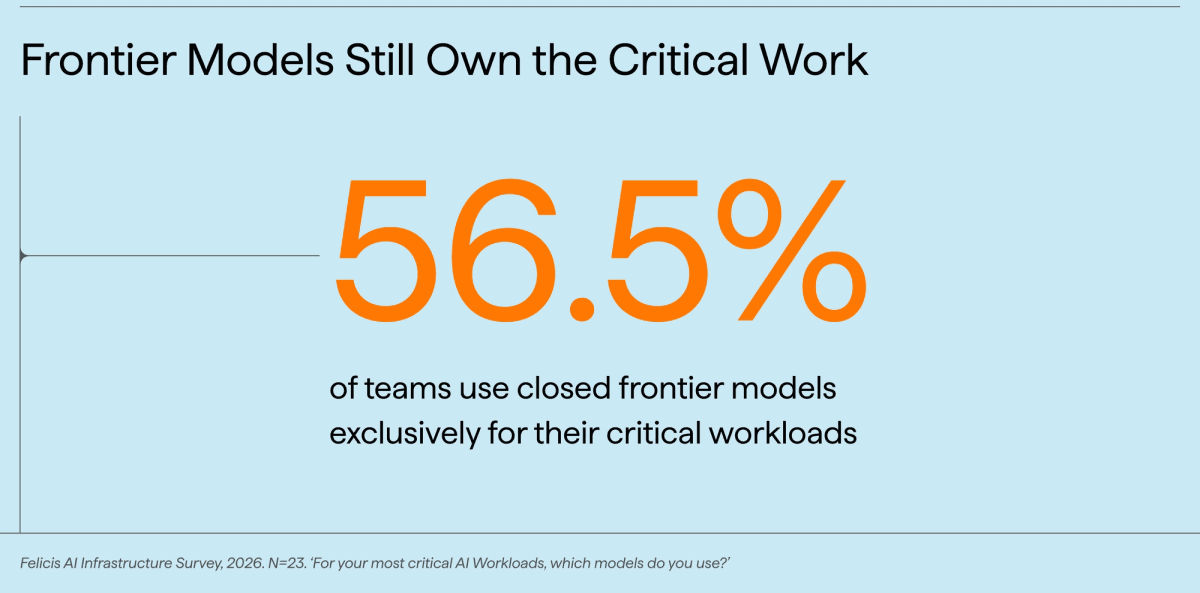
The math worked. That’s why a recent Felicis report showed that most enterprise teams still use closed frontier models exclusively. Even at rate-card pricing, frontier API costs were manageable for most workloads. Until the tokenmaxxing era.
Fast-forward to 2026, and things have changed fast. Three things changed between late 2024 & today — and together, they may have broken the math on renting for good.
Open source caught up.
In December 2024, DeepSeek released V3 — a 671-billion-parameter open-source model matching GPT-4o and Claude 3.5 Sonnet on most benchmarks, trained for “roughly” $5.6 million versus GPT-4’s estimated $50–100 million. Weeks later, R1 matched OpenAI’s o1 on AIME and MATH-500 at roughly 30x lower inference cost. The market understood immediately: Nvidia’s stock fell 17% the following week, the largest single-day market cap loss in US stock market history.
By mid-2026, the open-source ecosystem — Kimi K2.5, Qwen 3.5, DeepSeek V3.2, Llama 4 — matches or exceeds frontier performance on coding, legal reasoning, and general intelligence. That’s why you’re seeing companies like Harvey, Rogo, and Cursor start to invest heavily into fine-tuning their own models for certain tasks.
Frontier progress has slowed to incremental gains.
For three years, each new frontier model release felt like a step change. That era is over. Parameter growth in frontier models has slowed to roughly 5% annually — a stark contrast to the more than 100x growth between 2019 and 2021. The benchmarks that once separated frontier models from everything else are increasingly noisy.
The new reality: marginal gains at extreme and growing cost. If your strategy depends on always being on the latest frontier model, you’re running on a treadmill at 10 MPH. The gap between frontier performance and a well-tuned open-source model on your specific workloads has never been narrower.
Agentic workloads broke the token economics.
Single-shot API calls cost pennies. Agentic workflows — the kind every serious AI product is now built on — consume 10x to 1,000x more tokens per task as the agent reasons, plans, calls tools, retrieves context, and self-corrects. At rate-card frontier pricing, that’s not a margin problem. It’s an existential one, especially when employees were being rewarded only a few months ago for maxing out token spend.
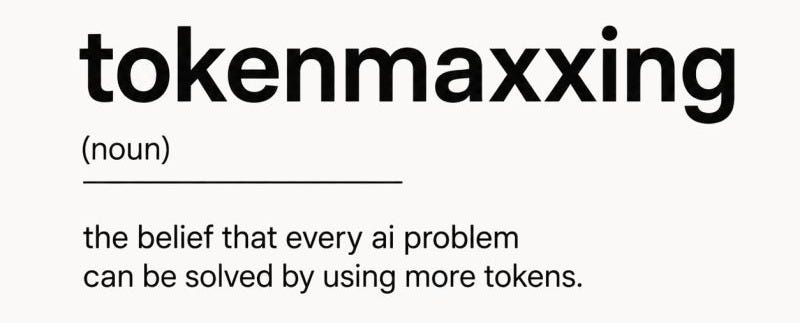
All of the companies that began the year defaulting to frontier API calls for every agentic workload are running an old playbook against 2026’s cost structure. It’s no wonder why companies like Microsoft and Uber have clamped down on AI spend.
The Risk Nobody Priced: What happens if your landlord kicks you to the curb?
Getting an eviction notice is never easy. That’s exactly what happened to Anthropic.
Most AI application companies ran some version of the following risk analysis: What if our frontier API provider raises prices? What if a model gets deprecated? These are normal risks that all companies typically forecast.
But Mythos exposed a category of risk that almost nobody had in their analysis: what if the government makes the decision for you?
The Fireworks AI team put it cleanly in their post-Mythos note:
“Renting works great right up until the day it doesn’t. The landlord can raise the rent. They can change the rules. And every once in a while, for reasons that have nothing to do with you, they can tell you it’s time to leave.” - Li Qiao, Fireworks AI

For a company like Anthropic, with a revenue run rate of $47 billion, that’s valued at nearly $1 trillion ahead of its IPO, the downstream impacts on the application layer are alarming. For every company building a flagship product on a model they don’t own, suddenly, that product is one government directive away from going dark.
The Companies That Are Two Steps Ahead
While most companies were still debating the question, a handful answered it by proactively adjusting to today’s new reality.
Cursor + Composer
Cursor built Composer — its proprietary coding model — on Kimi K2.5, an open-source one-trillion-parameter mixture-of-experts model. Cursor’s team spent 85% of total compute not on pretraining, but on their own post-training and RL pipeline — running thousands of agent rollouts in parallel, scoring each against private eval rubrics, and optimizing for the exact workflows their users actually run.
The training data wasn’t benchmarks or synthetic problems. It was real agentic coding tasks: multi-step debugging, refactoring across large codebases, tool-calling sequences that match what Cursor’s users do every day.
The result: Composer 2.5 matches Claude Opus 4.7 on coding benchmarks at one-tenth the cost. Not eleven percent cheaper. One-tenth. That’s not a margin improvement. That’s the difference between a business model and a business.
Harvey + Post-Training
Harvey took a different path to the same destination. Working with Baseten Research, they post-trained an open-weight model against their Legal Agent Benchmark — a proprietary evaluation suite covering more than 1,200 tasks across 24 legal practice areas. The tasks mirror real partner-level legal work, and performance is measured with all-pass grading: partial completion is treated as failure.
The research surfaced something revealing. The post-trained open model adopted the same strategy as frontier models — reading documents end-to-end, not skimming with pattern matching — not because Harvey programmed that behavior, but because optimizing against the right rubrics made comprehensive reading the best approach.
The result: an open-weight model landing inside the closed-source frontier band. Frontier models on Harvey’s benchmark run to roughly $50 per task and 20+ minutes of latency. Harvey’s post-trained model delivers comparable results at a fraction of the cost.
Both companies followed the same logic: real product usage data, domain-specific eval rubrics, and long-horizon workflows where general-purpose frontier intelligence is significant overkill. The raw material was already there. Most enterprise companies have it. Almost none are using it.

What Owning Intelligence Actually Buys You
The case for owning intelligence isn’t primarily about cost — though the cost argument stands on its own. It’s about control.
Cheaper. An open-weight model post-trained on your domain can reach frontier-equivalent performance at a fraction of API cost. Cursor’s one-tenth-of-Opus economics. Harvey’s fraction of $50-per-task frontier pricing. These aren’t incremental improvements. They’re structural.
Faster. When you control the model, you control the inference stack. You can optimize latency for your specific workflows, tune serving parameters for your traffic patterns, and cut context windows without waiting for an API provider’s roadmap.
Your IP. The model trained on your proprietary data, your eval rubrics, and your domain workflows is uniquely yours. It cannot be replicated by a competitor who calls the same API you do. For the first time in the AI application era, the application layer has a defensible, compounding moat.
Sovereign. No government directive shuts down your custom model. No lab policy change alters what your model will and won’t do. No pricing reprice forces an emergency renegotiation. When your intelligence is yours, someone else’s regulatory situation is not your operational crisis.
The Bottom Line
By 2027, owning your intelligence won’t be contrarian. It’ll be status quo.
The companies that figured this out earliest are sitting on a massive advantage that is likely to compound quarterly. Their models improve as more user data accumulates. Eval rubrics sharpen. Inference costs fall as they optimize for their specific workloads. The gap between them and competitors still renting — still running on someone else’s terms — widens every month.
Here is the smart money story across this series so far:
Part II: hyperscalers are buying watts at the infrastructure layer.
Part III: smart application-layer companies are building their own models.
The companies doing neither — renting frontier intelligence, with no infrastructure layer moat, and no proprietary model — will be exposed.
What other companies are leading the way in owning their intelligence? I’d love to hear your recommendations below.

Next time (Part III, Volume 2): How to Own Your Intelligence Like a Pro — step-by-step guide and market map of the ecosystem building the infrastructure to make it happen.
Disclaimer: The information contained in this article is not investment advice and should not be used as such. Views expressed are my own and should be considered as such, and are not the views of NextEra Energy Investments (NEI) or NextEra Energy (NYSE: NEE).
Open source/weight models seem to have hit an inflection point. I think the hard part is timing adoption. Companies that adopt later may overtake earlier adopters by using improved hardware and techniques. Those gpus get obsolete fast. (Similar to this problem https://www.centauri-dreams.org/2006/11/24/barnards-star-and-the-wait-equation)
Open source models are the way to go.
I've been running qwen from my MacBook, for the past 2 months. Didn't tolchba cloud sub!