

As AI absorbs summaries, reporting, tracking, and orchestration, spans of control widen and layers of middle management are disappearing overnight.
Key Findings:
The C-suite is climbing back down to IC roles. A wave of public-company CTOs and founders — plus Andrej Karpathy — have left executive seats to join Anthropic as individual contributors under a single flat title: Member of Technical Staff (MTS).
Middle management exists to move information — aggregating context from below, relaying strategy from above, keeping everyone aligned. AI now does that routing work, which is why the middle layer is eroding fast.
Flattening cuts both ways. It removes managers, but it also amplifies high-leverage individuals: one great IC can now do what a coordinated team used to. AI doesn’t just automate labor — it amplifies agency.
The best people want proximity to the work. Impact in the AI era is concentrating in the people closest to the technical frontier, not the ones managing the biggest teams.
The hidden cost is the talent pipeline. Cheap grunt work was how juniors earned their reps. Automate it away and you risk severing the apprenticeship that produces tomorrow’s seniors.
Something Odd is Happening in Tech
C-Suite execs of billion-dollar companies are quitting to take IC roles at Anthropic.
In May 2026, Andrej Karpathy — OpenAI co-founder, former AI Director at Tesla, one of the most recognizable engineers alive — joined Anthropic. Not to run a team. Not to hold a title. He joined the pre-training team as an IC so he could “get back to R&D.”
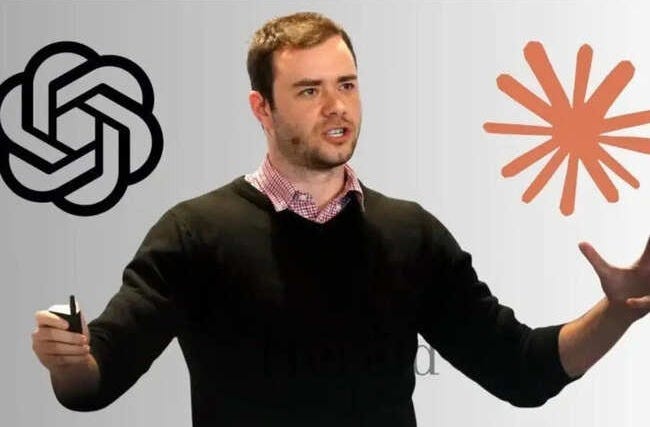
And surprisingly, he’s not even an outlier.
Over the previous year, a growing cluster of executives walked away from the C-suite to take IC roles at Anthropic under a single, deliberately flat designation: Member of Technical Staff. The CTOs of Workday, Instagram, Box, You.com, Super.com, and Adept AI all made the same move. Peter Bailis left the CTO seat at Workday — an $8 billion company with 18,000 employees — after less than a year to do RL engineering at a lab that now builds the kind of HR software Workday sells.
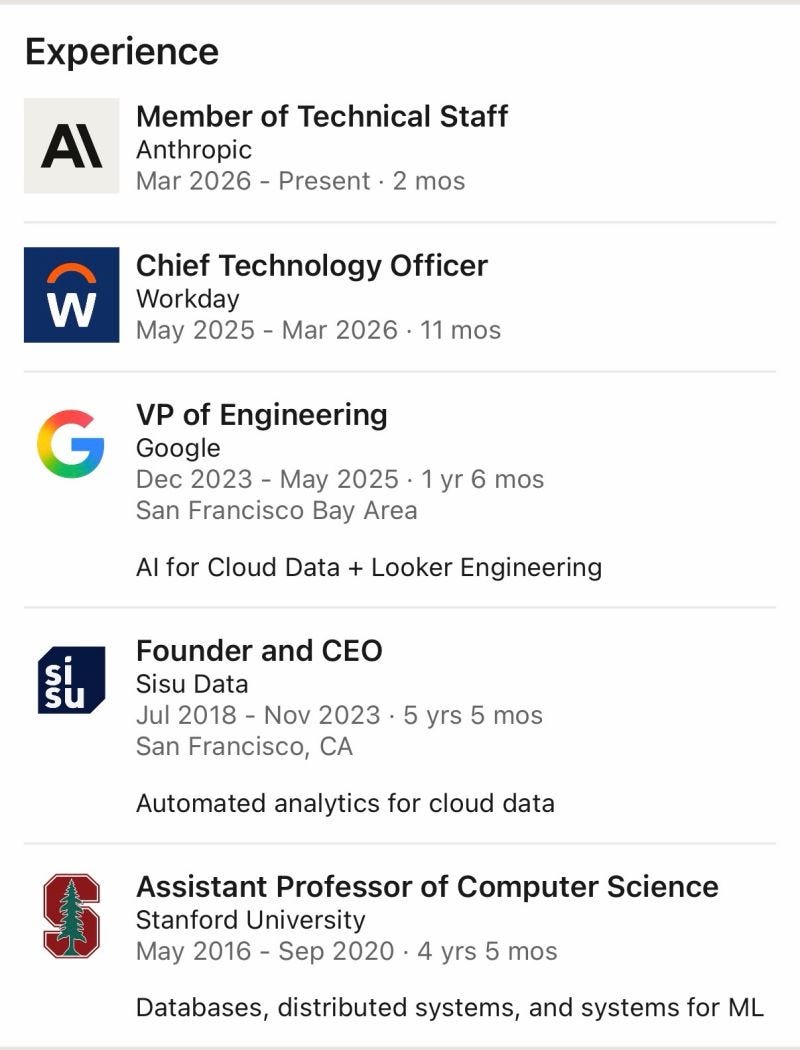
These are not people who ran out of options. They had the equity, the titles, and the institutional authority that most of corporate America spends a career climbing toward. They traded all of it for something the org chart can’t price: proximity to the work, without layers of management between them and the frontier.
How did we get here?
A story in five (short) parts.
I. Middle Management’s Disappearing Act
Before we declare anything dead, it helps to remember why it was born.
Middle management isn’t a conspiracy to inflate org charts. It’s a solution to a real problem: information doesn’t move through large groups of people on its own. Once a company grows past the size where one person can see everything, coordination becomes the bottleneck — who’s working on what, what’s blocked, what the priorities are, what the front line is seeing that the C-suite isn’t.
Managers were the routing layer. They aggregated context from below, relayed strategy from above, and kept everyone pointed in the same direction. In theory.
However, AI has changed the game completely.
When Meta laid off roughly 8,000 people earlier this month — about 10% of the company — the internal memo didn’t frame it as cost-cutting. Zuck said people appreciate “the ability to take greater ownership and execute their vision with less bureaucracy and management to navigate.” The CEO of one of the largest companies on earth described middle management as something to be navigated around.
Companies have been flattening since the 1990s — reengineering, enterprise software, cloud collaboration tools — and each wave widened spans of control. None eliminated the function, because something still had to do the coordinating, and that something was a human being. Until now.
II. AI Is Compressing Coordination Costs
The principle is simple. The fewer coordination bottlenecks you have, the fewer managerial layers you need.
What you get instead is the trio every restructuring memo now reaches for: flatter orgs, wider spans of control, more autonomous workers.
The numbers are getting absurd in places. Across Meta, the average span of control has climbed to roughly 14 and is still rising, with some managers carrying 90 direct reports. Inside Meta’s Superintelligence Labs — the most AI-forward corner of the company — spans have reportedly stretched to 50 to 1.
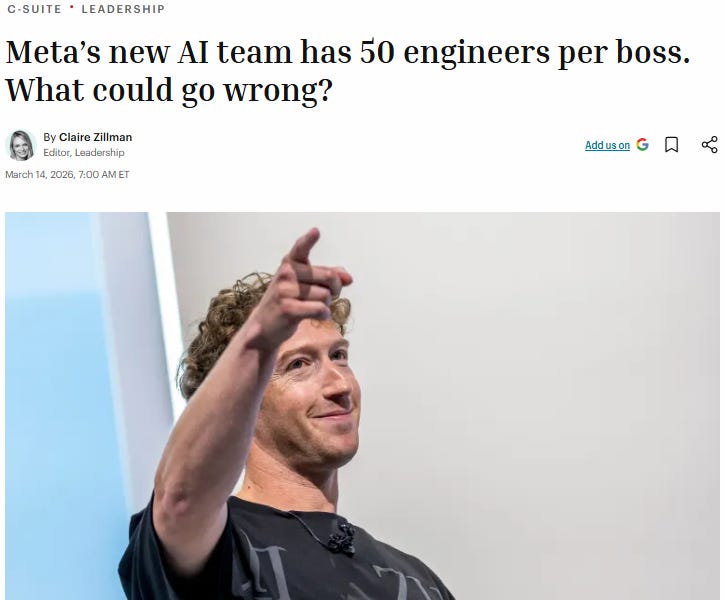
A 50-to-1 ratio is double the 25-to-1 ratio that is usually seen as the “outer limit” of the so-called span‑of‑control scale. What could go wrong?
III. The Return of the High-Leverage IC
Suddenly, being an IC is the hottest job in tech. Founders back coding with AI: Mark Zuckerberg, Garry Tan, and Jerry Liu from LlamaIndex.


When AI absorbs coordination overhead, it doesn’t just remove managers. It changes what a single talented person can do.
One great individual contributor can now analyze faster, execute faster, synthesize faster, and communicate faster than an entire small team could a few years ago. The research that took a week takes an afternoon. The deck that needed three people needs one. The report that waited on a chain of reviewers ships in a morning.
AI doesn’t just automate labor. It amplifies agency. Early-stage startups have always punched above their weight for the same reason — smaller teams, higher output, less bureaucracy.
Turn out, the pyramid was in many ways an artifact of expensive coordination. Make coordination cheap, and any high-agency individual — regardless of whether it’s a junior sales rep or CEO — can become the most valuable unit in the company again.
IV. So Why Are the CTOs Running for the Exits?
For decades, the conventional wisdom in tech was that an IC’s impact could only scale so far — to do more, you had to manage more. Recent evidence seems to indicate that’s no longer the case. Three reasons why:
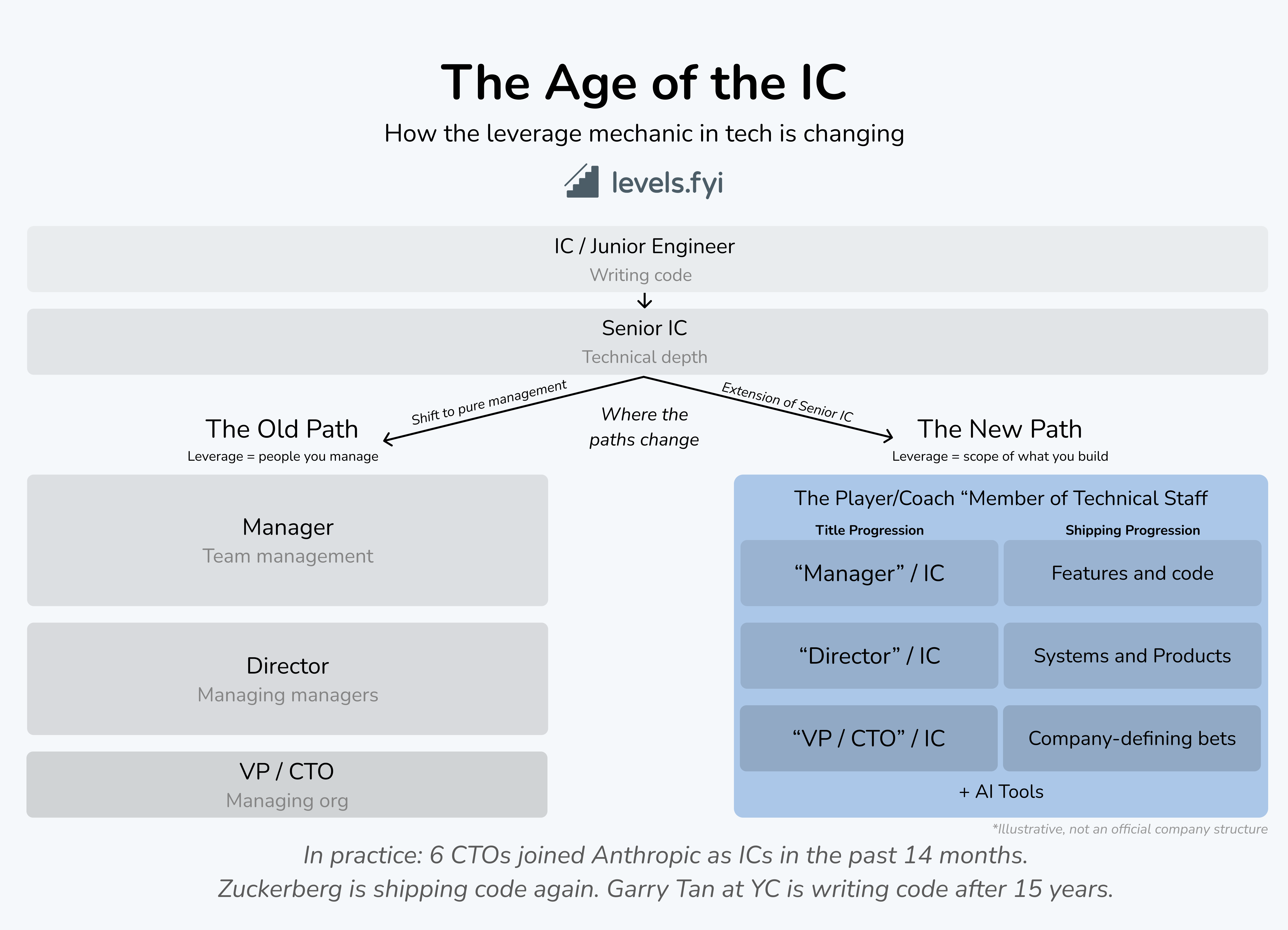
Leverage beats span. The move isn’t seen as a demotion, but rather a bet on impact. In the AI era, the people closest to model training and research agendas hold more leverage than the ones managing large enterprise teams.
The flat structure is the point. Anthropic’s “Member of Technical Staff” designation deliberately avoids heavy management layers — and at top-tier compensation (base salaries roughly $300,000 to $405,000, with substantial equity), the roles are financially competitive with C-suite packages. You give up the title, not the upside.
Everyone wants to be at the frontier. With figures like Karpathy joining pre-training to use AI to accelerate AI’s own development, the most ambitious technologists want to be on the front lines of the work itself — not two layers removed, approving someone else’s roadmap.
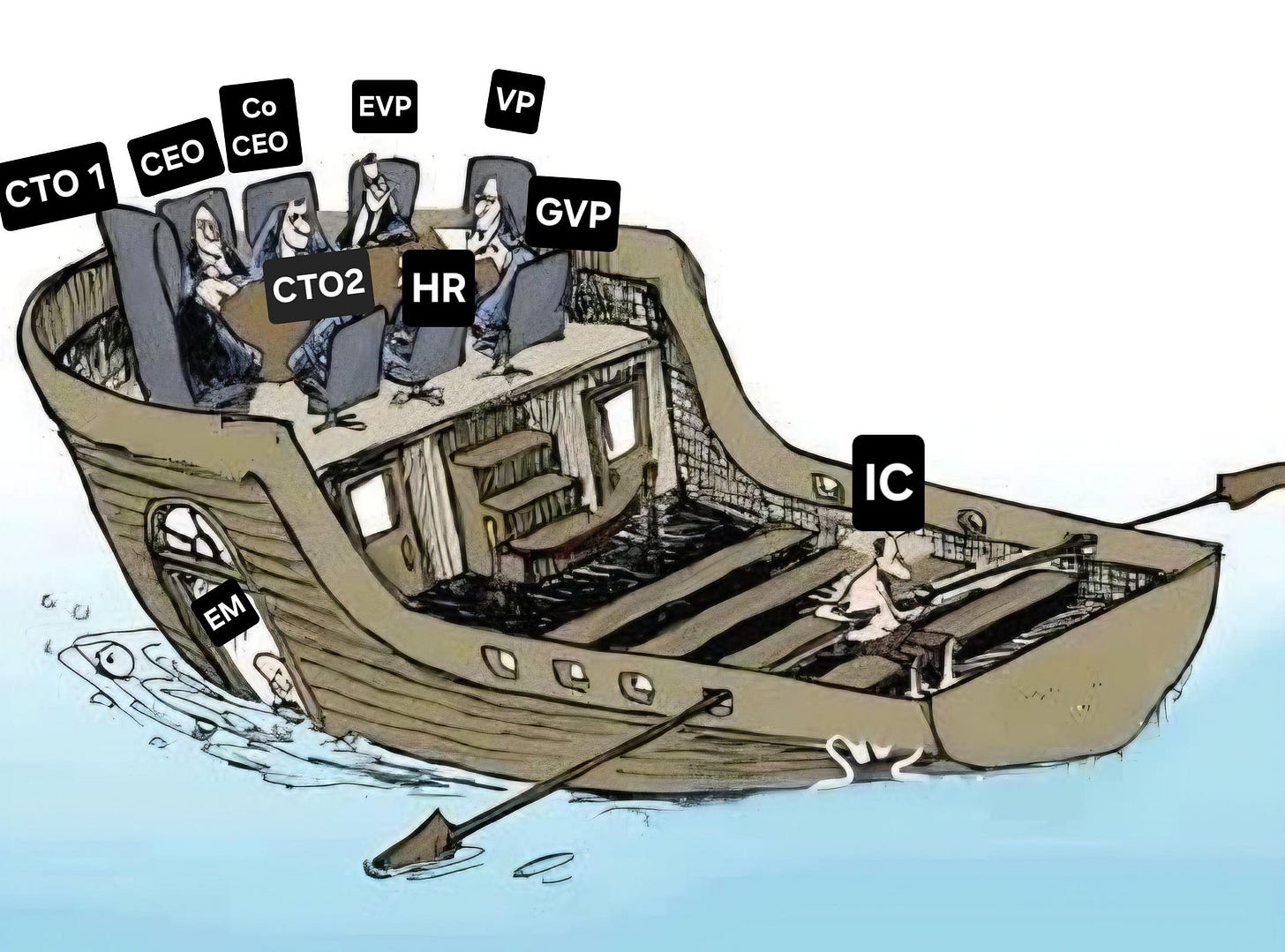
The whole leadership team is aligned on direction. The IC is the direction.
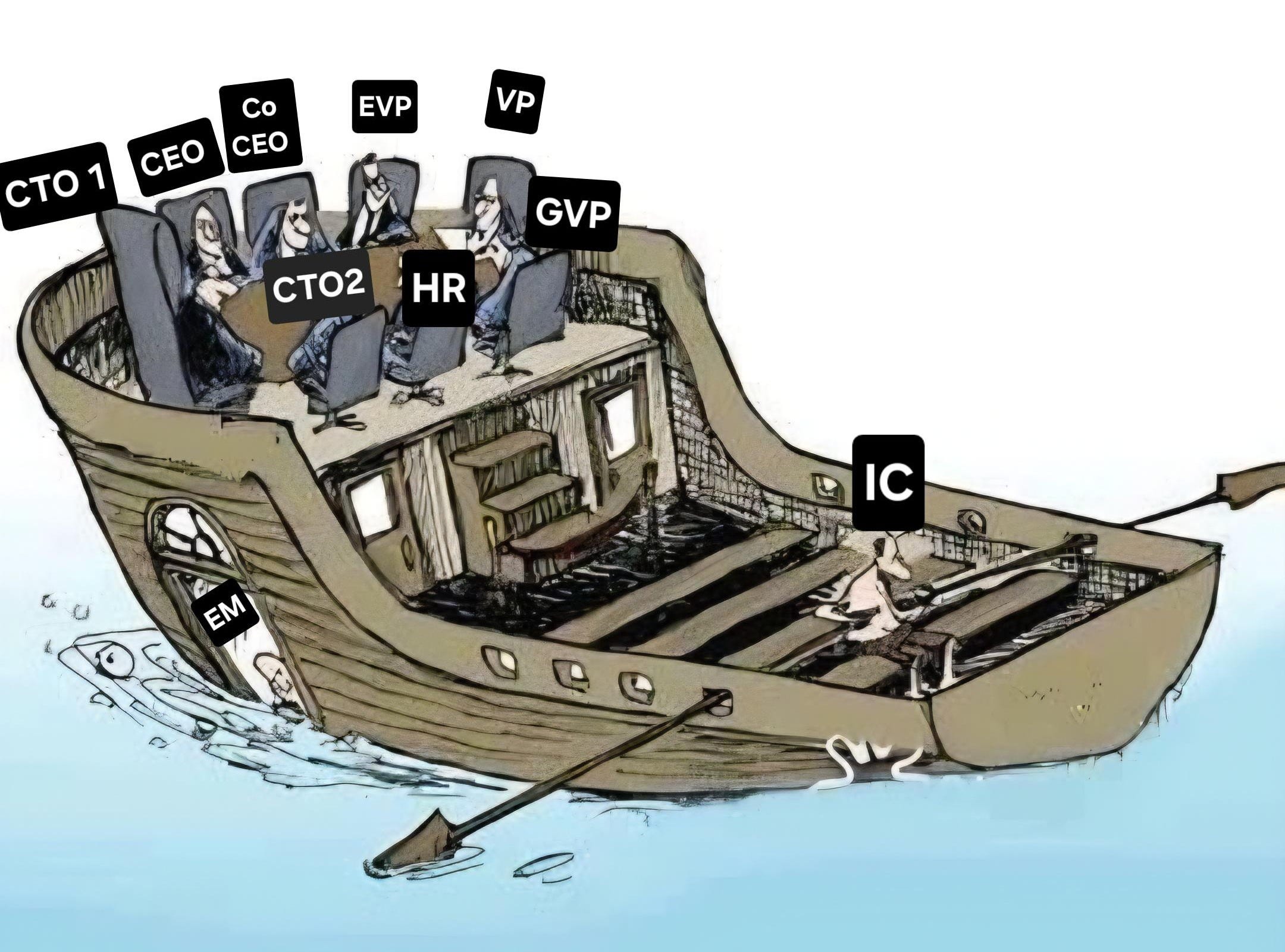
V: What Risks Lie Ahead if Everyone is an IC?
Here’s the problem with optimizing away the middle of the pyramid: Companies may accidentally optimize away the very people who teach other people how to grow.
Entry-level work traditionally was an exchange: the junior did the grunt work — the research, the first drafts, the modeling, the documentation — and in return got reps, feedback, and mentorship. But what happens if there’s no one left to teach?
Wharton researchers call the thing we’re losing “cognitive apprenticeship” — people learn complex skills through observation, guided practice, and the gradual assumption of responsibility. Take venture capital - it’s widely known for its apprenticeship model of learning.
The traditional method of learning VC on the job is by working under senior partners, shadowing investment decisions, and learning by doing.
The apprenticeship model in VC has survived for decades because it’s critical for a firm’s survival: every generation of GPs has to produce the next one, or the firm doesn’t outlive its founders.
But what happens when there’s no one left to train the next generation of GPs? Is the next crop of Forbes Midas List investors supposed to learn the craft from AI agents?
Flattening an organization is easy. Rebuilding a severed talent pipeline is not. Just ask Disney, or GE — two companies that spent the last decade learning what happens when succession breaks.
Disclaimer: The information contained in this article is not investment advice and should not be used as such. Views expressed are my own and should be considered as such, and are not the views of NextEra Energy Investments (NEI) or NextEra Energy (NYSE: NEE).