


DeepSeek has been all over the news recently. But why should you care? I answer eight key questions.
Q1: What is DeepSeek?
A. DeepSeek is a Chinese AI research lab, similar to OpenAI, founded by a Chinese hedge fund, High-Flyer. One of the co-founders of High-Flyer, Liang Wenfeng, founded DeepSeek as a side project initially, before eventually turning his passion project into a full-fledged company.
Unlike most other major foundation models, except for Meta’s Llama family of models, DeepSeek’s AI models are open-source and can be used by anyone for commercial purposes. It has released several families of models, each with the name DeepSeek followed by a version number.
The recent excitement has been about the release of a new reasoning LLM called DeepSeek-R1. DeepSeek-R1 is a modified version of the DeepSeek-V3 model that has been trained to reason using “chain-of-thought.” In very simple terms, this approach teaches a model to show its work by explicitly reasoning out, in natural language, about the prompt before answering. This chain-of-thought approach is also what powers GPT o1 by OpenAI, which was currently the clubhouse leader for answering math, science and programming questions. However, DeepSeek-R1 compares extremely favorably, which being cheaper and fully open-source for anyone to use.
Bottom Line: DeepSeek appears to be just as good as household names like ChatGPT. The AI Arms Race just heated up.
Q2: I’ve never even heard of DeepSeek before recently. Why is everyone talking about it?
A. There are three main reasons for all the fuss around DeepSeek-R1's release.
The Cost: Without a doubt, the biggest news that DeepSeek-R1 used reinforcement learning to equal OpenAI o1’s performance – at 95% less cost. DeepSeek R1 allegedly cost less than $6 million to develop, which is a fraction of the costs incurred by leading AI players such as OpenAI and Anthropic (and yes, the word allegedly is doing a lot of work there).
The Neverending US-China Arms Race: Second, DeepSeek showed that China's AI capabilities are much closer to the U.S. than previously thought. DeepSeek-R1 initially sent US stocks plunging because investors were spooked by the idea that a Chinese company could match or outperform leading US companies at a fraction of the cost (allegedly ~$6 million vs $100 million+ for Chat GPT-4).
The Decision to Open-Source: The final cause of excitement is that DeepSeek is open source. The company’s open-source model weights are available at Hugging Face. The company’s newly released DeepSeek-V3 and DeepSeek-R1 models are licensed under the MIT license, the same permissive software license also used by notable projects such as Ruby on Rails, .NET, and React. The main benefit for developers is that it will be much cheaper to use than using OpenAI’s GPT o1, if deployed efficiently on your own hardware.
Bottom Line: By leveraging open-source tech, DeepSeek has opened up new use cases not possible with closed-weight models like OpenAI, simply due to cost alone.
Q3: Is DeepSeek free to use?
A: Yes, the web version is currently free to use. DeepSeek’s open-source models can be used on smartphones and PCs.
Note: The API requires payment, but the pricing is still very affordable. DeepSeek provides two main models that you can use through an API:
DeepSeek-V3 (deepseek-chat): A generalist model trained on a massive amount of text (15 trillion tokens).
DeepSeek-R1 (deepseek-reasoner): A model designed for advanced reasoning, math, and coding tasks.
Bottom Line: Yes, it’s free, and you should try it (unless that’ll get you into trouble at work, then maybe don’t).
Q4: Does this mean you don’t need billions for AI models anymore?
A. Yes, and no.
I don’t think that DeepSeek-R1 means that AI can be trained cheaply and without expensive chips. The widely reported $6 million number figure is fairly misleading, as many folks smarter than me quickly pointed out that the $6M figure covers only the final training run (the true figure is much higher when you factor in Capex and R&D). Regardless of the true cost, it’s a wakeup call to Silicon Valley. As it relates to training costs for AI development, there are two key lessons to take away from R-1’s launch:
Second-Mover Advantage: DeepSeek is a classic case of the benefits of second-mover advantage, one of the first lessons MBA students learn in their Innovation classes (RIP to Clay Christensen, HBS Legend). By basing their work on existing research from OpenAI, Anthropic, and Llama and others, DeepSeek was able to leverage huge second mover advantage.
Time to Rethink AI Scaling Laws: Regardless of what you believe R-1’s true cost to be, DeepSeek has definitely shown that previous training methods were horribly inefficient. In the pre-DeepSeek era, the prevailing thinking was that scaling AI models was solely about adding more GPUs and using more electricity. That myth has been debunked in spectacular fashion, and frankly, we might all be better off. Don’t be surprised if the next round of models from U.S. companies will be trained more efficiently and achieve better performance.
Bottom Line: Suddenly, US Big Tech companies and investors shelling out hundreds of billions of dollars into training AI models doesn't look quite so smart. DeepSeek’s achievements suggest that efficiency will now become critical.
Q5: Does DeepSeek’s release mean it’s “game-over” for US Big Tech & AI Leaders?
A. Probably not.
DeepSeek is a gamechanger because it made it easy for anyone to access world class AI models by going open source. However, R1 is not really a fundamental advance in technology, per se. More accurately, it’s an impressive advance in training efficiency. Don't get me wrong - it's still unbelievable - but it was always going to be far more efficient to recreate something like GPT o1 than to train it the first time. As noted above, that's the beauty of second-mover advantage. In a few weeks, I’m sure OpenAI or Anthropic will release their next ground-breaking products and its “ball up top”.

The story is similar for US technology companies, such as Meta and Alphabet. Many analysts were quick to conclude that DeepSeek’s success proved that the US companies were not as valuable or advanced as previously believed. However, this concern is likely also overblown. The real paradigm shift is that DeepSeek has gone fully open source - it will be critical for companies like Meta and Alphabet to also embrace open-source at the expense of their beloved closed-source strategies.
Many are worried about what DeepSeek means for NVIDIA's future. But as you’ll see below, NVIDIA has been the subject of many large sell-offs over the years, and yet it has still managed to bounce back each time.
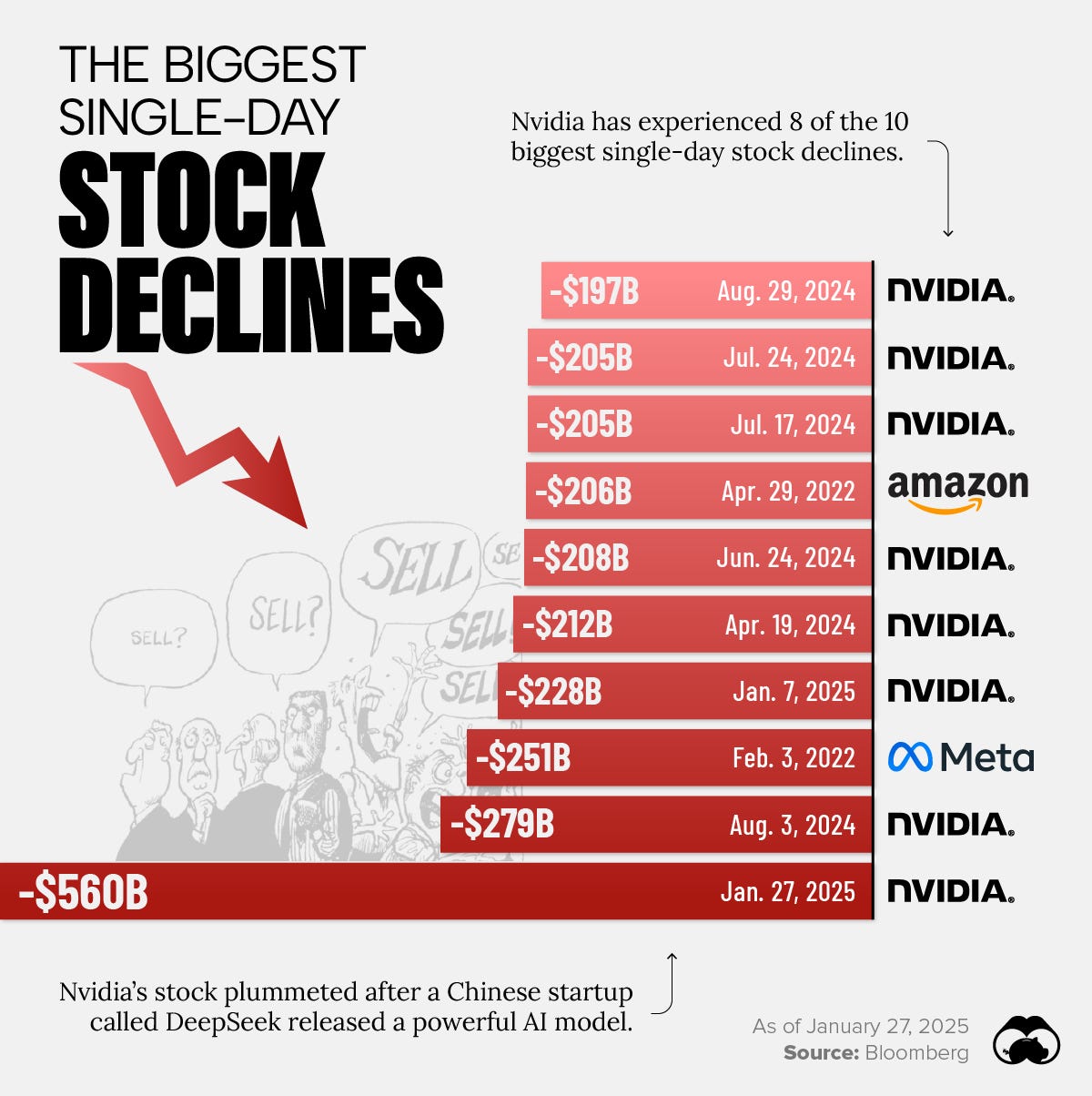
Investors are worried that DeepSeek's cost-efficient methods will throttle demand for the high-performance GPUs that NVIDIA makes. From the minute the DeepSeek panic first swept across the internet, I've never understood this reaction, for two key reasons:
AI Success Takes More than One Run: At the risk of stating the obvious, AI development isn't just about a single training run, it involves experimentation, continuous improvement, and rapid iteration. Training an AI model is like a massive chemical experiment or cooking class, where access to compute allows firms to use and try many different recipes before landing on a final formula they love the best (yes this is a terrible analogy, I know).
Inference Remains Part of the Equation: Even if AI models can be trained more efficiently, putting these models into production still requires a crazy amount of compute, especially chain-of-thought models that simulate human reasoning. We always knew the focus would eventually shift from training the best models to deploying them efficiently – we just didn’t realize this would happen overnight. DeepSeek’s influence will force the market to focus on inference efficiency (i.e., lowering costs) – something many were already predicting. And for now, at least, the U.S. still has a huge advantage in deployment.
By the way, do you know who makes specialized chips for AI deployment workloads, like the H20? You guessed it: NVIDIA.
Bottom Line: The concerns about an “Extinction Event” for Big Tech overblown. DeepSeek is not suddenly going to destroy NVIDIA, OpenAI and Meta - regardless of the reaction from US markets.
Q6: If I use DeepSeek, will my data be sent to China?
A: Well this one is interesting - it depends. Let me explain:
If you download the DeepSeek mobile app or use DeepSeek’s official services (chat.deepseek.com), your data will indeed be sent to China as stated in the User Agreement and Privacy Policy. By using these services, you are deemed to have agreed to the Terms and Conditions. (Read: Don’t do this)
However, if you access DeepSeek-R1 models via a serverless API in the cloud (i.e., via AWS or Azure), you’ll essentially get your own copy of the model, without your data going anywhere. (Note: Even if you’re using cloud providers, please still review their terms of service and privacy policies!!)
Bottom Line: DeepSeek can be accessed securely and will not magically steal your data and hand it over to the Chinese Gov’t – unless you willingly give it to them.
Q7: Should the US be worried about China?
A. Let’s not overreact. But maybe a little bit?
Q7: Part I - Failed Export Controls & Closed-Source Mistakes
Given the state of current US relations with China, it’s clear Deepseek struck a nerve with Washington and Silicon Valley in particular. Of course, just like with TikTok, there are legitimate data privacy concerns with using an AI app from a Chinese company. It is likely you’ll soon see US lawmakers push for some sort of China-specific regulations, such as stricter export controls, and large corporations banning DeepSeek from company devices over China concerns. While this type of cautious approach is understandable short-term, it may prove unwise long-term.
Just as our export controls on AI chips proved ineffective, additional regulations may again have an adverse effect – diamonds are born under immense pressure, as they say. Plus, haven’t we learned anything from the embarrassing and much-ado-about-nothing Tik Tok ban?! It’s clear that the Chinese Government is not afraid to call our bluff - just like Chinese startups aren’t afraid of their US tech counterparts.
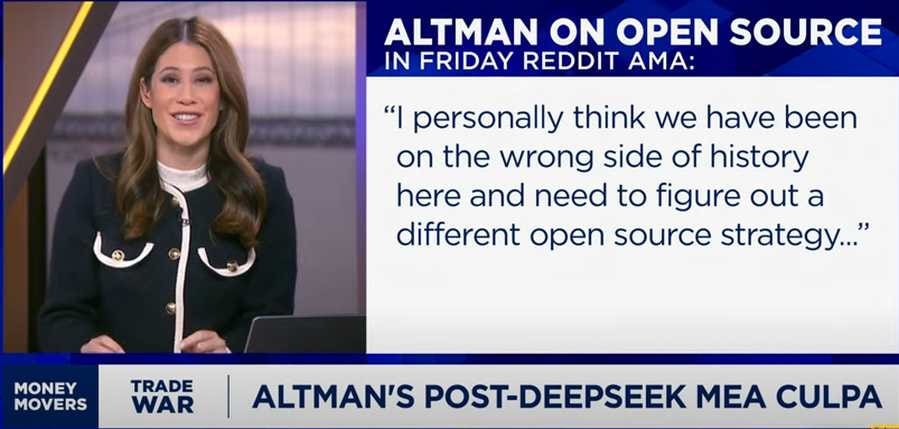
China’s embrace of open-source is exactly what has allowed it to evolve into a global force that's reshaping the AI landscape. Instead of adding restrictions, the US should really take this time to re-evaluate its increasingly closed-source corporate innovation culture in order to promote faster AI advancement. In a stunningly candid admission, OpenAI CEO Sam Altman recently admitted the company made a major mistake by not open-sourcing its AI models sooner.
OpenAI is ‘on the wrong side of history’ and ‘needs to figure out a different open source strategy’
Source: Sam Altman, Reddit
OpenAI originally positioned itself as a nonprofit research lab focused on developing safe and beneficial artificial general intelligence (AGI). Over time, however, the company shifted its business model, emphasizing closed-source proprietary models like ChatGPT.
Similarly, companies such as Alphabet and Meta, despite externally promoting open-source initiatives, still rely heavily on closed-source (and, ahem, copycat) strategies that limit broader access and collaboration.
Bottom Line: The export restrictions were ineffective - or even worse – may have backfired by allowing China to develop a big innovation in cost-effective AI development. Let’s not make the same mistake again.
Q7: Part II - the Mistral AI Story
History also shows that one victory does not mean that China will automatically dominate the US going forward. You might remember a company called Mistral AI, which people once thought would be the end of OpenAI. It serves as an interesting test case:
In December of 2023, the French startup released Mixtral 8x7b, a mixture of experts model (SMoE) with open weights that received lots of hype, as it was believed to rival or surpass closed-source efforts from OpenAI & Anthropic. Microsoft even decided to fan the flames when it announced it was investing in the Paris-based startup in February 2024.
However, surprise surprise, its US-based rivals simply adopted many of the insights from Mixtral 8x7b and got better. Second mover advantage strikes again. Since then, Mistral AI has been a pretty minor player in the foundation model space.
Bottom Line: David doesn’t always beat Goliath.

Update: It seems that Mistral heard the slander and is trying to make a comeback. The tea is hot.
Q8: What does this mean for early-stage investors and founders?
A. My bet is that a rising tide lifts all boats.
In the startup world, innovation is the lifeblood that fuels growth and success. And when you're someone who works closely with AI startups like me, it's very exciting to see cutting-edge, open-source models get released. This allows smaller companies and startups to compete with the big tech companies. This drives innovation.
From an early-stage AI perspective, there are three obvious winners:
Stock Up: AI Application Layer: The biggest winner are app-layer startups, who for most of 2024 were mocked as being “Chat-GPT wrappers”. Long-term, it’s also becoming clearer where the economic value will increasingly accrue in the AI sector. The cost of serving tokens will likely converge on the cost of the underlying infrastructure plus only a small margin. Vertical AI applications, domain-specific models, and AI tools built for horizontal, functional-specific use cases will all likely see massive boosts to their long-term prospects.
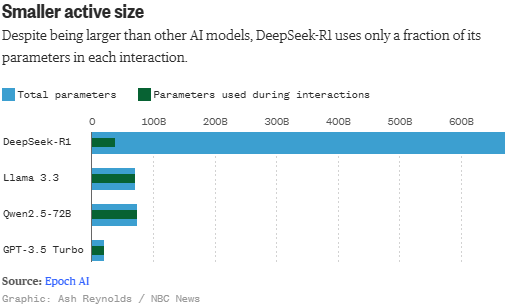
Stock Up: Companies with a “Model Agnostic” Ethos: Flexibility is a key advantage of model-agnostic tools, and the rapid pace of AI development - with new models seemingly in the headlines each week - was always a major reason to go this route. But DeepSeek's emergence further underscores the importance of having a model agnostic architecture that lets you plug different AI models into your stack. The ability to get the efficiency gains from using various LLM players ensures your architecture is cost-efficient and competitive. Just look at the incredible chart below - somehow, DeepSeek is punching above its weight with a large, powerful model that runs just as well on fewer resources.
Stock Up: EVERYONE: When the cost to train and deploy AI models drops significantly, everyone wins. DeepSeek’s emergence means that its competitors will eventually need to follow suit and drop their prices. Also expect to see more open-source models in the future, which benefits the global AI community.
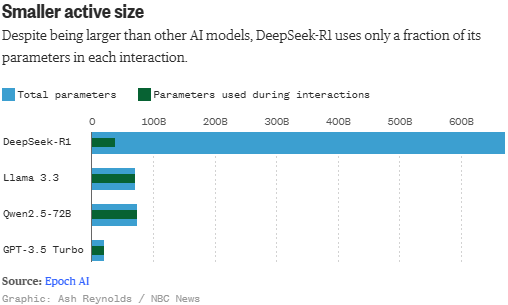
Bottom Line: Cutting-edge AI development and deployment may be within the reach of many more organizations than we previously thought possible.
CONCLUSION: So, Big Deal or Not?
A: Big Deal. China's DeepSeek appears to have built AI models that rival OpenAI, all while using significantly less cash, chips, and energy. So yes, it's a very big deal.
Go Deeper: My Favorite Resources for Furthering Reading on DeepSeek
No Hype DeepSeek-R1 Reading List (Oxen.AI) [Why I Like It: A cool list of academic papers meant to be slowly digested, not while scrolling social media.]
DeepSeek R1 and the Future of AI Competition with Miles Brundage (ChinaTalk Podcast): Here from Miles Brundage, a six-year OpenAI veteran who ran Policy Research and AGI readiness, about why all the “AI Influencer” DeepSeek takes are so terrible and what’s really happening in China.
Bonus: The Inference Landscape (Generative Value) [Why I Like It: As mentioned above, DeepSeek has accelerated the market towards inference in a huge way. This provides a great breakdown of the major players in the landscape.]
On Deck: A short preview of what’s to come.
This week: We introduced DeepSeek, the Chinese AI startup that’s made headlines recently, and answered a few key questions.Next week: We’ll explore What DeepSeek means for Enterprise AI efforts.
Coming soon: Busting myths about Agentic AI in the workplace.
Disclaimer: The information contained in this article is not investment advice and should not be used as such. Investors should do their own due diligence before investing in any securities discussed in this article. While I strive for accuracy, I can’t guarantee the accuracy or reliability of this information. This article is based on my opinions and should be considered as such, not a point of fact. Views expressed in posts and other content linked on this website or posted to social media and other platforms are my own and are not the views of NextEra Energy Investments (NEI) or NextEra Energy (NEE: NYSE).