


Key Findings
Miro sold to Bending Spoons for $1.36 billion, a 92% discount to its $17.5 billion 2022 valuation, Bending Spoons’ second billion-dollar deal in five weeks.
In August, I ranked Miro fifth on the SVI at 23/30 and named Bending Spoons as the likely buyer. My $2–3 billion valuation estimate came in high.
Miro was healthy: profitable, $435M net cash, 4 million paying users, 99% of the Fortune 100.
Testing a seventh SVI factor for November: Self-Cannibalization, whether management guts its own product before AI does. Intercom proved it works: it sacrificed $60 million in legacy ARR for Fin, which Salesforce agreed to buy for $3.6 billion in June 2026.
In the November SVI update, expect Grammarly to be in danger of a perfect 30/30 score. Other Vulnerable companies include Notion, ClickUp, Monday.com, and HubSpot, while Asana and ZoomInfo join Grammarly in High Vulnerability.
The SVI Never Lies: Miro’s Exit for a Heavy Discount Proves It
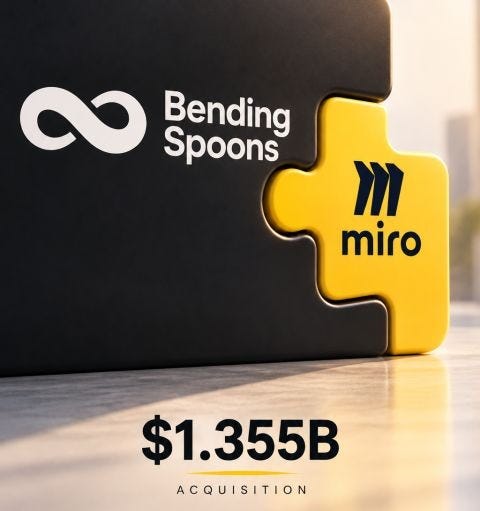
On Thursday September 10th, Bending Spoons agreed to buy Miro for $1.36 billion in enterprise value. That’s a 92% discount to the $17.5 billion valuation ICONIQ Growth set when it led Miro’s Series C in January 2022.

I called this one before it happened. In The Airtable Collapse, I ranked Miro fifth on the SaaS Vulnerability Index at 23/30 and named Bending Spoons directly as a likely buyer. I got the price wrong, but not in the direction you’d expect: I guessed too high.
Miro Didn’t Need to Sell
What’s crazy is that Miro, by all accounts, is not a bad or struggling business. Miro got to $600M ARR, raised $500M, and still had $435M in cash in the bank.
Prior to the $400M Series C led by ICONIQ at a $17.5B valuation, the company had only raised about $75M to date.
So why accept an offer from Bending Spoons, a company founded 2 years after Miro in 2013, at only a ~2.3x ARR multiple? Well, clearly the founders saw the writing on the wall. This company was vulnerable, and likely saw this as the least worst option.

The SVI Score, Revisited
Here’s what I wrote in August, scoring Miro against the six SVI factors:
🟠 Vulnerable (SVI 18–23)
Miro — SVI 23/30 🟠 A private-market name with Airtable-level valuation risk. ARR of ~$665M growing 5.6% year-over-year, against a $17.5B valuation set in January 2022. The company’s valuation has been unchanged for 4 years, while the company laid off 18% of its workforce in late 2024. Visual collaboration retains genuine value, which keeps the score at 23 rather than higher, but if Miro needs to raise or exit, the markdown could get ugly.
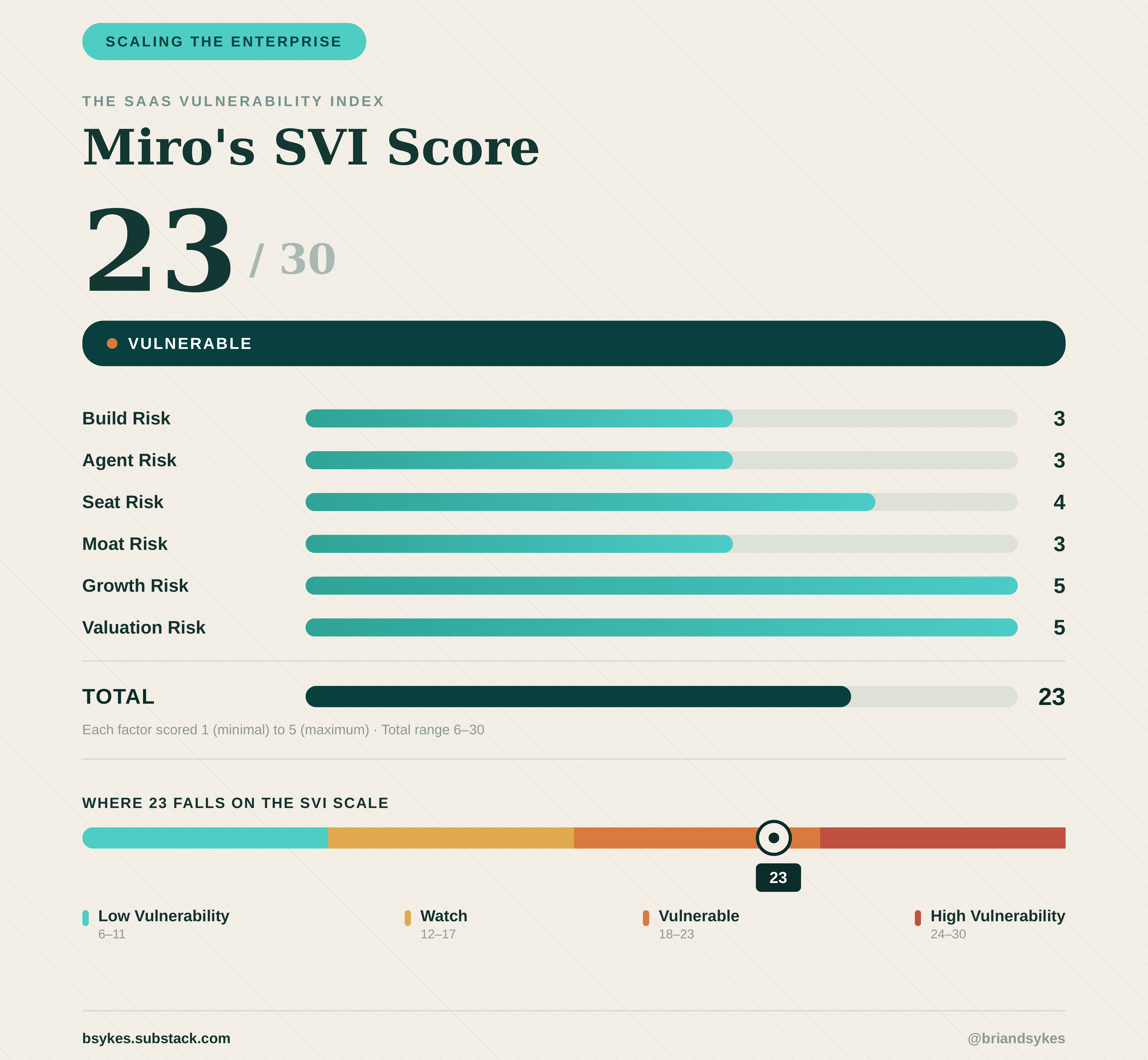
The score was a repricing call, not a bankruptcy call: solid revenue, a decelerating growth rate, and a valuation stuck in January 2022, and that’s exactly what happened.
The Miro Math
Let’s break down the Miro x Bending Spoons deal. The acquiror is paying $1.36 billion in enterprise value, or roughly $1.79 billion in equity value once you add back Miro’s $435 million in net cash. Some Miro shareholders are rolling $295 million of their proceeds into new Bending Spoons stock. Both boards have approved the deal, and it’s expected to close in Q4 2026.
Bending Spoons disclosed Miro’s ARR at approximately $600 million, with almost 90% of it coming from business and enterprise accounts. The $1.36 billion EV works out to 2.3x ARR, and the $1.79 billion equity value, which reflects net cash, works out to roughly 3x. For comparison, that same $600 million of ARR at the old $17.5 billion valuation would price out to nearly 29x.
The takeaway: Pricing a VC-round with an aggressive growth multiple can bite hard when it’s time to raise the next round. Gotta hand it to Gergely Orosz, author of the Pragmatic Engineer newsletter on Substack, for calling this on Twitter 4 years ago.


Miro Wasn’t a Bad Business
What’s funny is that if you squint your eyes, Miro is a very strong business. The company is profitable, holds $435 million in net cash, and serves nearly 4 million paying users out of 100 million total users across more than 250K organizations. Miro is used by 99% of the Fortune 100. It’s customer list includes: Best Buy, Deloitte, Dell, Shopify, Disney. Many users are emphatic supporters of the software and absolutely love the tool for everything from event planning to brainstorming to product managemnet. None of that looks and feels like a company in distress.
The Backstory
The company started life in 2011 as RealtimeBoard, a whiteboarding tool, before the pandemic turned it into a category leader: 5 million users to 30 million in two years, paying customers up 550%, integrations with more than 250 apps including Atlassian, Cisco, Microsoft, and Zoom. That growth is what justified the $17.5 billion Series C.
The company just never came close to living up to its immense expectations. And by 2026, it’s clear the market had run out of patience waiting for the company too.
What Miro had was a Covid-era valuation that it simply couldn’t catch up to.
Why Bending Spoons, Again
Bending Spoons’ M&A playbook and strategy is starting to become clear. The pattern is simple: buy cash-generating software businesses at compressed multiples, cut costs, run them as high-margin assets. Evernote. WeTransfer. Meetup. Vimeo. AOL. Airtable. Now Miro. The company says it has run this model for more than a decade and has never sold a business once it bought one, which is either a discipline worth respecting or a warning to anyone selling, depending on your perspective.
The other thing worth mentioning, this is actually a pretty decent outcome for Miro’s founders and investors. It’s likely that ICONIQ, its Series C lead investor, had already written down its position substantially. And because the company had seemingly stalled out on growth, with 5% YoY growth, its options weren’t great.

For Bending Spoons, Miro fits the model almost too well: roughly $600 million in ARR, a 2.3x enterprise-value multiple, 90% enterprise revenue, $435 million in net cash, and a profitable business that didn’t need a rescue. That’s one of the reasons I had predicted this outcome (a sale to Bending Spoons) in my August post on The Airtable Collapse: Which SaaS Companies Might Be Next?

What both CEOs said. Miro’s Andrey Khusid, who co-founded the company 15 years ago as RealtimeBoard, called it “an AI-first workspace that teams run their most important work through,” with more than 750 customers generating over $100K each in ARR. Bending Spoons’ Luca Ferrari called the deal “a privilege, and no small responsibility,” and said the plan is to invest in the fundamentals customers already value: performance, reliability, functionality. Neither man used the word “markdown.”
The Investors Who Backed the Peak
ICONIQ Growth led Miro’s $50 million Series B in 2020 and came back to lead the $400 million Series C that set the $17.5 billion mark in January 2022. Journalist Eric Newcomer’s reporting on that round, resurfaced this week, puts ICONIQ’s ownership stake at 16.2% following the Series C, alongside Accel and Salesforce Ventures. Every investor who wrote a check into a Covid-era software company at a Covid-era multiples is running this same math on their own portfolio right now. However, the good news for ICONIQ is that numerous sources have reported that due to a liquidation preference, Series C investors will at least get their money back in the exit.

Looking Ahead: The Q4 SVI Update
Rankings Update
The good news is that in November, I’ll be creating a Q4 Update for the SVI rankings. Expect new scores for existing companies, and new companies altogether based on recent developments in the market.
Some companies will trend up, others will trend down for various reasons. For example, Grammarly might be the first company to ever earn a perfect 30/30 score when we revisit these rankings in our November update. Every time a Frontier AI Lab ships a new feature that helps with writing, I can feel the groans from the Grammarly SF office.
What the Next Version of the SVI Will Measure
Self-Cannibalization
In the next rankings update, I’m testing a seventh factor, Self-Cannibalization, on the next batch of companies before deciding whether it earns a permanent place in the SVI. Self-Cannibalization refers to the idea of whether management is willing to cannibalize its own product with a new AI-native product before someone else does it for them. Ironically, Miro actually tried this, acquiring Reforge in March 2026, repositioning itself as an “AI Innovation Workspace,” and shipping AI assistants and connectors pulling context from GitHub, Jira, and Slack. Unfortunately, none of it changed the outcome, but it’s a different kind of company than one that did nothing.
One great example of a company that has executed this vision successfully: Intercom.
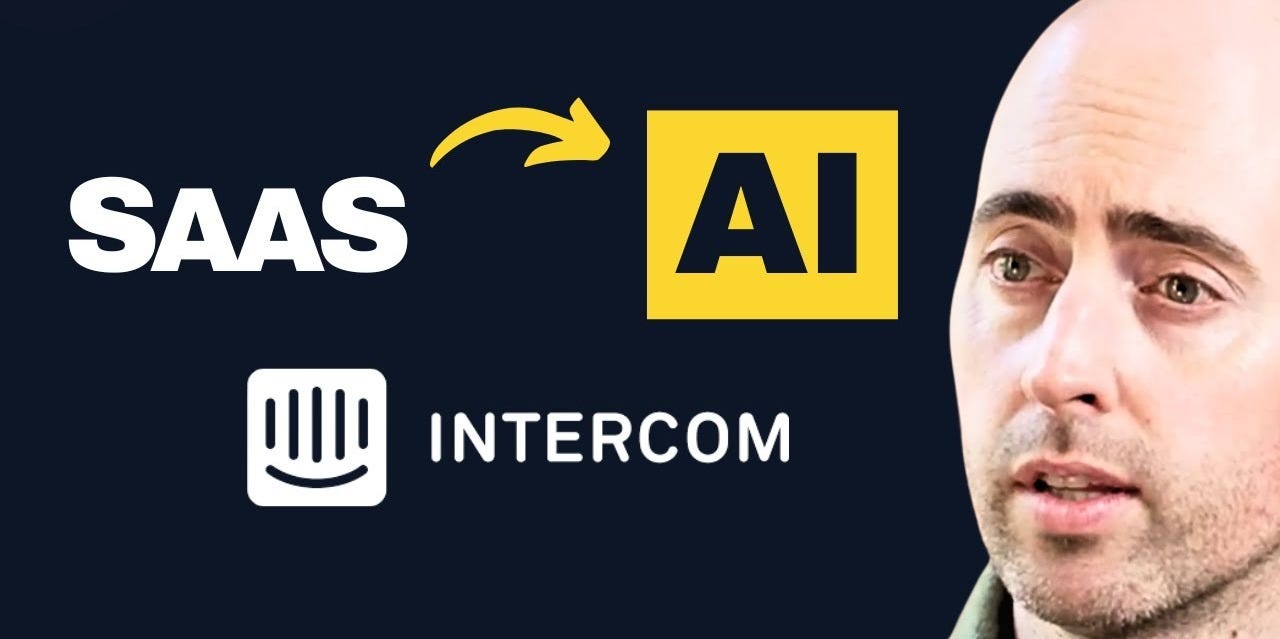
Intercom (later rebranded as Fin) executed a massive corporate turnaround by sacrificing $60 million in legacy seat-based ARR to pivot completely to an AI-first model powered by its autonomous customer service agent, Fin AI Agent.
Getting there meant making some hard choices along the way:
Board: Rebuilding the board with startup operators instead of veteran SaaS executives
R&D: Shifting nearly 80% of R&D onto Fin while it was still a single-digit share of revenue
Layoffs: Cutting close to 40% of the workforce along the way.
Name: Rebranding the company entirely to Fin & buying a Fin.ai domain for $1M
Marketing: Pointing its paid marketing at the new Fin.ai domain for years before the revenue caught up
It worked: In June, Salesforce signed a definitive agreement to acquire Fin for ~$3.6 billion, showing that betting on self-cannibalization can actually pay off in a big way if companies are willing to go all-in. It’s an all-time enterprise SaaS turnaround story.
Who’s Up Next?
Notion, ClickUp, Monday.com, and HubSpot are still sitting in the Vulnerable band from the original index, for the same structural reasons Miro was: seat-based pricing, AI-exposed core workflows, and valuations set before anyone had to answer for what AI does to both. However, there are three companies at the top of the list in the High band of the SVI worth mentioning again below.
🔴 High Vulnerability (SVI 24–30)
Grammarly — SVI 27/30 🔴 The highest score in the cohort, edging above Airtable itself. The core product of writing assistance is now freely available inside every frontier LLM, natively, in the tools people already use. At $700M ARR and a $13B valuation (18.6× ARR), Grammarly’s brand retains real enterprise recognition, but the original moat is toast. That’s likely why the company rebranded as Superhuman to unite its writing tools, email, and documents into a single AI productivity platform. However, if it needs to raise or exit at current market conditions, it’ll be in trouble. A valuation correction is coming.
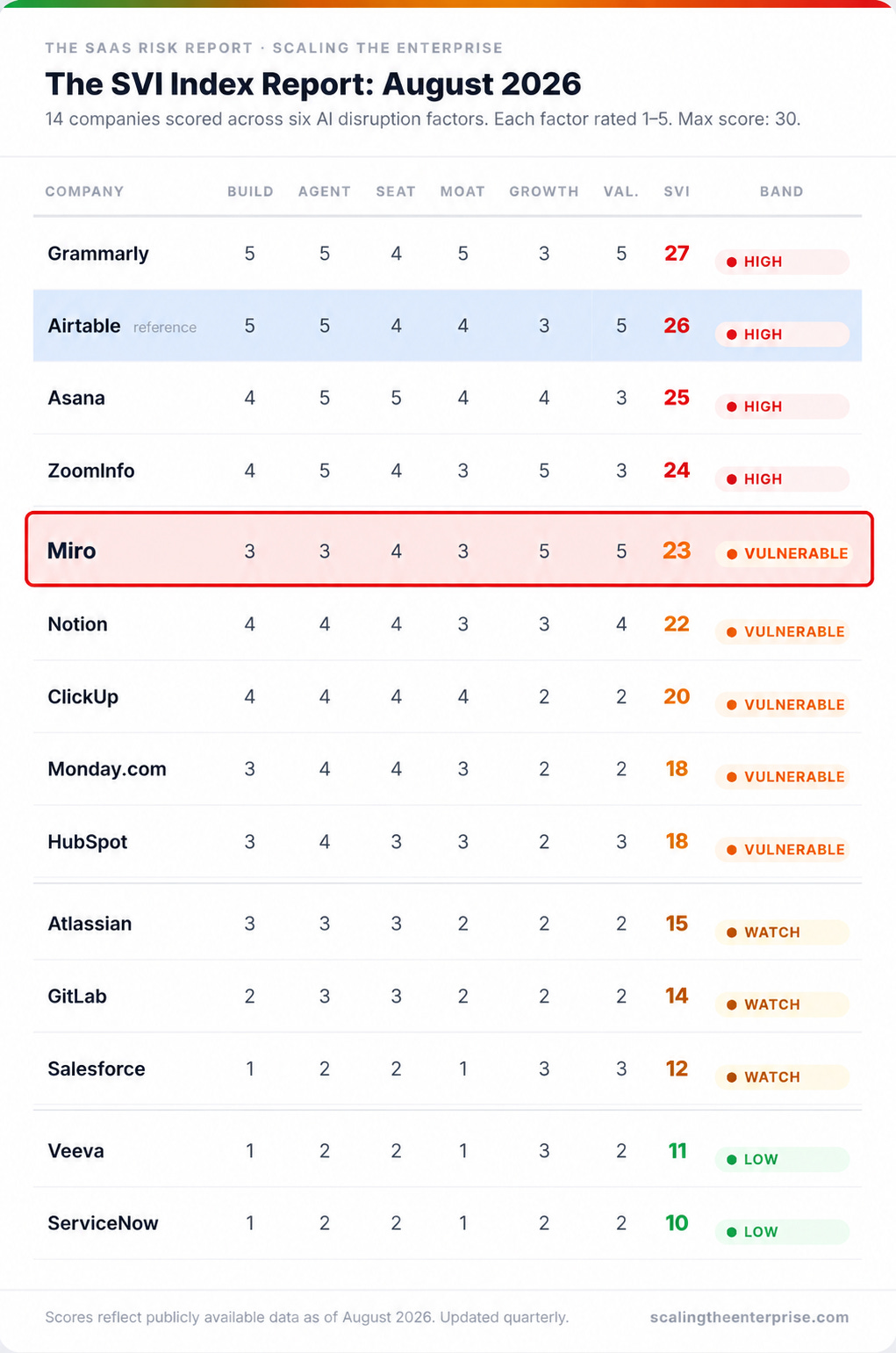
Just below Grammarly are Asana and ZoomInfo, two public companies that are actively getting disrupted by AI tools like Claude and Lovable.
Asana — SVI 25/30 🔴 The clearest public-market Airtable analog. Recent filings show FY2026 revenue of $790.8M, growing just 9.25% year-over-year from a base of $723.9M base. The stock is down ~36% in 2026 YTD to around $8.77. Task management, project tracking, and workflow routing are precisely what AI agents are built to handle autonomously.
ZoomInfo — SVI 24/30 🔴 The sharpest growth collapse in the cohort: ~1% revenue growth projected for 2026 on a $1.2B ARR base. ZoomInfo’s own language admits that “AI and agentic confusion” among buyers has impacted its business. Customers are shifting to internal AI tools, and AI-native competitors like Clay are closing in. B2B contact enrichment is exactly what AI agents assemble from public sources.
Airtable was the first data point. Miro is the second. They won’t be the last.
Disclaimer: The information contained in this article is not investment advice and should not be used as such. Views expressed are my own and should not be considered as the views of NextEra Energy Investments (NEI) or NextEra Energy (NYSE: NEE).