


In my last post, I introduced the SaaS Vulnerability Index: a framework for thinking about which software companies are most exposed to AI disruption.
The thesis was simple: if AI can make software easier than ever to make, does your software company still have a defensible moat?
Airtable failed that test. Its interface, workflows, schemas, and automations are exactly the kind of thing an agent can build easily, and Bending Spoons picked the company up for 2.7x ARR as a result. If you missed my last post, you can check it out below.

Workday, on the other hand, is a different beast. Even if you hate Workday, you’re probably stuck using it. As a legacy system of record, it’s hard to displace.
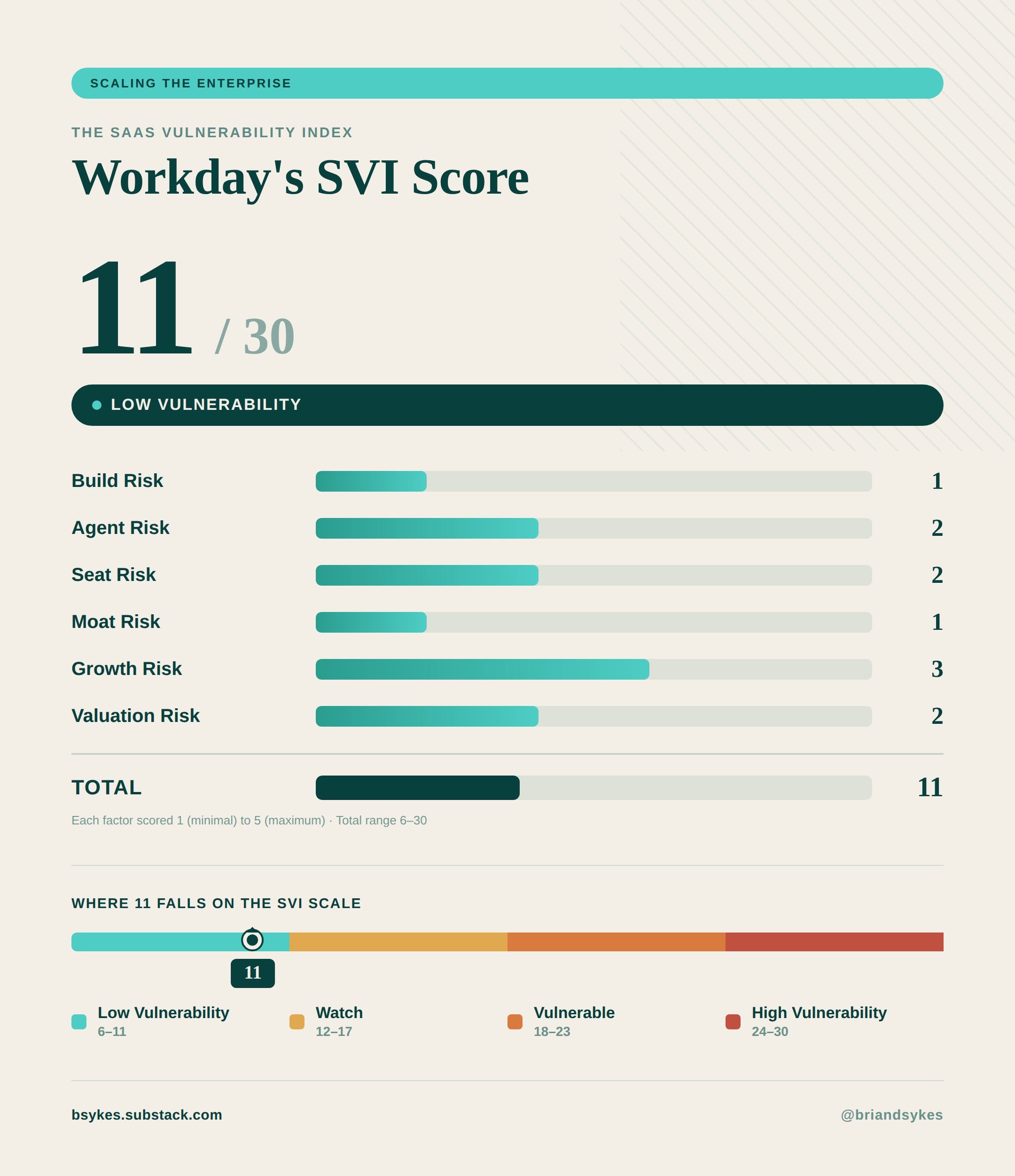
An SVI score of 11/30 is telling. While it doesn’t mean Workday is immune to competition, or the general software repricing happening right now, it does mean that it’s in a much stronger position than others. AI companies seeking to displace Workday will find a very formidable and scrappy opponent.
Workday’s Retention Numbers Deserve Your Respect
Retention, not revenue growth, is Workday’s calling card. The company enjoys 97% gross revenue retention (GRR) across more than 11,500 customers and 80 million users under contract. That means Workday keeps 97 cents of every contracted dollar every year, in a category where a customer can theoretically walk to a competitor or vibe-code a replacement. I say in theory, because in practice, they usually don’t.
The revenue scale backs that stickiness. $2.542B in Q1 FY27 revenue, up 13.5% year over year. $2.354B of that subscription revenue, up 14.3%. $27.3B in subscription backlog, with $8.8B of it converting to revenue over the next 12 months. This isn’t a workplace productivity tool that can be easily vibe-coded, it’s a core system thousands of organizations use to run critical functions like hiring, payroll, finance, and compliance, and its retention numbers are proof that switching costs are real.

For a legacy system like Workday, data is its strongest and most defensible moat. And when the company is devoting immense resources to making it both difficult and expensive for third-party AI tools to access its data, Workday is harder to walk away from than ever. Its $51 billion price tag is clear proof of that fact.
Until that changes, Workday’s customer success reps can keep resting easy, as customers will likely continue to renew each year for a long time.
Is Workday’s System of Record “Agent Proof”? Its CEO Sure Thinks So
Workday’s software may seem simple on the surface. But Workday’s user interface is just the part of the platform that’s visible to users. What sits underneath is harder to touch: employee history, compensation and payroll records, benefits and tax data, org hierarchies, approval chains, compliance rules, audit logs, financial reporting structures. A competitor can clone a UI in a weekend. Nobody is cloning a decade of institutional memory, careful workflow configurations, and regulatory edge cases.
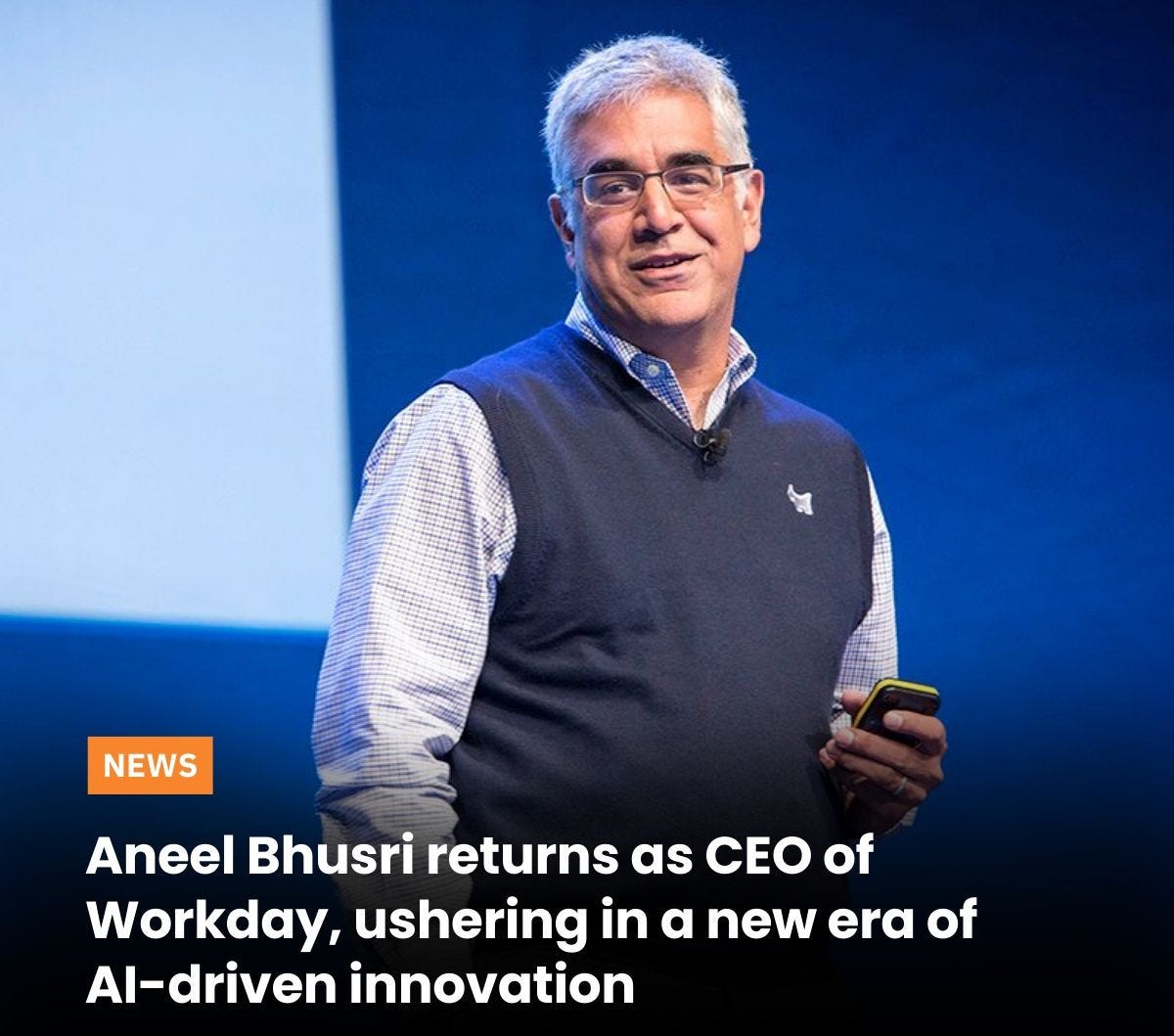
CEO Aneel Bhusri made the same case on Workday’s Q4 earnings call. His argument: HR and ERP systems have to process transactions with absolute accuracy, enforce complex security models, and comply with statutory requirements across dozens of jurisdictions, and that complexity doesn’t collapse just because AI can write code.
“No amount of vibe coding is going to produce an HR or an ERP system.” — Aneel Bhusri, Workday Q4 FY26 earnings call
What’s interesting is that Workday isn’t letting AI-native companies have all the fun. In fact, over the past 12 months the company has been quietly trying to defend its market position with a mix of offensive and defensive moves.
On the offensive side: Workday is actively hedging its bets through a mix of organic and inorganic moves. The company’s goal is to transform its core system of record into an agent-ready platform, an effort bolstered by its acquisition of AI knowledge management platform Sana and the rollout of native HR, finance, IT, and travel agents.
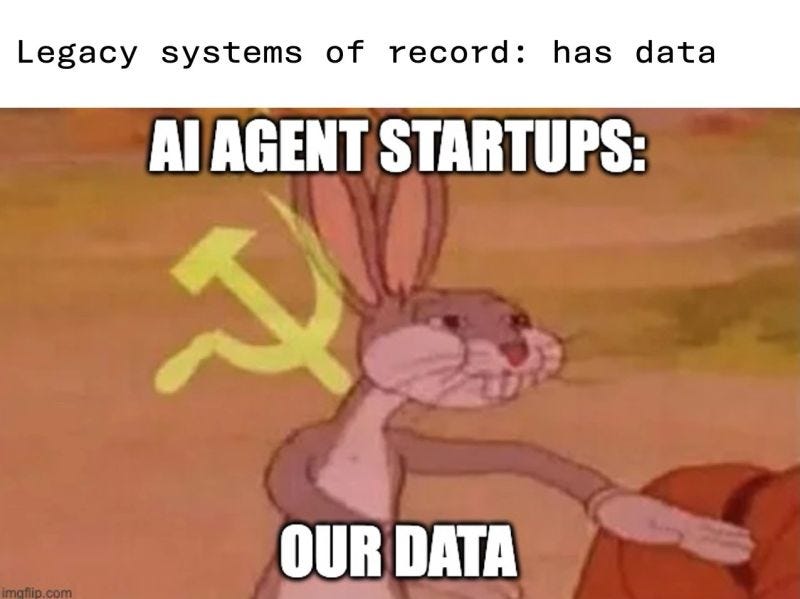
On the defensive side: Workday has been one of the most vocal critics against AI startups that attempt to extract data from enterprise software tools. During the same Q4 earnings report mentioned above, Bhusri called out AI agent companies for being “parasites” that are getting “a free ride” on systems of record. He later promised Workday would soon “put an end to that”. A few weeks later, Workday implemented a consumption-based pricing model called Flex Credits to meter and monetize API usage and AI interactions across its platform. Coincidence? I think not.
What a $51 Billion Buyout Says About SaaS
On August 14, Axios and Reuters reported that Silver Lake was in talks to take Workday private in a deal that could value the company around $51 billion, one of the largest software buyouts ever discussed. The stock closed up nearly 18% that day, its best single-session move in a decade, and the broader software sector rallied with it.

Reaction to the news was split across Wall Street.
Morgan Stanley has an Underweight rating and a $145 price target on Workday, and had flagged just weeks earlier that AI adoption inside back-office workflows would move slower than investors expect given the governance requirements involved. But even Morgan Stanley’s take on the buyout was positive, saying the deal proves Workday has a moat and a large opportunity to automate the back office over time. They also said this could restore confidence in public software valuations generally, which would be great news for Workday holders and long-term SaaS investors.
Jefferies raised its price target to $205 and made the moat argument directly, pointing to 97% retention and Workday’s position as a system of record as exactly what protects it from AI disruption. Wedbush’s Dan Ives went further on CNBC, calling the deal a signal smart money doesn’t see a “SaaS apocalypse” coming in the video below.
Other Systems of Record Are Sitting Pretty Too
The same logic applies to a small group of enterprise incumbents that sit underneath core business processes and aren’t easily displaced by AI.
ServiceNow. Its value is the orchestration layer across IT, security, HR, and customer service workflows, not the interface on top of it. Q2 2026 subscription revenue hit $3.877B, up 23% in constant currency, on top of a 98% renewal rate that’s held in the 97-98% range for five straight quarters. AI increases the number of workflows that need governing, which strengthens the position rather than threatening it.
SAP. Wired into finance, supply chain, procurement, and manufacturing systems deeply enough that replacing it means reconstructing how a company operates, not migrating software. SAP serves more than 440,000 customers across 180 countries, including 92% of the Forbes Global 2000. Cloud revenue reached €6.3B in Q2 2026, up 24% YoY in constant-currency, and current cloud backlog jumped 26% to nearly €23B, an acceleration from the prior quarter. Cloud ERP Suite alone makes up 88% of that cloud revenue. AI can improve usability, but it does not eliminate the underlying dependency on SAP.
Oracle. Sits underneath the databases and core applications that run large enterprises. Interfaces evolve around it, but the financial and operational dependency stays put. Oracle closed fiscal 2026 with $67.4B in total revenue, up 17%, and serves more than 430,000 customers across 175 countries.
The Rise of Enterprise Gateways that Restrict Data Usage from Systems of Record

For 25 years, APIs connected enterprise software, letting applications exchange data at virtually no additional cost once you bought the software. That era is changing.
Despite having strong market positions, these same enterprise software are starting to make third-party AI agents pay for API calls to access company data. AI startups looking to leverage data from legacy systems are increasingly finding metered tollbooths that restrict and tax data usage, capping their profitability.
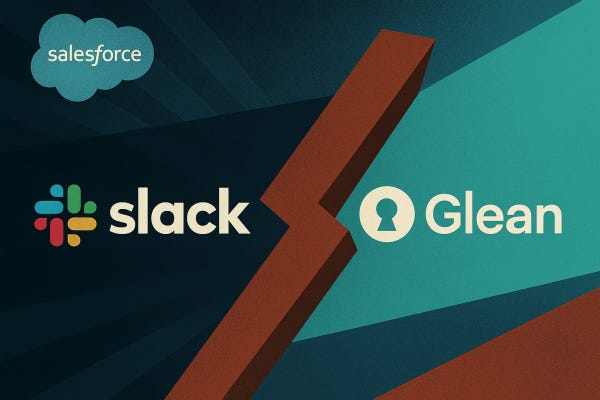
Salesforce is probably the clearest exmple, as the company best known for its CRM now enforces severe restrictions on data usage, retention, and rate limits for third-party tools connecting to Slack via APIs.
This move was made specifically in order to clamp down on third-party AI platforms (specifically AI tools and enterprise search rivals like Glean) that harvest Slack data at-scale, as this behavior reduces the need for users to log-in and utilize the underlying software databases directly. And while Slack may be the best known example, companies like SAP, Workday and ServiceNow all make AI agents “pay to play”.
How will AI startups respond to these aggressive actions from enterprise incumbents? That answer will be critical if these companies want to live up to their lofty valuations.
Disclaimer: The information contained in this article is not investment advice and should not be used as such. Views expressed are my own and should not be considered as the views of NextEra Energy Investments (NEI) or NextEra Energy (NYSE: NEE).